

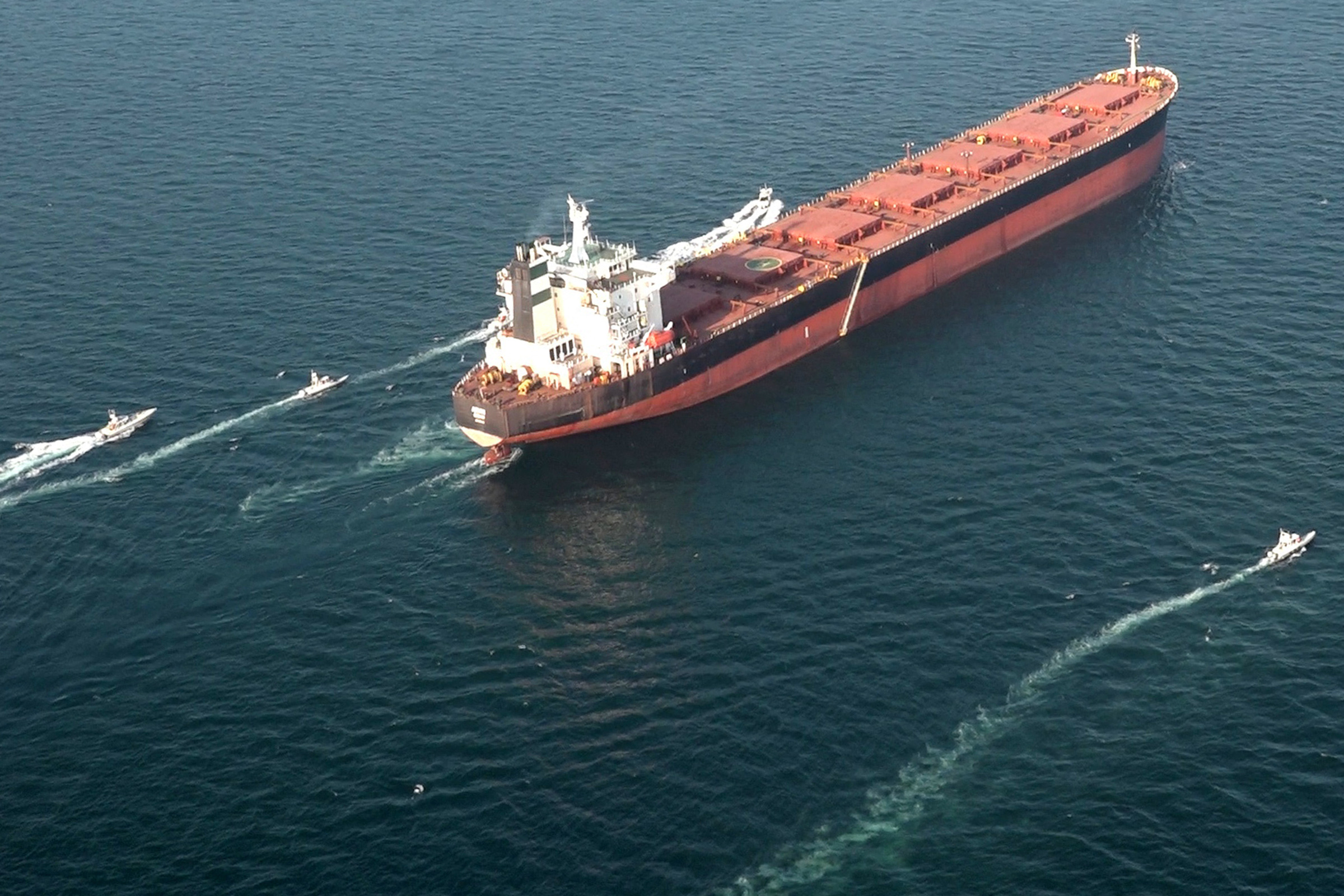
Two ships have passed through the Strait of Hormuz since Iran agreed to reopen the critical waterway as part of a ceasefire deal with the United States and Israel, maritime monitor Marine Traffic confirmed on Wednesday.
The Greek-owned bulk carrier NJ Earth crossed the strait this morning, whilst the Liberia-flagged Daytona Beach transited earlier, shortly after departing Bandar Abbas, according to Marine Traffic.
The crossings mark the first passage through the strategic shipping lane since the two-week ceasefire took effect overnight from Tuesday to Wednesday, less than an hour before President Donald Trump’s deadline to obliterate the Islamic republic if it did not accept US war demands.
Around a fifth of global crude oil and liquefied natural gas passes through the waterway in peacetime. The Middle East conflict erupted on 28 February when the United States and Israel began bombing Iran, prompting Tehran to retaliate with strikes across the region and restrict access to the strait.
More than five weeks later, approximately 800 ships with thousands of seafarers onboard remain stuck in the Gulf, according to shipping journal Lloyd’s List.
Severe disruption
An average of eight commodities carriers have transited the strait per day from 1 March to 7 April, according to maritime data provider Kpler — an almost 95% decrease on peacetime levels.
Of the 307 total crossings during that period, 199 were by oil and gas tankers, with most heading east towards the Gulf of Oman. Six out of 10 transits involved ships coming from or heading to Iran. For tankers carrying cargo, that proportion rose to eight out of 10, according to an AFP analysis based on Kpler data.
A total of 172 million barrels of crude and refined products spread across some 187 tankers were at sea in the Arabian-Persian Gulf as of 7 April, according to Kpler.
The Middle East war has caused the most severe supply disruption in the history of the global oil market, according to the International Energy Agency. Crude and refined petroleum products flows through the Strait of Hormuz fell from around 20 million barrels per day to an average of about 2.6 million since 1 March, based on data by the IEA and Kpler analysed by AFP.
ALSO READ: Both sides claim victory after US, Iran agree to 11th-hour truce
“Whilst the ceasefire creates a window for transit, flows remain conditional and operationally constrained. The scale and composition of the backlog suggest crude will lead the initial wave of exports, even as selective passage and opaque transit patterns continue to complicate market visibility,” Kpler said on Wednesday.
Attacks continue
Iran’s Revolutionary Guards have claimed three attacks on ships since Saturday, of which one has been confirmed by the International Maritime Organization.
The latest confirmed incident involved the Marshall Islands-flagged Qingdao Star container ship, struck on Tuesday morning by an unknown projectile which caused damage above the waterline, according to British marine security agency UK Maritime Trade Operations.
ALSO READ: Oil prices drop sharply, Asian stocks rise after US-Iran ceasefire agreement
In total, 30 commercial ships, including 13 tankers, have been attacked or reported incidents since 1 March in the Gulf, the Strait of Hormuz or the Gulf of Oman, according to the IMO, UKMTO and Vanguard Tech.
Iranian-controlled passage
Apart from three Omani tankers that passed through the strait last week near Oman’s shore, recent crossings appeared to have used a different, Iranian-approved route just off the country’s coast.
Kpler data shows that all ships crossing with their transponders on since Friday — including the two vessels since the ceasefire — passed through that route near Larak Island, which Lloyd’s List has dubbed the “Tehran Toll Booth”.
Lloyd’s List analyst Bridget Diakun said last week that there had been at least two cases of shippers paying Iran for permission to pass, whilst others may have been gaining passage through diplomatic negotiations.
Some shipowners and charterers are preparing to move their vessels stuck in the Gulf, Lloyd’s List reported on Wednesday morning.
ALSO READ: Pain at the pumps set to intensify as May could bring further R10 per litre diesel hike

