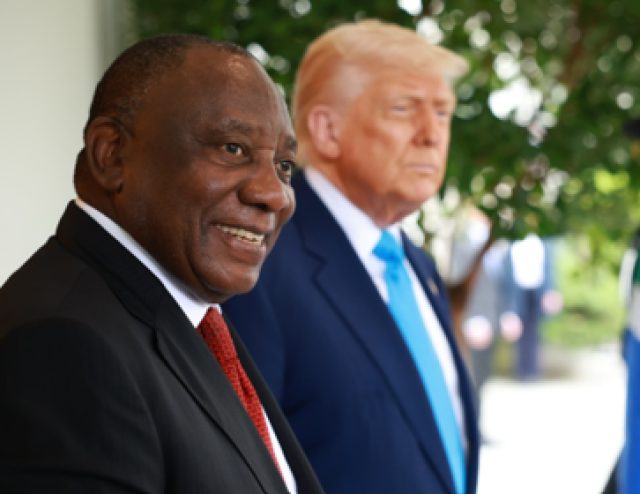
President Cyril Ramaphosa faced sharp questioning in the National Assembly yesterday over the government’s response to what EFF leader Julius Malema termed “senseless tariffs” imposed by US President Donald Trump on South African products.
Malema’s pointed question demanded to know “the full spectrum of the response of the Government to the specified senseless tariffs” and what impact the 30% duties would have on “current and future diplomatic and trade relations with the USA.”
In his reply, Ramaphosa acknowledged the gravity of the situation while defending his administration’s multi-pronged approach to the crisis.
“Like many other countries, South Africa is facing the prospect of significantly higher tariffs on exports to the US,” Ramaphosa told the National Assembly. “The Government is therefore in continued engagement with the United States to secure a mutually-beneficial trade and investment deal.”
The President revealed that his administration has already mobilised diplomatic resources, with “the Presidency and the Department of Trade, Industry and Competition” having “sent representatives to the United States who are preparing for further formal negotiations with the US government.”
These envoys, Ramaphosa explained, “are meeting a number of stakeholders, including representatives in the administration, legislators, business people and others.” He added that “many other countries are doing the same to secure agreements with the United States government.”
Decades-long partnership under threat
Ramaphosa highlightd the depth of the US-South Africa relationship, noting that “the US is South Africa’s second largest trading partner” and that “our economic relations are strong and go back many decades.”
“Trade between our countries has historically been complementary in nature,” the President explained, detailing how “we buy many goods and services from the US, such as petroleum, aircraft and parts, medical instruments, soya beans, motor vehicles, poultry and pharmaceuticals.”
In return, he noted, “South Africa exports to the US include minerals, agricultural products, pharmaceuticals, motor vehicles and medical isotopes.”
The investment relationship runs particularly deep, with Ramaphosa revealing that “South Africa is the biggest investor from the African Continent into the US, with 22 of our companies investing in areas like mining, chemicals, pharmaceuticals and the food chain.” Meanwhile, “more than 600 US companies operate in South Africa.”
Government’s economic response package
Addressing Malema’s demand for the “full spectrum” of government response, Ramaphosa outlined comprehensive domestic support measures. “Cabinet has also endorsed our own country’s Economic Response Package,” he announced, describing “measures that we are putting in place to support South African businesses that are affected by the tariffs.”
The President positioned the crisis as an opportunity, stating: “Government has decided that in response to the US position on tariffs, South Africa should take this as an opportunity to diversify our export markets for increased resilience and facilitate the entry into alternative markets for affected exporters.”
Ramaphosa detailed specific relief measures, explaining that “as part of measures to assist companies to absorb the effects of tariffs and facilitate long-term resilience, the Localisation Support Fund has made a commitment to support affected companies.”
Additionally, “we have initiated an Export and Competitiveness Support Programme. This will include working capital, plant and equipment facilities to address short to medium term needs across all industries.”
African sontinental strategy
The President emphasised regional integration as a key response strategy: “A crucial part of this work is to make full use of the opportunities presented by the African Continental Free Trade Area.”
He also highlighted domestic market potential, noting the government is “looking at better using the buying power of local consumers, businesses and government to support local producers.”
Concluding his response to Malema’s challenge, Ramaphosa stressed the continuity of engagement: “South Africa is responding to the imposition of tariffs by the United States by intensifying its engagement with the US administration on trade and investment.”
“We are working to stabilise diplomatic relations and we are introducing a range of measures to make South African companies more resilient and more competitive,” the President said