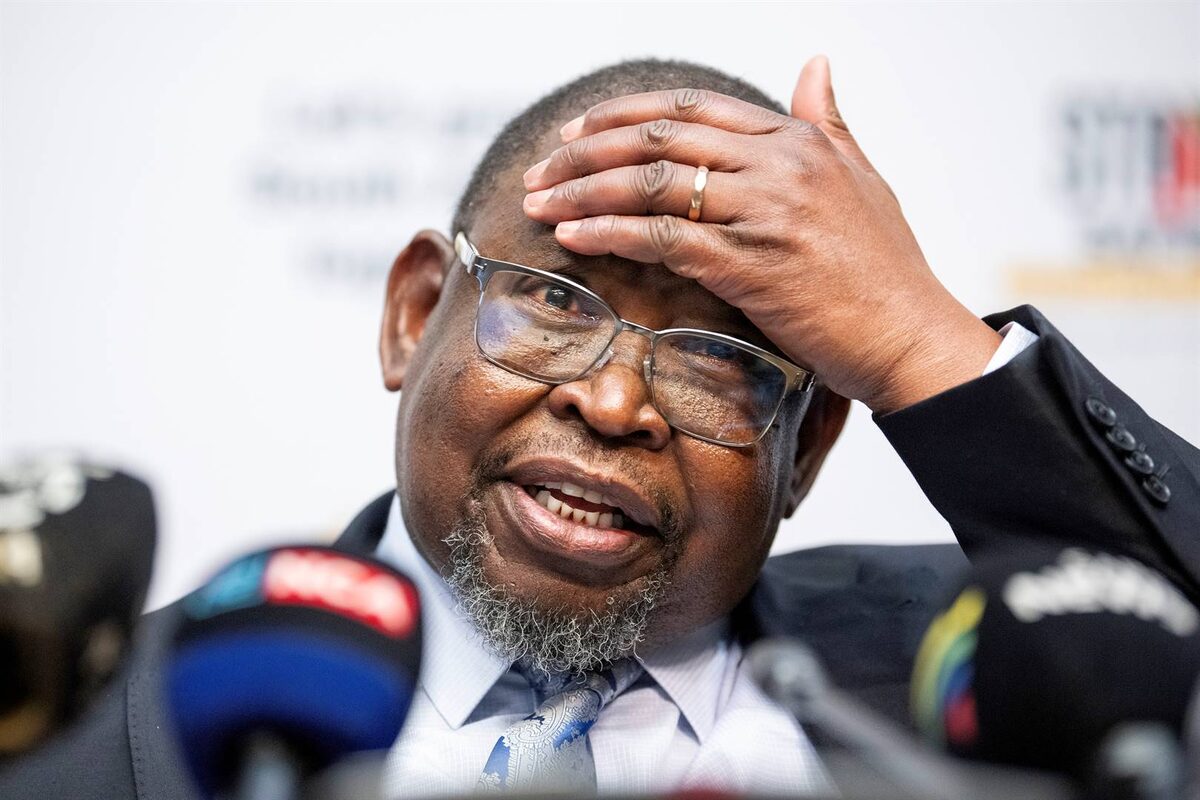

South Africa may finally get a formal fiscal anchor committing government to greater budget discipline when Enoch Godongwana, the finance minister, tables his medium-term budget policy statement (MTBPS) on Wednesday.
The possibility comes amid growing concern that the war in the Middle East, which has sent oil prices soaring and slowed economic growth, is putting pressure on the treasury’s plans to repair state finances as outlined in the February budget.
Godongwana will nevertheless be expected to announce better budget figures on Wednesday, with stronger tax revenue, a smaller budget deficit and more favourable debt projections.
Fiscal anchor proposals
Godongwana announced in November last year that government was considering different options for a fiscal anchor, with a preference for a principle-based framework that must ensure greater parliamentary oversight, transparency and accountability.
In February he undertook to present a proposal for such a framework during the MTBPS.
The International Monetary Fund (IMF) has meanwhile recommended stricter, numerical rules, with an interim debt target of 70% of gross domestic product (GDP) and a long-term target of 60%.
Economists differ, however, on what Godongwana will announce. Stellenbosch University’s Bureau for Economic Research (BER) expects the treasury to stick with a principle-based approach, whilst Nedbank economists foresee that a numerical rule could be introduced linking government spending to changes in tax revenue.
Economist wishlist
Dr Lerato Ntuli, economist at asset manager Anchor Capital, says the mini-budget offers an opportunity to strengthen the credibility of South Africa’s public finances amid a significantly more difficult international economic environment.
At the top of Anchor Capital’s wishlist is that the treasury provides clarity on the proposed fiscal anchor, including measurable debt or spending targets, its application and when the legislation will be presented to parliament.
The asset manager also wants the treasury to revise its economic growth expectations, inflation and interest rate forecasts to properly reflect the consequences of the energy crisis. The IMF expects oil prices this year to average around $96 per barrel, approximately 41% more than last year.
Anchor Capital also asks that any replacement for the social relief of distress grant, which expires in March 2027, be funded in an affordable and sustainable manner.
Further priorities include protecting infrastructure spending, faster structural reforms and greater transparency about the financial risks posed by state-owned enterprises.
Better budget outlook
Johann Els, chief economist at PSG Financial Services, expects tax revenue could exceed the February budget’s estimates by at least R50 billion, “which is a significant improvement on the figures in the February budget”.
According to Els, the budget deficit could consequently drop from the estimated 4% in February to around 3,5% of GDP, whilst the primary budget surplus could improve from 1,4% to 1,9% of GDP.
“This will help to put state debt on a more sustainable path,” says Els.
Stronger tax collections are not only helped by higher precious metal prices. Personal income tax and value-added tax (VAT) are also performing better than expected.
Els warns, however, that the tax windfall is not necessarily sustainable.
“The treasury will probably still be cautious about how much of the current improvement it factors into its projections for future years. This is understandable, given the uncertain economic outlook and pressure on government to spend more.”
Fuel price relief and growth forecasts
Consumers will also watch closely whether Godongwana announces further fuel price relief. According to the BER, a proposed R10 billion from the equalisation fund could help limit fuel price increases over the festive season, provided the necessary approvals are obtained.
The BER meanwhile expects the treasury to revise February’s growth outlook of 1,6% for 2026 and its inflation forecast of 3,4%.
“The medium-term outlook is however less reassuring,” warns Lisette IJssel de Schepper, the BER’s chief economist.
“The boost that high commodity prices offered earlier has diminished somewhat, economic growth remains weak, and sustained inflation pressure and increasing demands for government spending pose further risks.”
Nedbank agrees that public finances will improve despite weaker economic growth, but is less optimistic about tax revenue.
Unlike PSG’s expected tax windfall of at least R50 billion, Nedbank predicts that gross tax revenue this year will be around R3,6 billion below the February budget’s estimate.
Nedbank also expects a smaller improvement in the budget deficit, from 4% to 3,9% of GDP. The bank predicts economic growth of just 1,1% this year and believes state debt will only drop to around 75% of GDP by 2029/30.
ALSO READ: Political parties call for fuel relief, job creation ahead of mid-term budget