

PARIS, France – French authorities launched a massive manhunt Monday for a sophisticated criminal gang that stole eight priceless pieces of royal jewellery from the Louvre Museum in a brazen daylight robbery that has sparked national outrage and exposed glaring security vulnerabilities at France’s premier cultural institution.
The audacious heist, which unfolded in just seven minutes Sunday morning, saw masked thieves use a furniture hoist truck to scale the museum’s exterior and break into the Apollo Gallery housing France’s crown jewels. The stolen treasures include an emerald-and-diamond necklace gifted by Napoleon to Empress Marie-Louise and a diamond-studded diadem once worn by Empress Eugenie.
Justice Minister Gerald Darmanin acknowledged the security breakdown in a frank radio interview Monday morning, calling the incident a national embarrassment.
“What is certain is that we have failed, since people were able to park a furniture hoist in the middle of Paris, get people up it in several minutes to grab priceless jewels, and give France a terrible image,” Darmanin told France Inter radio.
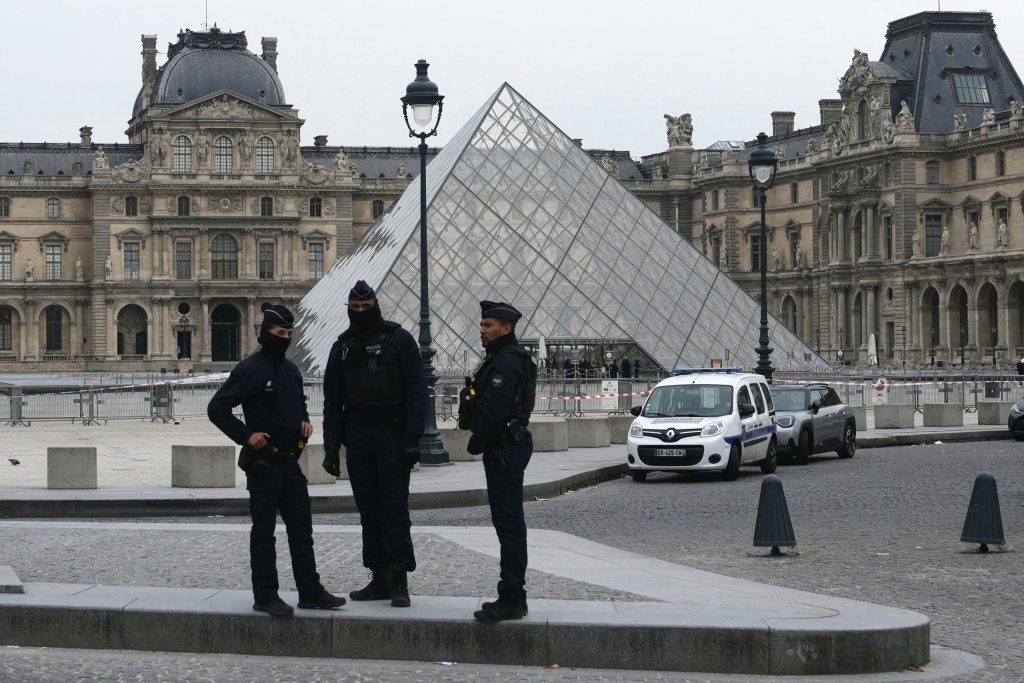
The robbery has reignited criticism of museum security across France, with Interior Minister Laurent Nunez previously acknowledging that protecting cultural institutions represents a “major weak spot” in national security.
According to sources close to the investigation, the thieves struck between 9:30 and 9:40, just 30 minutes after the museum opened to the public. Using a truck-mounted extendable ladder typically employed by moving companies, the criminals accessed the Apollo Gallery through an exterior window.
Amateur video footage captured by a museum visitor and broadcast on French television shows the masked perpetrators using cutting equipment to breach display cases containing the royal collection.
A 60-member investigative team is working under the theory that the raid was orchestrated by an organized crime group, possibly involving foreign nationals, according to Nunez.
The stolen items represent some of France’s most precious historical artifacts:
• An emerald-and-diamond necklace from Napoleon to Empress Marie-Louise
• A diadem belonging to Empress Eugenie, featuring nearly 2,000 diamonds
• A necklace once owned by Marie-Amelie, France’s last queen, containing eight sapphires and 631 diamonds
• Five additional 19th-century jewellery pieces
The thieves also attempted to steal the crown of Empress Eugenie, adorned with 1,354 diamonds and 56 emeralds, but dropped and damaged it during their escape when confronted by museum staff.
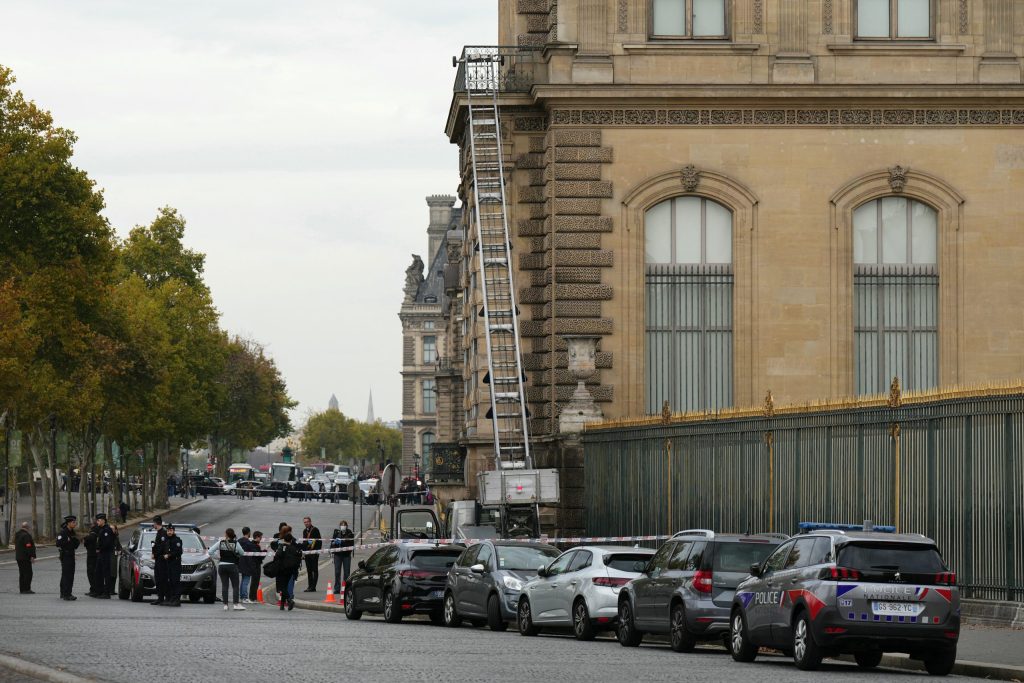
Alexandre Giquello, president of the renowned Drouot auction house, noted that the stolen pieces would be “impossible to sell on in their current state,” suggesting the thieves may intend to dismantle them for individual gems.
The theft has triggered sharp political criticism across the spectrum. Far-right National Rally leader Jordan Bardella called the incident “an unbearable humiliation for our country,” questioning the state’s ability to protect national treasures.
President Emmanuel Macron responded on social media, vowing that “everything” was being done to apprehend the perpetrators and recover the stolen artifacts.
This marks the first successful theft from the Louvre since 1998, when a Camille Corot painting was stolen and never recovered. The incident comes amid a troubling pattern of museum thefts across France, including recent raids on Paris’s Natural History Museum and a facility in Limoges, with combined losses exceeding $8 million.
The most infamous theft in the Louvre’s history occurred on a quiet morning in August 1911, when Leonardo da Vinci’s Mona Lisa simply vanished from its place on the museum wall. The perpetrator was Vincenzo Peruggia, an Italian handyman who had previously worked at the Louvre installing protective glass over paintings. His intimate knowledge of the building proved invaluable as he executed what would become the most famous art theft in history.
Peruggia’s method was remarkably simple yet effective. He hid in a broom closet overnight, waiting for the museum to close. When morning came and the building was relatively empty, he calmly removed the small painting from its frame and walked out of the museum with the masterpiece tucked under his work clothes. The theft wasn’t discovered until the next day when a visitor noticed the empty space where the world’s most famous painting should have been.

For over two years, the Mona Lisa remained missing, generating international headlines and turning da Vinci’s work into a global icon. The painting was finally recovered in 1913 when Peruggia, driven by a misguided belief that the artwork should be returned to Italy, attempted to sell it to the Uffizi Gallery in Florence.
Following the Mona Lisa incident, the Louvre significantly enhanced its security measures, making successful thefts increasingly rare. However, the museum was not immune to criminal activity in subsequent decades. The most significant theft in recent memory occurred in 1998 when a landscape painting by Jean-Baptiste-Camille Corot disappeared from the museum’s collection.
The Corot theft, which involved either “View of Volterra” or “The Magpie” depending on sources, highlighted ongoing vulnerabilities in museum security despite decades of improvements since the Mona Lisa incident. The painting remained missing for several years before being recovered in 2001, prompting another major overhaul of the Louvre’s security protocols.
Beyond these incidents, the Louvre has experienced a series of smaller but still significant thefts. In 2003, several ancient Egyptian artifacts disappeared from the museum in what investigators described as a coordinated series of thefts targeting smaller, more portable items.
Seven years later, jewellery pieces from the Louvre’s collection were stolen in incidents that received less media attention.
The museum has also faced vandalism incidents. In 2013, Eugène Delacroix’s iconic painting “Liberty Leading the People” was vandalised when a visitor wrote on it with a black marker.
The investigation continues as authorities work to strengthen security measures at cultural institutions nationwide.



You must be logged in to post a comment.