

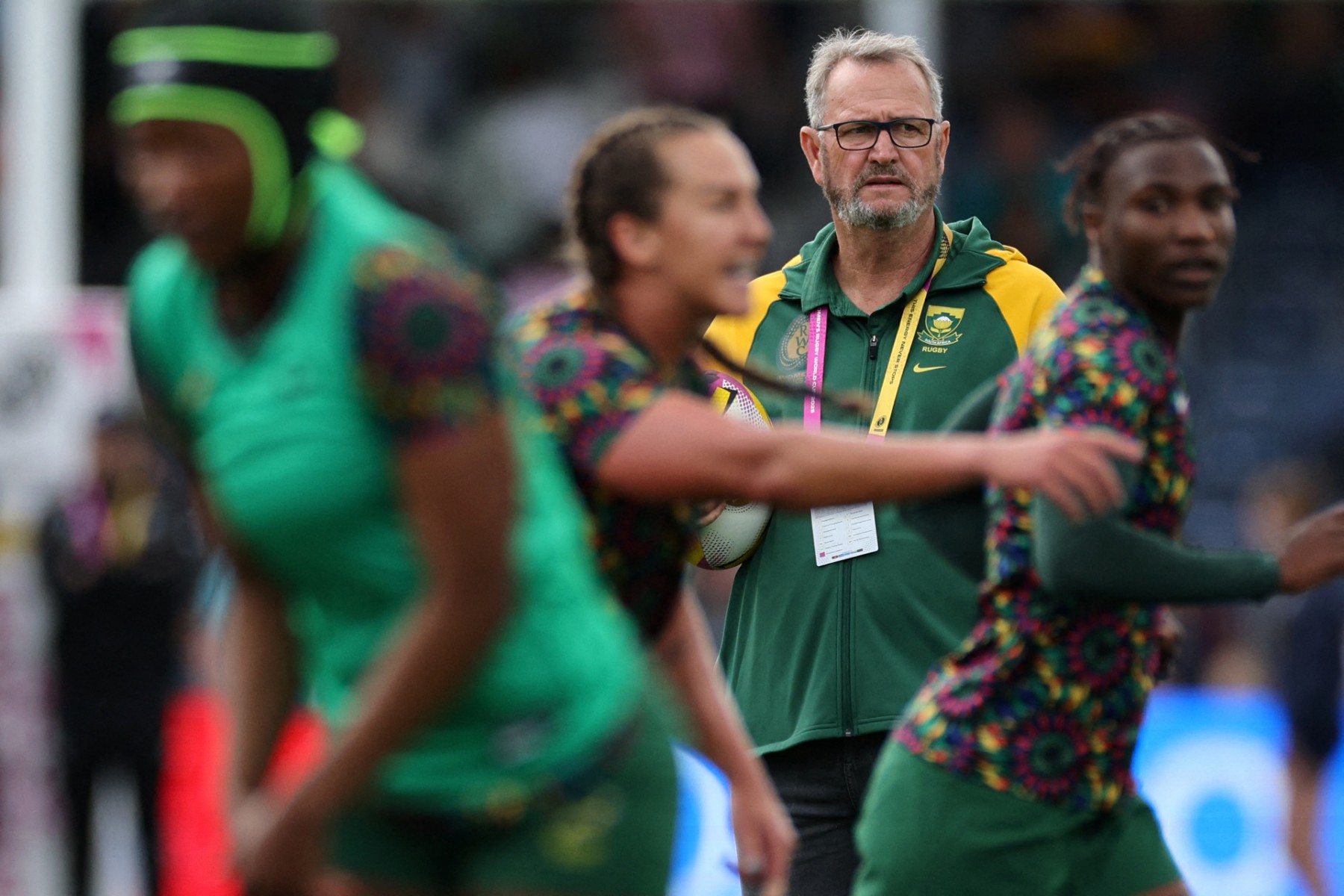
Swys de Bruin has stepped down as head coach of the Springbok Women after two years that rewrote the record books, shattered expectations, and introduced a style of play so gloriously unorthodox that even the All Blacks couldn’t quite work out what was coming next.
Also read: De Bruin shuts down bonus battle claims after resignation
SA Rugby President Mark Alexander extended his thanks and gratitude to De Bruin, who departed at the end of August 2026, leaving behind a team that sits in the top 10 of the World Rugby rankings for the first time in history and a highlight reel that includes a 14-player lineout in a World Cup quarter-final.
Yes, you read that correctly. Fourteen players. In a lineout. Against the Black Ferns. Because when Swys de Bruin decided to shake things up, he didn’t do it by halves.
From high performance mentor to World Cup architect
De Bruin joined SA Rugby’s High-Performance Department in August 2024, initially brought in as a mentor to coaches within the organisation’s structures. But when the Springbok Women needed a leader to guide them into the 2025 Women’s Rugby World Cup in England, De Bruin transitioned into the head coach role and set about building something special.
What followed was the best World Cup campaign in Springbok Women’s history. A quarter-final berth, achieved by a team that played with flair, physicality and a tactical unpredictability that left opponents scrambling. The Black Ferns eventually ended the run, but not before De Bruin’s side had announced themselves on the global stage in a manner impossible to ignore.
Under his guidance, South Africa broke into the top 10 of the World Rugby rankings for the first time – a milestone that reflects not just talent, but genuine progress in a programme that had been starved of resources and attention for far too long.
Giant killing becomes the norm
During De Bruin’s two-year tenure, the Springbok Women recorded memorable victories over Japan, Italy and the USA, all of whom were ranked higher than South Africa at the time. They weren’t just winning; they were beating teams they had no business beating based on historical form.
Also read: Springbok Women make history with quarter-final berth
The final tally reads 14 victories from 21 matches, including fixtures against the Barbarians Women and the Black Ferns XV in Cape Town. That’s a 67% win rate for a team that was still finding its feet on the international stage when De Bruin took over.
Alexander acknowledged that De Bruin’s contributions significantly elevated the visibility of the Springbok Women and strengthened the profile of the women’s game in South Africa.
“Swys quickly endeared himself to fans and supporters of the women’s game and that connection contributed to the growing support behind the Springbok Women. It also attracted greater corporate backing,” Alexander said.
And that corporate backing matters. Women’s rugby doesn’t grow on goodwill alone, it needs investment, sponsorship and genuine institutional support. De Bruin’s ability to capture public imagination translated directly into boardroom interest, and that legacy will outlast his tenure.
The tactical maverick who made the world pay attention
Alexander’s tribute lingered longest on the innovation, the sheer audacity of some of De Bruin’s tactical calls.
“Our team developed a unique style of play and an unpredictability that captured massive attention. Who will forget the 14-player lineout or setting up a maul from a scrum in that quarter-final against the Black Ferns.”
Those two moments alone, a 14-player lineout and a maul set from a scrum in a World Cup knockout match, will live forever in South African rugby folklore. They weren’t gimmicks. They were calculated tactical gambits designed to exploit space, create mismatches and force opponents into unfamiliar defensive scenarios.
Did it work? The Springbok Women pushed the Black Ferns harder than most expected. The result went against them, but the performance announced that this wasn’t a team making up the numbers anymore.
De Bruin brought the kind of tactical creativity more commonly associated with his work at the Lions, where he masterminded their run to successive Super Rugby finals. He applied that same intelligence to the women’s game, treating his players as equals capable of executing complex game plans under pressure.
The mentor role that started it all
Alexander also acknowledged De Bruin’s impact in his original capacity as a mentor to coaches within SA Rugby’s High-Performance structures.
“It was clear that he has the ability to convey his knowledge to players and coaches alike. That experience contributed meaningfully to the development of our current coaching group, who will continue to apply many of the principles and fundamentals introduced by Swys.”
That’s the less visible legacy, the hours spent in meeting rooms, on training fields, sharing knowledge with the next generation of South African coaches. De Bruin didn’t just coach the Springbok Women; he upskilled an entire ecosystem around them.
The principles he introduced, the tactical frameworks he built, the standards he demanded – all of that remains embedded in the programme. That’s how you build sustainability, not just short-term success.
A personal tribute from the president
Alexander concluded with a tribute that carries weight coming from the top of South African rugby’s administrative structures.
“Swys is one of our leading coaches in our country and we wish him well for the future. We respect his decision to move forward in his career and thank him sincerely for his contribution to the growth of women’s rugby.”
Reading between the lines, there’s genuine gratitude there. De Bruin could have stayed in more lucrative, higher-profile roles elsewhere in the game. Instead, he invested two years in building something from scratch, elevating a programme that desperately needed exactly the kind of credibility and tactical nous he brought.
The 14-player lineout will be replayed for years. The maul from the scrum will be studied by coaches worldwide. But the real legacy is simpler: De Bruin left the Springbok Women in a better place than he found them, flying higher than they’ve ever flown before.
Thanks, Swys. The ride was unforgettable.


