

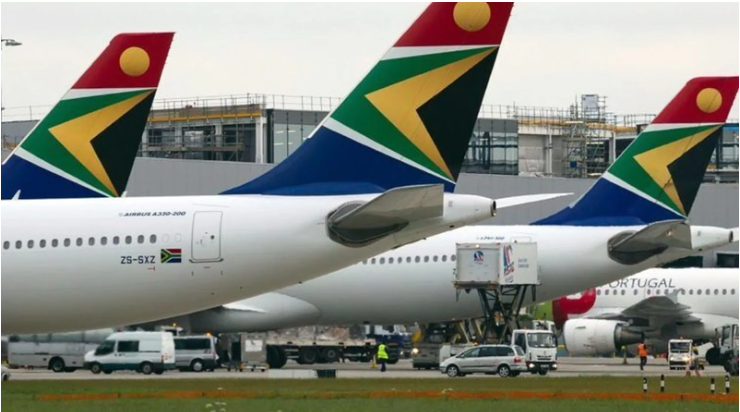
The Special Investigating Unit (SIU) has secured a landmark judgment from the Special Tribunal reviewing and setting aside South African Airways’ (SAA) unlawful R85,3 million aircraft dry-lease extension with Flyfofa Airways (Pty) Ltd.
The decision mandates the recovery of profits earned by Flyfofa under the invalid contract and opens the door to potential personal liability proceedings against former and current SAA board members.
In a media statement SIU spokesperson Selby Makgotho on 18 September, the unit announced a major legal victory after securing a Special Tribunal judgment that invalidates South African Airways’ (SAA) unlawful R85,3 million aircraft lease deal with Flyfofa Airways (Pty) Ltd.
Problematic procurement history
The SIU’s probe successfully challenged the 1 July 2019 decision by the SAA Board to extend a dry-lease agreement for a Boeing 737-300 freighter for 36 months at a total cost of R85 340 863. The SIU revealed that SAA concluded this multi-million rand extension without conducting any competitive bidding process or securing the necessary deviation approvals from the National Treasury, effectively ceding its domestic overnight freighter operations to Flyfofa.
The SIU statement detailed a problematic procurement history dating back to September 2015, when the SAA Board initially approved a process deviation as a risk-mitigation measure. When Flyfofa made presentations to SAA’s Cross-Functional Sourcing Team in March 2016, SAA’s own internal risk assessment categorised Flyfofa’s financial standing as “high risk”, highlighting the total absence of audited financial statements, a solvency ratio of 0.1, and operating losses across the preceding two financial years.
ALSO READ: SAA receives sixth consecutive disclaimed audit as opposition parties demand answers
Despite these severe red flags, SAA proceeded with short-term wet-lease arrangements during 2016 before signing a three-year dry-lease contract for two Boeing 737-300F aircraft on 3 November 2016. Crucially, the SIU investigation uncovered that when SAA executed the 2019 contract extension, Flyfofa’s aircraft (registration ZS-TGG) was grounded, yet SAA continued making lease payments to Flyfofa throughout the grounding period.
Strict financial disgorgement orders
The Special Tribunal has instituted strict financial disgorgement orders against Flyfofa. Flyfofa is required to deliver a comprehensive accounting of all funds received from SAA alongside actual performance costs to the SIU’s legal team within 30 days of 11 September, explicitly documenting the period aircraft ZS-TGG was grounded and any substitute services rendered. Within 14 days of completing the account debatement, Flyfofa must surrender all calculated profits or unjustified enrichment to the SIU, accompanied by interest accrued at 11% per annum from the date of the tribunal order.
Turning to the Special Tribunal judgment, Judge C. Fortuin formally set aside the 1 July 2019 agreement on legality grounds, ruling that the SAA Board’s decision violated Section 217(1) of the Constitution, which requires state entities to contract for goods and services through a system that is fair, equitable, transparent, competitive, and cost-effective. The judgment further established that the lease extension failed to comply with statutory governance frameworks, specifically breaching Treasury Regulation 16A.6 and National Treasury Instruction Note 3 of 2016-’17, as SAA operated without a properly recorded, approved, and reported procurement deviation.
In delivering the ruling, the judge issued a stern judicial rebuke of SAA’s corporate governance, emphasising that the board’s conduct warranted clear criticism and carried a direct financial cost borne by the public.
Personal accountability
While individual board members were not cited as direct respondents in the review proceedings, the tribunal took decisive action to enforce personal accountability by directing its registrar to transmit copies of the judgment to the minister responsible for SAA, as well as SAA’s current directors and board chairperson.
ALSO READ: SAA under fire for delayed reporting of Cape Town fuel emergency
The minister has been ordered to submit a formal report to the tribunal registrar within 90 days confirming what disciplinary or legal measures have been initiated against responsible board members and detailing their outcomes. Furthermore, the judgment outlined several avenues for further legal action, including financial misconduct proceedings under the Public Finance Management Act (PFMA), applications under the Companies Act to declare directors delinquent or place them on probation, civil recovery suits, reviews of remaining directors’ ongoing suitability, and referrals to the National Prosecuting Authority (NPA) or the Directorate for Priority Crime Investigation (Hawks) for potential criminal corruption charges.




You must be logged in to post a comment.