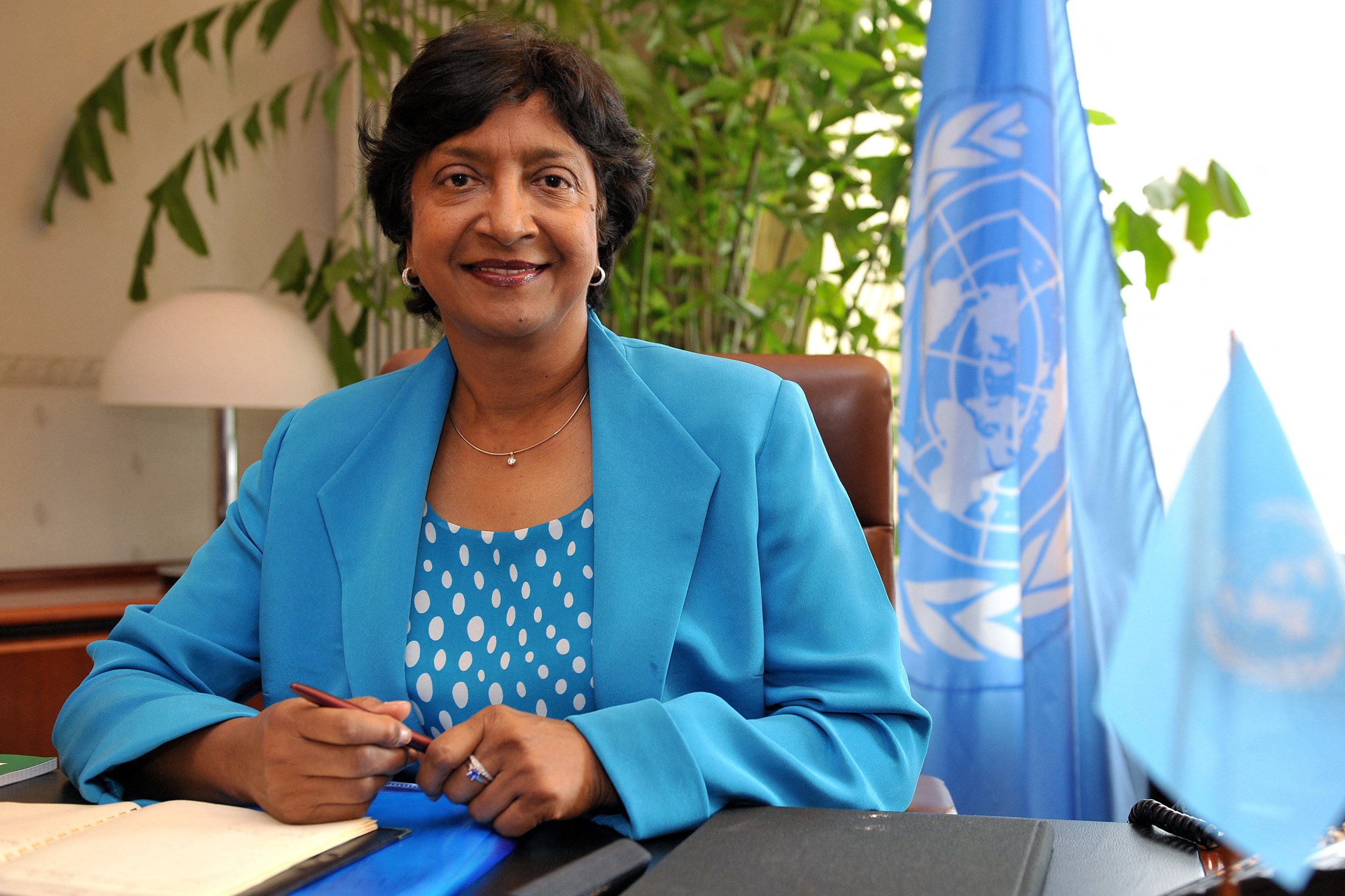
The Nobel Peace Prize went to South Africa’s Navi Pillay (85) on Friday, honouring the judge who led the Rwanda genocide tribunal and chaired a UN commission that accused Israel of genocide in Gaza last year.
Pillay currently serves as a judge on the International Court of Justice in a case where Myanmar faces genocide accusations. She has been “instrumental in ensuring that war crimes, crimes against humanity, and genocide are prosecuted,” said Jorgen Watne Frydnes, chair of the Norwegian Nobel Committee in Oslo.
The veteran jurist responded to the news with a joke about US President Donald Trump’s public desire to win the prize himself.
“If you clap a little bit more I may share this prize with Trump,” she said during a standing ovation in Nuremberg. Amnesty International Secretary General Agnes Callamard captured the moment and posted it on X.
Gaza genocide findings spark controversy
Pillay headed the UN Independent International Commission of Inquiry, which found last year that genocide was occurring in Gaza. The commission does not speak on behalf of the UN itself.
She told AFP at the time that her team had shared “thousands of pieces of information” with prosecutors at the International Criminal Court.
The UN said the prize for Pillay shows the “value” of human rights “more than ever”.
International law under attack
The Nobel jury said it chose Pillay at a time when “the system of international law is under tremendous pressure and its institutions are under attack.”
“At a time of existential challenges — including more wars and conflicts than the world has seen in a long time — international law is no longer just a supplement to peace and security. It is an absolute necessity,” Frydnes said.
“Navi Pillay’s commitment to universal legal principles and her firm moral compass are constants in a long career,” the committee said.
This year saw 287 individuals and organisations nominated for the prize.
Trump’s prize ambitions dashed
The award is likely to anger Trump, whose administration has repeatedly attacked international justice institutions.
Since returning to the White House in January 2025, Trump has made clear he wants the prize. He has insisted he deserves it most and claimed to have ended up to eight wars.
“They have a reputation for maybe not giving it to people like me .. and I think it would be a great discredit to them,” Trump said on Wednesday.
But his war against Iran, territorial expansion ambitions in places like Greenland, hard line on migrants, and attacks on multilateralism and the media have disqualified him for the prize, according to experts in Oslo.
Last year, the prize went to Venezuelan opposition leader Maria Corina Machado, a choice generally seen as acceptable to Trump. Machado even gave him her Nobel gold medal, believing he deserved it after the capture of President Nicolas Maduro. However, she failed to get his political backing in return.
The reasons for choosing Peace Prize winners have changed substantially since 1901, shifting from promoting peace to defending human rights in a trend that gained momentum during the Cold War, according to an AFP analysis.
The Nobel committee says it is not swayed by external pressures.
“Of course we have to discuss it, but it’s not like that influences the discussions in the room and decisions that come out,” committee secretary Kristian Berg Harpviken told AFP ahead of the announcement.
The prize includes a gold medal, a diploma and $1.2 million.
The award ceremony takes place in Oslo on 10 December, the anniversary of prize creator Alfred Nobel’s death in 1896. Nobel was a Swedish inventor and philanthropist.
The Peace Prize is the only Nobel awarded in Oslo, with the other disciplines announced in Stockholm.
Earlier this week, the prizes for medicine, physics, chemistry and literature were announced in Stockholm. The literature prize went to Canadian poet Anne Carson on Thursday for her modern twists on Greek mythology and antiquity.
The 2026 Nobel season wraps up on Monday with the economics prize.
Pillay becomes the 11th South African Nobel Prize winner, and the fifth South African to win the Nobel Peace Prize.
ALSO READ: Venezuelan opposition leader presents Nobel medal to Trump in White House meeting
Previous South African peace prize winners include Albert Luthuli (1960) for his non-violent struggle against apartheid, Desmond Tutu (1984) for his role as a unifying leader in the non-violent campaign to resolve apartheid, and Nelson Mandela and FW de Klerk (1993) for their work for the peaceful termination of the apartheid regime.
South Africa has also produced two Nobel literature laureates: Nadine Gordimer (1991) and JM Coetzee (2003).
In science, South African winners include Max Theiler (1951, physiology or medicine) for his discoveries concerning yellow fever, Allan MacLeod Cormack (1979, physiology or medicine) for the development of computer-assisted tomography, Sydney Brenner (2002, physiology or medicine) for discoveries concerning genetic regulation, and Michael Levitt (2013, chemistry) for the development of multiscale models for complex chemical systems.
ALSO READ: South Africa launches Nobel Prize-winning panel to combat global inequality