

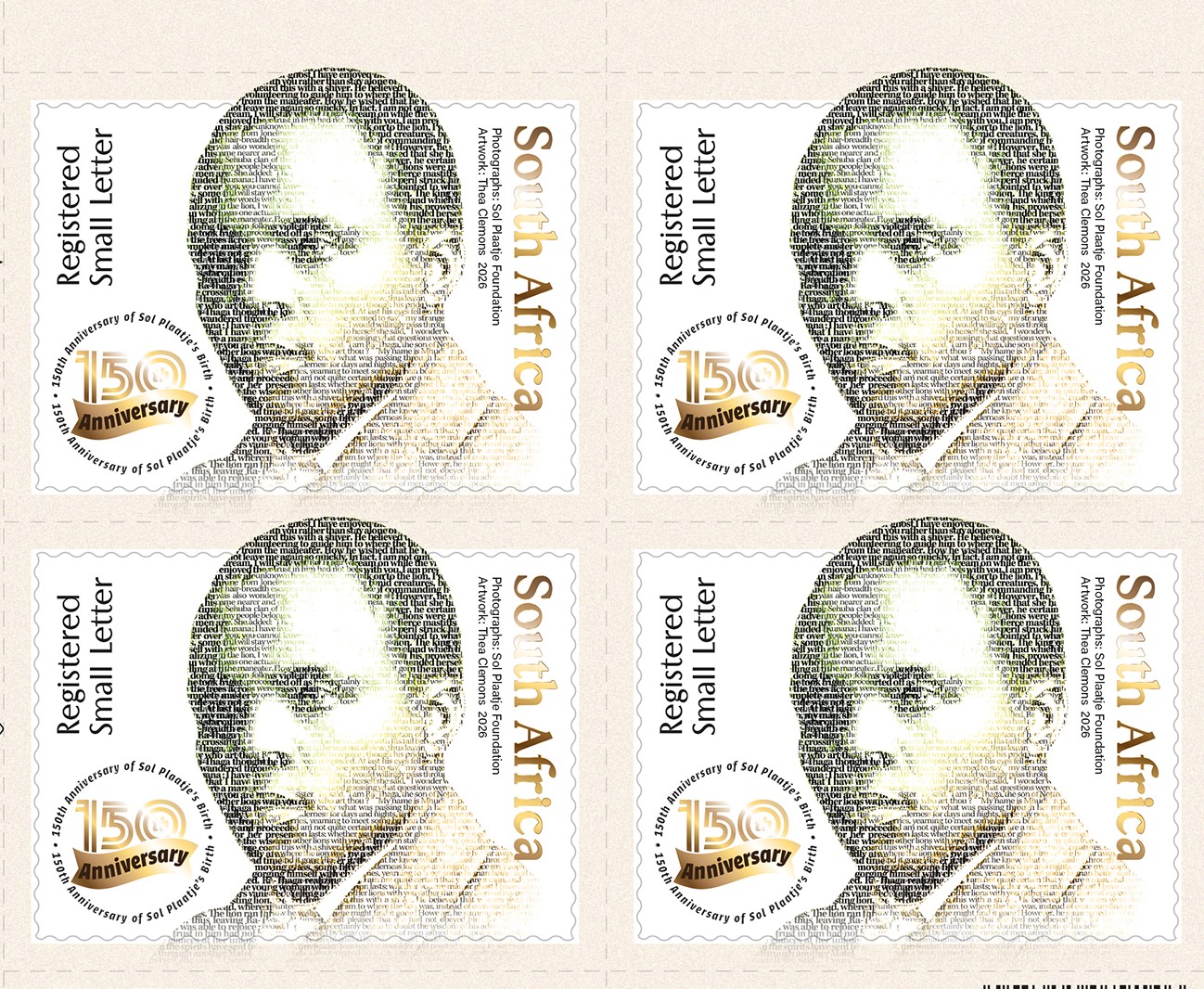
The 150th anniversary of the birth of Solomon (“Sol”) Tshekisho Plaatje is commemorated by the South African Post Office with a commemorative stamp.
Plaatje, born on 9 October 1876 at Doornfontein near Boshof in the Free State, is regarded as one of South Africa’s influential intellectual and political figures. He was a writer, journalist, court interpreter, linguist, historian and political organiser. His work helped preserve African history and challenged the ways in which Black South Africans and their experiences were represented.
The stamp issuance coincides with World Post Day, which is observed annually on 9 October. World Post Day marks the anniversary of the Universal Postal Union (UPU), established in 1874 in Bern, Switzerland. The creation of the UPU started the global communications revolution by allowing mail to flow freely across borders.
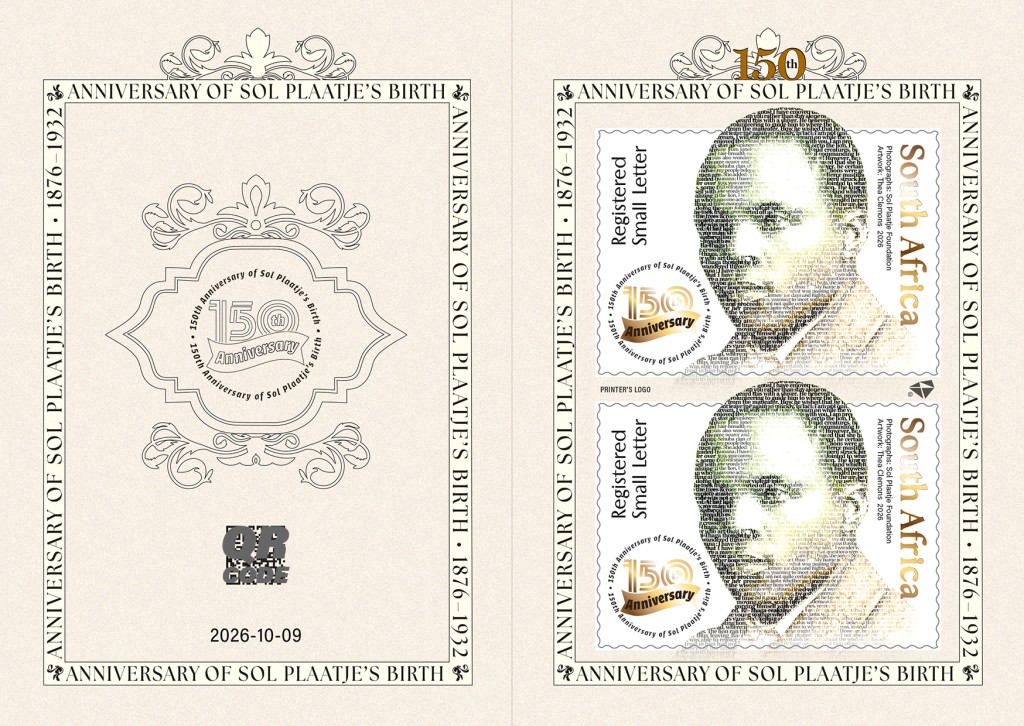
At the centre of the commemorative stamp is Plaatje’s landmark novel, Mhudi, which is widely recognised as the first novel written in English by a Black South African. First published by Lovedale Press in 1930, the novel tells the story of Mhudi and Ra-Thaga against the backdrop of the Difaqane/Mfecane, exploring love, displacement, conflict and survival whilst offering a richly detailed account of African societies and histories.
Design features and literary connection
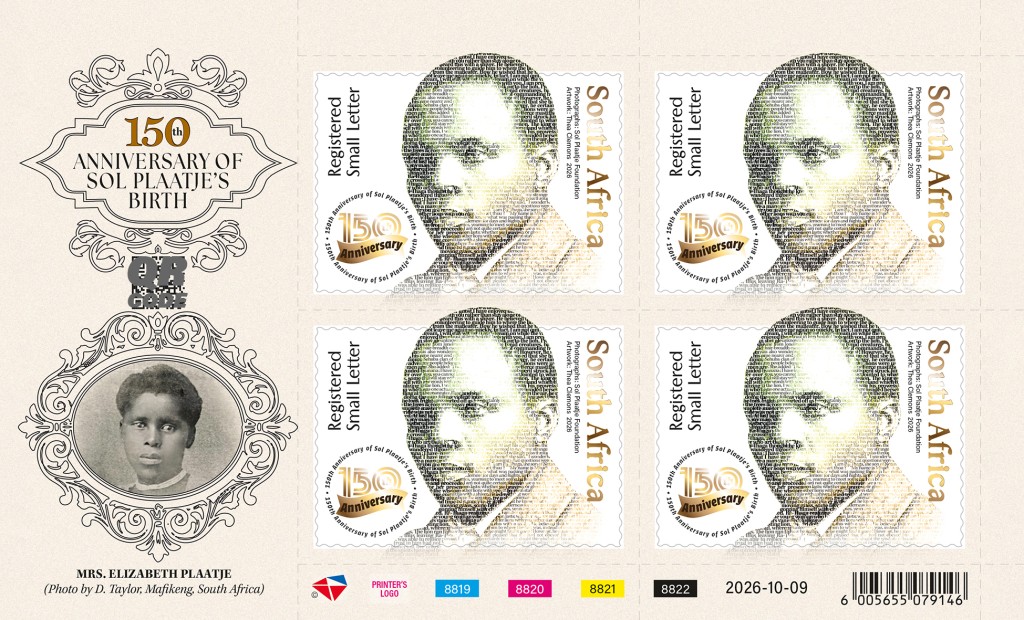
In a press release, the South African Post Office stated that the stamps comprise a mini-booklet containing two registered small-letter-rate stamps and a stamp sheet featuring four stamps of the same rate. The stamps were designed by Thea Clemons of the South African Post Office’s Philatelic Services and feature a distinctive portrait of Plaatje constructed from words drawn from Mhudi. The words are used to create the highlights and shadows of his face, transforming his own writing into a visual representation of the author.
The design creates a direct connection between Plaatje’s literary legacy and the stamp, reinforcing the enduring power of language to preserve memory, identity and history.
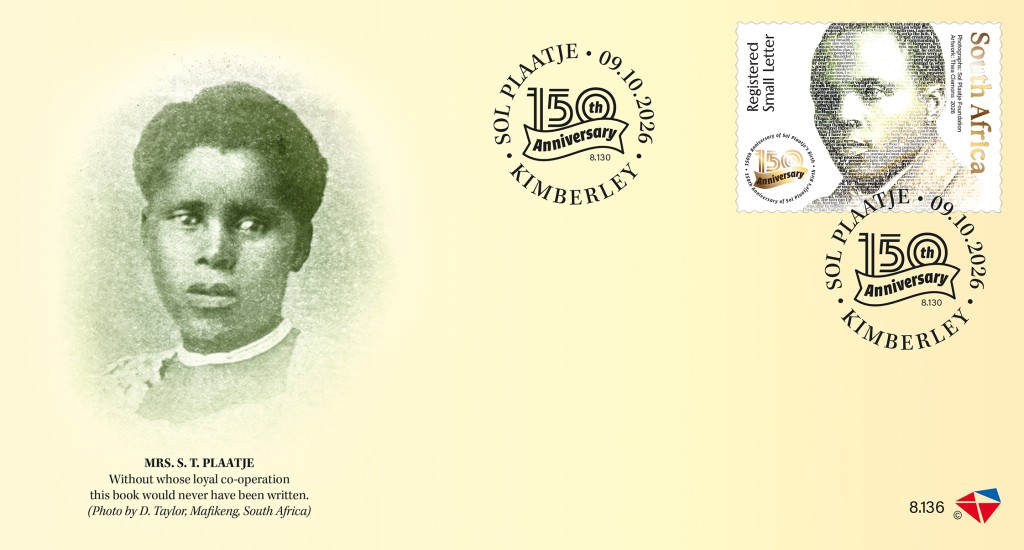
A gifted linguist, Plaatje demonstrated the possibilities of African languages as vehicles for literature and cultural expression. He became the first African to translate works by William Shakespeare into Setswana, creating a bridge between the English literary tradition and African-language literature.
“For the South African Post Office, commemorative stamps provide more than a means of postage. They create small, enduring records of people, events and moments that have helped shape South Africa’s history,” noted Clemons.
ALSO READ: Appointment strengthens Sign Language capacity at Sol Plaatje University
Legacy in words
The Plaatje 150th anniversary stamp places his face and words into that tradition of remembrance, allowing his legacy to travel beyond the pages of books and history texts.
“Sol Plaatje’s legacy reminds us of the power of words to record history, preserve culture and give expression to the experiences of people whose stories might otherwise be lost,” said Fathima Gany, acting CEO.
ALSO READ: Sol Plaatje University confers 1 500 degrees at 11th graduation ceremony
Background
Born in 1876 into a Barolong family, Plaatje grew up during a period of profound political and social change in southern Africa. The effects of the Difaqane/Mfecane shaped the environment in which he came of age and influenced his later interest in recording African history and experience.
His career developed across several fields. He worked as a court interpreter and journalist before becoming a respected editor and commentator on the social and political issues affecting Black South Africans. His literary contribution is best known through Mhudi, in which he used fiction to reconstruct aspects of the history of the Barolong Batswana people. Set against a period of conflict and upheaval, the novel presents African communities and individuals with humanity and complexity.
Plaatje’s writing was not limited to fiction. His 1916 book, Native Life in South Africa, documented the impact of the 1913 Natives Land Act on Black South Africans and became an important contemporary record of the consequences of the legislation. His contribution to South African history also extended into politics and language.
The terms Difaqane and Mfecane refer to a period of warfare, upheaval and migration in southern Africa, mainly during the early 1800s. Communities were displaced, political alliances changed and new kingdoms emerged. The two names describe broadly the same period: Mfecane is a Nguni term commonly translated as “the crushing”, whilst Difaqane (also spelt Difeqane) is a Sotho-Tswana term commonly translated as “the scattering” or “forced migration”.




You must be logged in to post a comment.