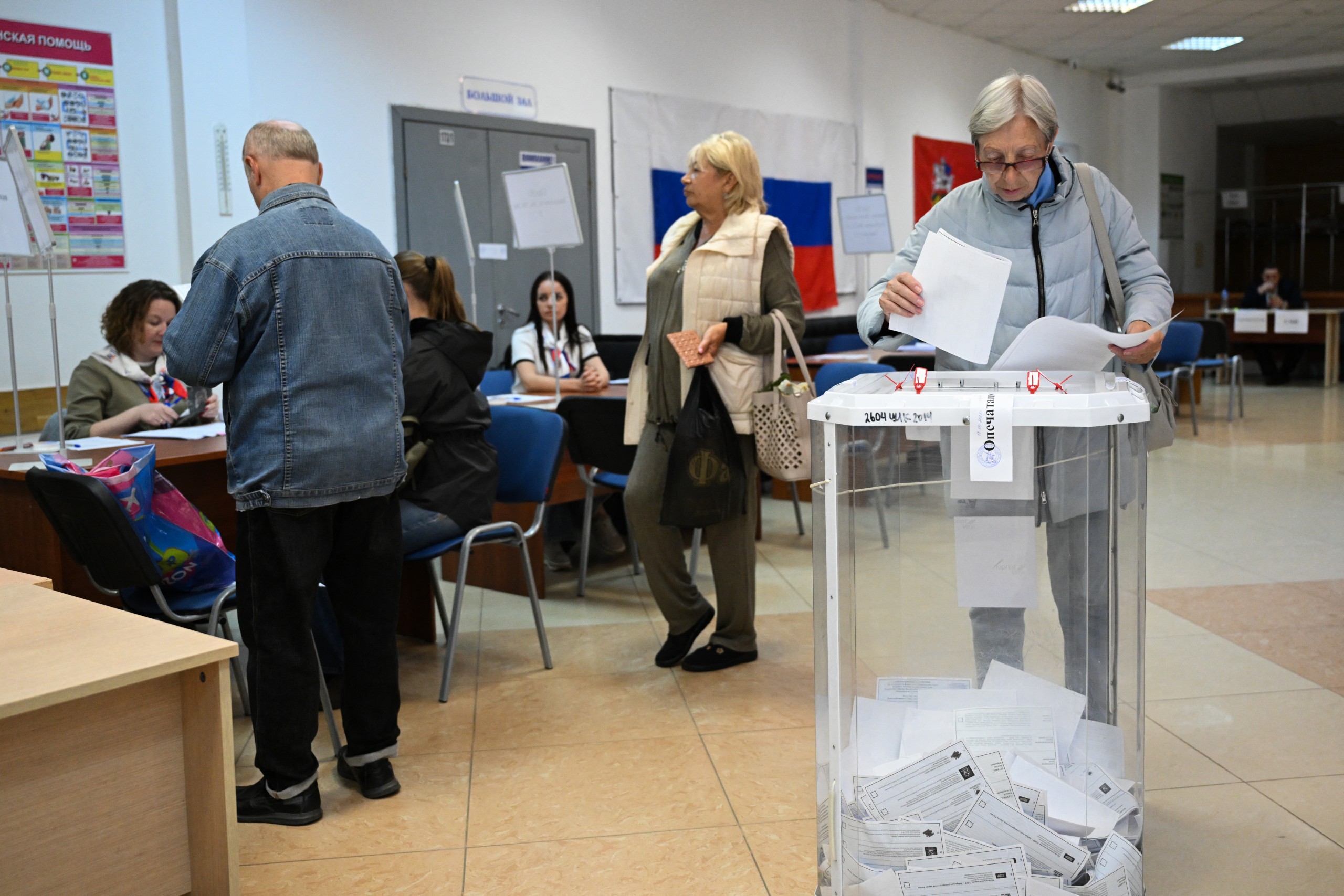
MOSCOW – Russians are casting their votes on Sunday (20 September) on the final day of a tightly controlled three-day parliamentary election set to strengthen the Kremlin’s grip on power, as the day has been marred by Ukrainian drone strikes on Moscow and cyberattacks on the voting system.
The ruling United Russia party, which backs President Vladimir Putin and has won every parliamentary election in Russia since 2003, is widely expected to secure another victory against the backdrop of the Ukraine war, now in its fifth year.
ALSO READ: Russians head to polls as Ukraine conflict enters fifth year
The final day of voting has seen two people killed — a woman (44) and an elderly man — in Ukrainian drone attacks on the capital that wounded about 20 others, according to Moscow regional governor Andrey Vorobyov.
Moscow mayor Sergei Sobyanin accused Kyiv of attempting to interfere with the poll, saying Russian air defences had shot down more than 1 600 Ukrainian drones, 450 of which were heading towards the Russian capital.
“The unprecedented attack was clearly planned with the aim of disrupting the elections. The enemy did not succeed,” Sobyanin said on Telegram.
Ukrainian President Volodymyr Zelensky praised the strikes, saying: “Our long-range responses had a very significant impact in the Moscow region last night.”
A Ukrainian drone strike also hit a bus in part of the country’s southern Kherson region occupied by Moscow, killing two people, including a member of the electoral commission, according to the authorities.
Cyberattacks and sabotage
Russia’s top electoral official said on Saturday that Moscow’s electronic voting system had been hit by powerful cyberattacks.
“All night long, the Moscow system was subjected to a very powerful, continuous attack,” Ella Pamfilova, chair of Russia’s Central Election Commission, was quoted as saying by Russia’s state RIA news agency.
“This attack is ongoing — it is happening practically non-stop,” she said.
Pamfilova also warned that saboteurs had severed communication lines in Russia’s far east.
“We view the incident as a deliberate act of sabotage and an attempt to disrupt voting in the region,” she was quoted as saying by state news agency TASS.
Russian President Vladimir Putin on Friday accused Ukraine of trying to hinder the vote, an accusation to which Kyiv has not responded. Ukraine has called the election farcical.
Limited opposition
Russia’s Supreme Court struck the anti-war Yabloko party off the ballot weeks before the vote, while all other parties cleared to run back Putin and the Ukraine offensive.
Only parties that support Putin and the Kremlin’s military campaign have been registered to run, while voting is also being held in areas of east Ukraine under Russian occupation.
United Russia’s main challengers — the Communist Party, the ultra-nationalist LDPR, A Just Russia and New People — all support the war and Putin.
Yabloko, a liberal party that has called for an end to the fighting, was barred from running its federal list by Russia’s Supreme Court, although its candidates remain on the ballot in some single-mandate constituencies.
Police arrested one of the party’s election observers on Saturday, Yabloko said, while one of its former regional chairs was jailed last month for 11 years.
Putin’s political opponents have mostly been driven into exile, whilst his main rival Alexei Navalny died in an Arctic prison in 2024.
Opposition tactics
Russia’s exiled opposition urged anti-Kremlin Russians not to boycott the elections but instead vote “against Putin’s party”.
Navalny’s widow Yulia Navalnaya called on anti-war Russians to collectively cast their ballots at noon on Sunday, a tactic that drew crowds in the 2024 presidential election.
Yabloko disagreed, arguing that it was better not to vote.
“You are suggesting that we once again go, like sheep, dancing to their tune, and vote for those who have caused the deaths of people in Russia and Ukraine?” party chairman Nikolay Rybakov said earlier this week.
Public sentiment
The election, which will decide all 450 seats in Russia’s lower house State Duma, is expected to close at 20:00 Russia local time on Sunday.
Whilst few Russians doubt the ruling United Russia party will cruise to victory again, the vote offers a gauge of public support for the war and government.
The election is the first since Moscow launched its Ukraine military campaign in 2022 and could offer clues about public opinion towards the conflict, Europe’s deadliest since World War II.
Putin has urged Russians to take part, casting the vote as a show of support for Moscow’s troops and an “answer to those who want to weaken Russia”.
In Moscow, one voter told AFP on Saturday they were frustrated by the state of the economy.
“Many people have lost their jobs. Wages are now falling rather than rising,” Diana (30) said.
Another voter, Tatiana (71), said she had voted for United Russia.
“It is the largest party, the hardest-working and most productive,” she said.
Mobilisation fears
Some fear the post-election period in Russia will bring about a new military mobilisation, similar to the 2022 call-up of 300 000 reservists that triggered an exodus of draft-age men from Russia.
Putin has denied such plans.
The election also comes as Ukrainian drone strikes cause increased disruption and fuel shortages inside Russia, hitting as far as Siberia and the Urals.