

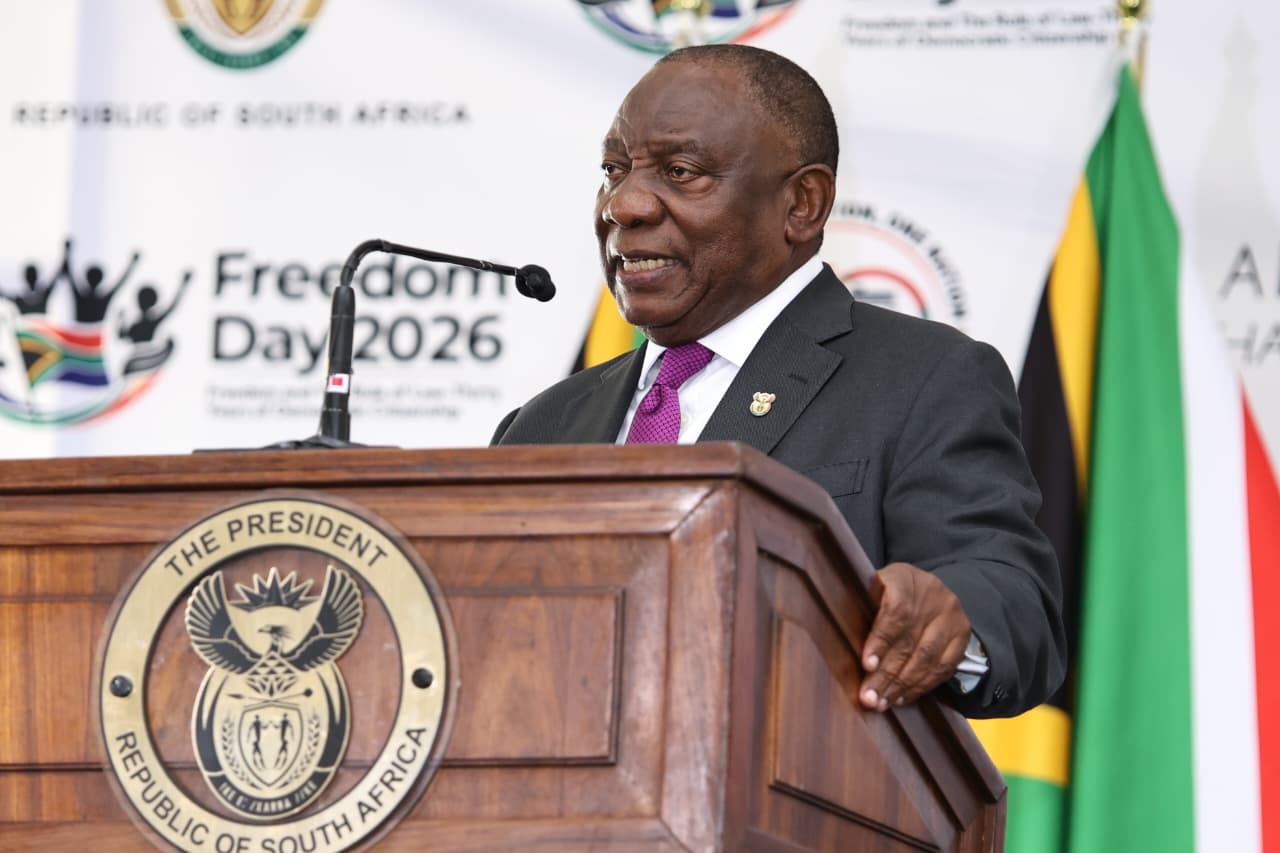
President Cyril Ramaphosa on Thursday released the government’s National Water Action Plan, telling a meeting of the newly established National Water Crisis Committee that the same approach used to end load shedding would now be applied to South Africa’s deepening water crisis.
Speaking at the Union Buildings, Ramaphosa drew a direct parallel to the Energy Action Plan he announced four years ago, which he credited with ending load shedding and stabilising the country’s electricity supply. “We are applying the same approach to the water crisis that has been unfolding in many parts of our country,” he said.
The National Water Crisis Committee — known by the acronym WATERCOM — was first flagged by Ramaphosa in his February State of the Nation Address, when he said the government’s response to the water crisis needed to be intensified and coordinated at presidential level. He said at the time that severe water interruptions and poor water quality, which had in some cases left water unsafe to drink, demanded a focused, government-wide response.
Key points of the National Water Action Plan
• Coordinated by WATERCOM, the National Water Crisis Committee, chaired by the President and bringing together national, provincial and local government along with SALGA.
• Sets out short-, medium- and long-term interventions to stabilise failing systems, recover services and expand access to clean water and sanitation.
• Targets a core cause of the crisis: municipal water revenue not being reinvested in maintaining or building infrastructure.
• Deploys expert technical support teams to struggling municipalities in the short term.
• Strengthens use of existing intervention powers — section 63 of the Water Services Act and section 139 of the Constitution — against non-compliant municipalities.
• Reprioritises water infrastructure grants to finish stalled projects, cut non-revenue water losses and reach unserved communities.
• Partners with Natjoints to fight corruption, theft and vandalism, including water tanker and construction “mafias.”
• Builds on the existing Water Task Team (led by the Deputy President, with the Department of Water and Sanitation, COGTA and National Treasury), including rural borehole and protected-spring programmes.
• Supports metros in ring-fencing water and electricity revenue through the Metro Trading Services Reform Programme.
• Advances a revised White Paper on local government to modernise the municipal system.
• Seeks to boost infrastructure investment, including from the private sector, and to review legal and regulatory mechanisms governing municipal service delivery.
Revenue not reaching infrastructure
Ramaphosa said the plan confronts what he called a basic flaw in service delivery: revenue that municipalities collect from water sales is too often not reinvested in maintaining pipes and reservoirs or building new infrastructure. He said this had left infrastructure dilapidated, causing frequent supply failures and, where water is available, poor quality.
In the short term, government will deploy teams of technical experts to municipalities that are struggling, and will make greater use of existing intervention powers, including section 63 of the Water Services Act and section 139 of the Constitution, against municipalities not meeting their obligations. Water infrastructure grants will also be reprioritised to complete stalled projects, cut non-revenue water losses and extend access to communities that currently have none.
Crackdown on water mafias
WATERCOM will work with the Natjoints security structure to target corruption, theft and vandalism affecting water systems, including so-called water tanker and construction mafias. “We cannot allow those who profit from a broken system to hold our communities to ransom. The perpetrators will be brought to book,” Ramaphosa said.
The new committee builds on the existing Water Task Team led by Deputy President Paul Mashatile together with the Department of Water and Sanitation, the Department of Cooperative Governance and Traditional Affairs, and the National Treasury. That work includes a programme to develop community boreholes and protected springs for rural communities without water access, and the Metro Trading Services Reform Programme, which helps metros ring-fence revenue from water and electricity sales. A revised White Paper on local government, aimed at institutional reform, is also under way.
Consultation with mayors and municipal managers
The plan was shaped by input from the President’s Coordinating Council, which brings together national ministers, premiers and local government representatives. Given the constitutional responsibility municipalities carry for water provision, the plan was also discussed at an extended sitting of the council that, for the first time, brought together all mayors and municipal managers in one meeting.
Ramaphosa acknowledged the plan would not produce overnight results but said “business as usual is no longer an option.” He said the public’s expectations were simple. “The people of South Africa are not asking for promises. They are asking for water to come out of their taps and for it to be safe to drink,” he said, adding that this was “a reasonable expectation” that government was determined to meet.
He said the plan’s success would depend on all spheres of government and social partners working in the same direction and being held accountable for delivery, and called on South Africans broadly to help find solutions to the crisis.

