
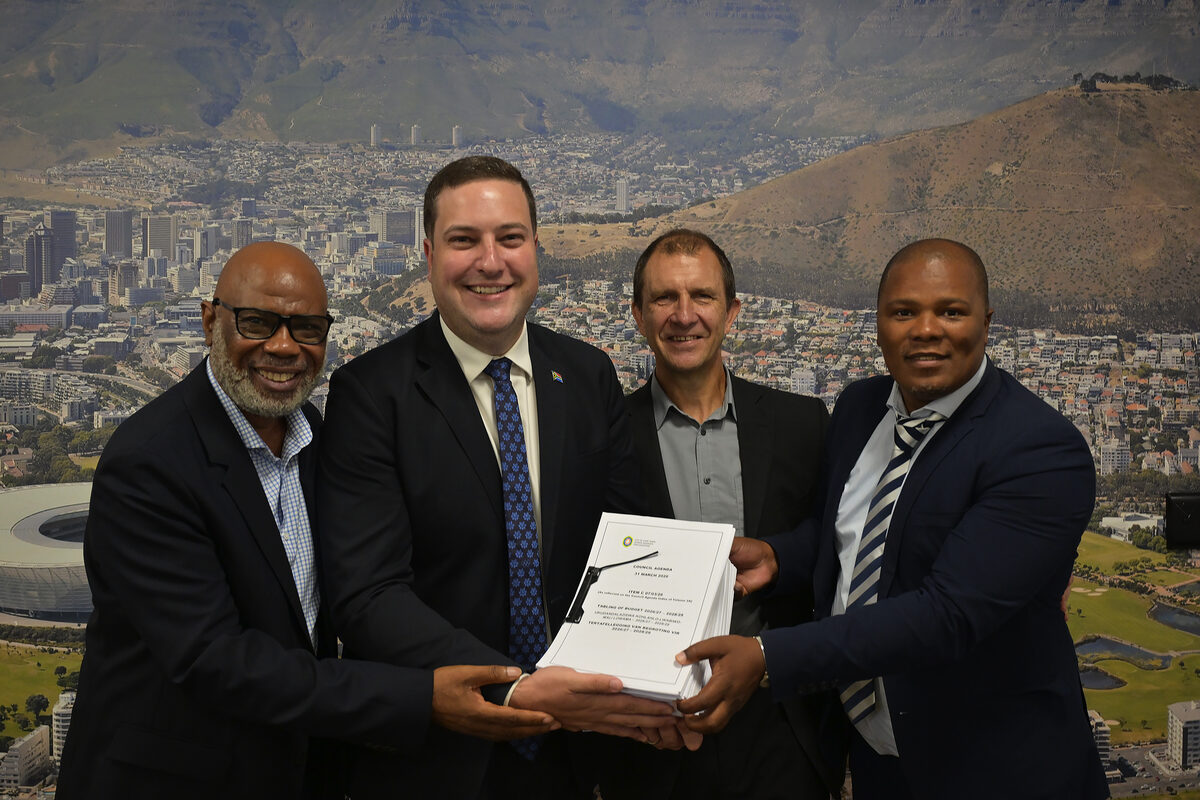
Presenting Cape Town’s draft budget of the current administration on Wednesday, Mayor Geordin Hill-Lewis championed what he termed a “City of Hope” blueprint, promising that approximately 60% of households would experience stable or reduced rates bills despite rising property values, while delivering record infrastructure investment through strategic rate reductions.
Yet opposition councillors denounced the proposals as a sophisticated “debt trap,” arguing that beneath the headline rate cuts lies an elaborate system of fixed charges that constitutes a punitive “stealth tax” on property ownership.
Hill-Lewis says the City will cut the rate-in-the-rand formula—used to calculate property rates—by 10.2% and keep the first R500 000 of property value rates-free, extended to homes worth up to R8 million. Other measures include a proposed raising of indigent relief thresholds. This includes a 100% rebate for water and sanitation, as well as city-wide cleaning, up to R620 000 property value (both up from R500 000), and a 100% rebate for refuse collection up to R580 000 (up from R450 000).
GV2025 comes into effect
Regarding the consumptive portion of the tariffs, “water and sanitation tariffs will rise by 4.5%, refuse and cleaning charges by about 3.75%, and electricity by an average of 6.67%.” In terms of the controversial fixed charges, currently being challenged in court, property value bands have been changed to mitigate the property value increases as the GV2025 comes into effect on 1 July.
READ ALSO: Cape Town proposes 10.2% rate-in rand cut amid soaring valuations
According to budget documents, revenue will fund the proposed 2026/27 City of Hope budget of R87.7 billion, with R74.7 billion allocated to the operating budget and R13.032 billion to the capital budget, which reflects a 4.4% increase over last year’s record-breaking R84.1 billion budget.
Major components for the 2026/27 operational budget include employee-related costs at R22.1 billion, which equates to 29.6% of the total operating expenditure; remuneration of councillors at R207 million; and bulk purchases of electricity at R18.9 billion.
Record infrastructure investment
Infrastructure investment highlights over the three-year budget framework, says Hill-Lewis, will include a R16.7 billion water and sanitation investment; R6 billion in electrical grid upgrades and maintenance to prepare for a decentralised energy future with less Eskom reliance; R3.7 billion in road maintenance, pothole repairs, upgrades to roads and stormwater, and R653 million in congestion relief projects.
A further R3.3 billion goes towards the major MyCiTi Cape Flats expansion, and R3.3 billion for informal settlement upgrading and state-subsidised housing. The budget further includes a R6.8 billion safety and security proposal for 2026/27.
According to Hill-Lewis, this draft budget achieves several things at once that simply wouldn’t be possible in other cities: an SA-record infrastructure investment that outpaces all Gauteng metros combined; the most comprehensive relief for struggling households and pensioners; and the lowest property rates and total monthly bills of any metro.
But on the other side of the aisle, not all are equally optimistic about the City of Hope Budget.
While the City masks its fiscal policy with a 10.2% cut to the property rate-in-the-rand, a technical analysis reveals a budget designed to extract record revenues through a financial sleight of hand.
GOOD Party councillor Sandra Dickson views the City of Hope Budget as a regressive debt trap for residents. “While the City masks its fiscal policy with a 10.2% cut to the property rate-in-the-rand, a technical analysis reveals a budget designed to extract record revenues through a financial sleight of hand,” she says.
“The City claims that it is a 6.67% average electricity increase, but for the actual ratepayer, this is not so. The fine print in the budget confirms that the regulated tariff—the actual price paid at the meter—will climb by a uniform 8.55% across almost every energy block and service charge. The Electricity Home User Fixed Charge is set to increase by this same 8.55%, bringing the new monthly mandatory cost to R424.29 (incl. 15% VAT). This is a monthly penalty for simply being connected to the grid, regardless of how much power a household saves,” she explains.
She furthermore holds the view that the City, in adjusting the property value bands for fixed charges, acknowledges the volatility of its own 2025 General Valuation Roll.
“While presented as ‘relief’ to prevent homes from jumping into higher billing brackets, GOOD views this as a cynical admission that the valuation system is untethered from reality. By shifting these bands, the City is merely fine-tuning its machinery to ensure it can still extract maximum revenue from the middle class without triggering a total collapse in payment ability.”
‘Stealth tax’
Dickson has consistently challenged the City’s legally questionable linking of fixed service charges to property value.
“These charges—covering water, sanitation, and ‘city-wide cleaning’—are effectively a second property tax that ignores actual consumption. Under this model, a family in a modest R3 million home is now forced to pay a combined monthly total of approximately R1,135.50 (incl. 15% VAT) in fixed service charges for water, sanitation, and cleaning before they have even opened a tap or put out a single bin,” she says.
“This is a ‘stealth tax’ on property ownership that penalises the asset-rich but cash-poor middle class,” she claims.
“While the Mayor touts a record R40 billion three-year infrastructure plan, much of this is a recycling of old announcements. More critically, the City continues to struggle with implementation; in the last financial year, R1.6 billion in capital funds went unused. The City is asking residents to pay more for projects it has proven it cannot deliver on time.”
Social contract broken
Freedom Front Plus councillor Pieter Jansen van Vuuren commented, saying the costs of water and electricity have become a primary driver of household poverty in the metro.
“We are living in a time and in a city where the cost of living is not just rising; it is exploding. Our residents are being squeezed from every side—by skyrocketing fuel prices, national inflation, and most significantly, by the City’s own aggressive tariff structures.”
Van Vuuren reinforces Dickson’s perspective, arguing that the City’s dependence on fixed charges—imposed irrespective of actual usage—fundamentally undermines the principle of fairness.
The citizens of Cape Town are not just unhappy; they are pushed to the brink.
“The Freedom Front Plus is deeply concerned by the City’s apparent disregard for the economic reality of its residents. We see a City that prides itself on financial sustainability while its ratepayers are drowning in debt,” he says.
“The citizens of Cape Town are not just unhappy; they are pushed to the brink. One need only look at the High Court case brought by SAPOA and supported by various ratepayer associations against this very City. This legal battle over the 2025/26 budget and its unfair tariff models is a clear indictment of this administration’s failure to pay attention to those who literally keep the lights on, even for those who do not pay,” he says.
READ ALSO: SAPOA awaits crucial judgement on Cape Town fixed charges High Court case
“When the public is forced to take their own government to court just to ensure that rates and taxes are levied fairly and legally, it is a sign that the social contract in Cape Town is broken.”
Budget open for comment
The City of Hope Budget 2026/27 is open for public comment until 30 April. Visit www.capetown.gov.za and click the draft budget trending box on the homepage for all budget-related information as well as a public engagement schedule.
Submit comments on the draft Budget:
• Email: Budget.Comments@capetown.gov.za
• Online: www.capetown.gov.za/collaborate ; or www.capetown.gov.za/HaveYourSay
• Visit Subcouncil offices
• Phone: 0800 212 176