Oscar Jegou should be counting his blessings, and perhaps sending a thank you card to World Rugby’s disciplinary committee.
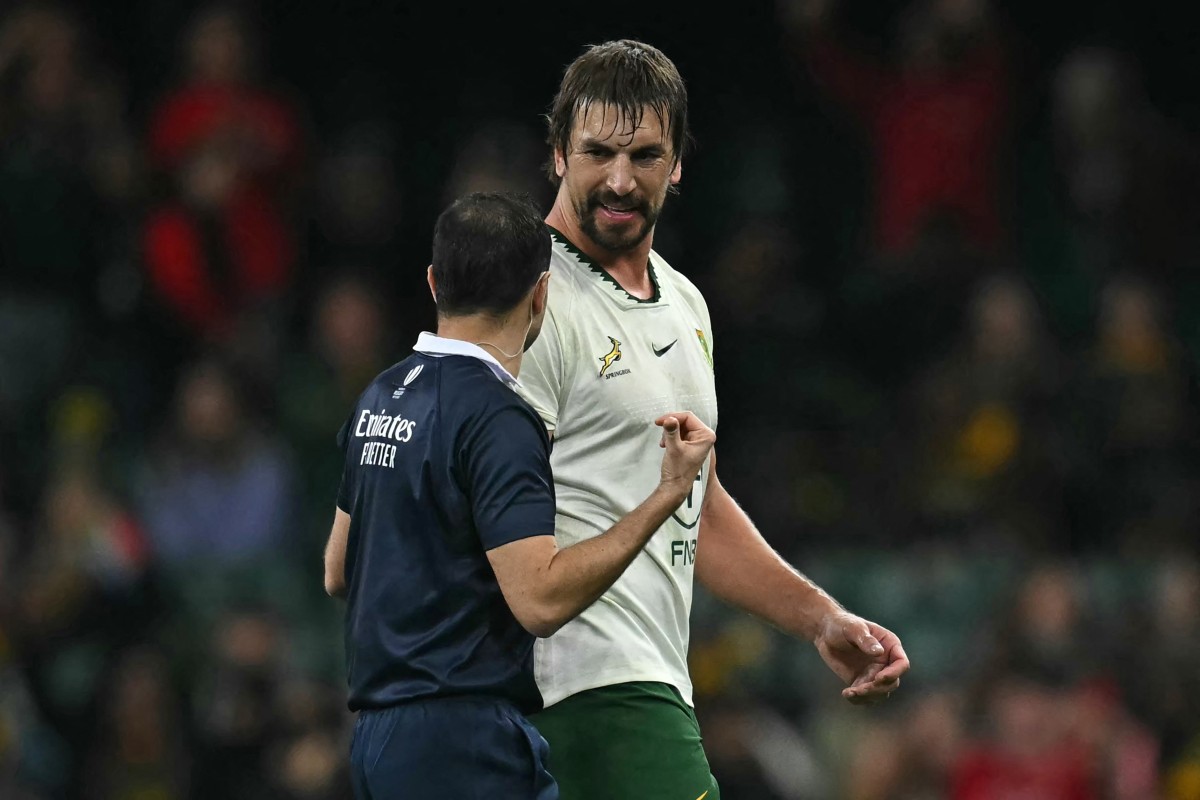
The French forward has copped a mere four-week ban for eye-gouging Scotland’s Ewan Ashman during last Saturday’s thrilling Six Nations clash that the Scots won 50-40. But here’s where it gets interesting: Springbok Eben Etzebeth received a 12-week suspension for essentially the same offence just months ago.
Same crime. Wildly different punishment.
Jegou’s transgression occurred in the final quarter when he made contact with Ashman’s eyes.
Yet somehow, neither referee Angus Gardner nor TMO Brett Cronan, both Australian officials, deemed it worthy of sanction during the match. No penalty. No card. Not even a stern word.
It took post-match citing for justice to even enter the conversation, with the disciplinary hearing convened on Wednesday evening to rule on the incident that match officials somehow missed in real time.
The verdict: Six becomes four
The Six Nations disciplinary committee determined Jegou’s actions met the low-end entry point of six weeks, a baseline established precisely because Ashman escaped injury during the incident.
“In applying World Rugby’s sanctioning provisions, the independent Disciplinary Committee determined that the low-end entry point of six weeks was appropriate in light of the fact that (among other reasons) there was no injury caused to the victim,” the governing body’s statement read.
Then came the mitigation. Good conduct. Clean disciplinary record. Two factors that slashed the suspension by a third, bringing the final sanction down to four weeks.
“In light of mitigating factors (including the player’s good conduct and good disciplinary record), the independent Disciplinary Committee applied a two-week reduction in sanction, thus reducing the final sanction to four weeks. There were no aggravating factors to increase the sanction,” the statement concluded.
Four weeks. For sticking fingers in an opponent’s eyes.
Go to KickOff.com to see which matches Jegou will miss.
The Etzebeth comparison that won’t go away
Now, let’s talk about the elephant in the disciplinary room.
In November, Eben Etzebeth received a 12-week ban for eye-gouging Wales’ Alex Mann during the Springboks’ end-of-year Test. Similar offence. Different continent. Vastly different punishment.
Twelve weeks versus four.
Jegou should consider himself extraordinarily fortunate. Whether that fortune stems from genuine mitigation factors, jurisdictional inconsistency, or the simple lottery of which disciplinary panel hears your case remains an open question.
But the optics aren’t great. Eye-gouging is eye-gouging. The victim’s nationality, the tournament, and the player’s previous good behaviour shouldn’t fundamentally alter the punishment for one of rugby’s most dangerous acts.
The officiating black hole
Perhaps equally concerning is how the incident escaped sanction during the match itself. Gardner and Cronan had access to multiple camera angles, slow-motion replays, and the technological arsenal that modern rugby provides.
Yet they saw nothing warranting intervention.
It raises uncomfortable questions about real-time officiating standards and whether TMOs are truly empowered, or willing, to call out dangerous play that referees miss. If cameras clearly captured Jegou’s actions, why did it take post-match citing to bring consequences?
When a French player receives four weeks and a South African receives 12 for comparable offences within months of each other, it doesn’t inspire confidence in the system.
Either Etzebeth was harshly treated, Jegou got off lightly, or the variables between incidents are so vast that comparing them becomes meaningless. None of those options paint the disciplinary process in flattering light.
Jegou will serve his four weeks and return to action. Ashman escaped injury, which matters. Jegou
Four weeks might be the ruling. But the debate is just getting started.