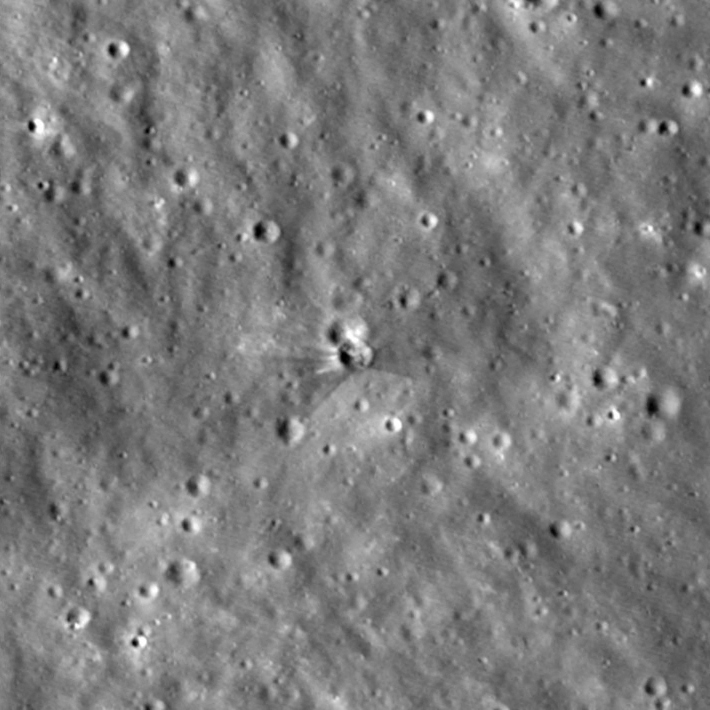
NASA has released new images showing the crater created when a SpaceX rocket stage crashed into the Moon earlier this month.
The photographs, captured by the Lunar Reconnaissance Orbiter (LRO) between 11 and 12 August, reveal the impact site where a SpaceX Falcon 9 upper stage struck the lunar surface on 5 August.
Scientists from the US space agency calculated the crater measured 18 metres wide and less than three metres deep, based on shadow length measurements.
Private mission preceded impact
The Falcon 9 launched in January 2025 carrying Firefly Aerospace’s Blue Ghost 1 lunar lander, a private mission that successfully made a soft landing on the Moon.
These were not the first images of the crash site. The Korean space agency published photographs on 6 August taken a day earlier by Korea Pathfinder Lunar Orbiter (KPLO), also known as Danuri.
Complex imaging operation
The LRO, operational since 2009, circles the Moon from pole to pole every two hours whilst the Moon rotates beneath it.
A NASA statement said capturing the image presented significant challenges. To photograph a specific location on the Moon, the spacecraft must wait until that spot rotates into view, which took six days in this case. The spacecraft also required precise tilting so its camera pointed towards the crater whilst passing 96 kilometres overhead.
Timing proved equally challenging. NASA noted that if the camera captured the image even 10 seconds too early or late, the target would drift off-centre by 16 kilometres.
Surface features revealed
The images captured from different viewing angles revealed various features, including brighter and darker streaks radiating from the crater.
NASA explained the darker streaks consist of surface dust and rocks altered over time by solar wind, galactic cosmic rays and micrometeorite impacts, thrown up by the collision from half a metre below the surface.
The brighter streaks hugging the crater’s rim were fresh material excavated from deeper underground.
International collaboration
Finding the crater site required global collaboration between leading experts and enthusiasts.
NASA’s Centre for Near Earth Object Studies progressively refined the trajectory until identifying the impact location, which it provided to Korea.
The Danuri team then sent their coordinates to NASA’s LRO team to help refine their follow-up imaging sequence.