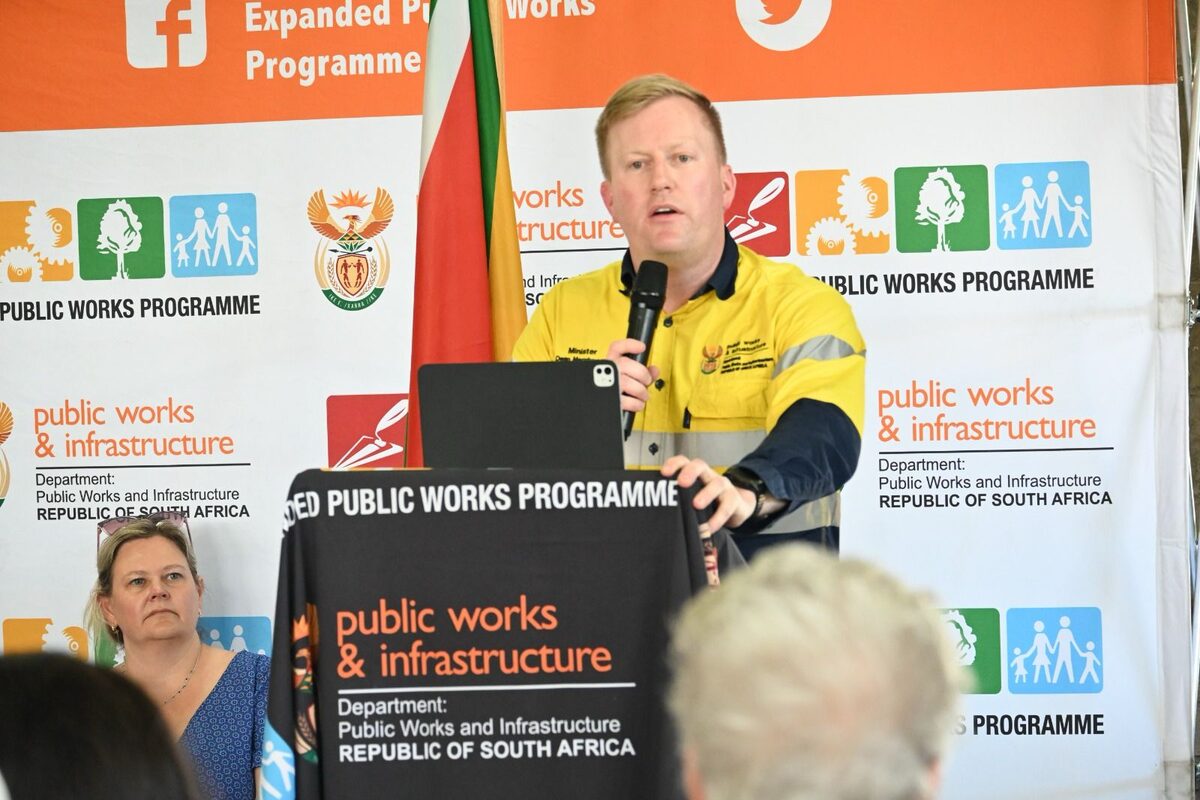
JEFFREYS BAY – A national listening tour on the Expanded Public Works Programme (EPWP) brought important updates to the Kouga region on Friday, 21 November, as Minister of Public Works and Infrastructure, Dean Macpherson, announced significant reforms aimed at improving the programme’s effectiveness, transparency, and long-term impact.
Speaking at a packed Pellsrus Community Hall in Jeffreys Bay – attended by EPWP participants, community members, Kouga Local Municipality Executive Mayor Hattingh Bornman, Speaker Lorraine Maree, MMC for Finance and Local Development Shena Ruth, members of the Eastern Cape Legislature, municipal officials, and community leaders – Macpherson outlined the government’s plan to strengthen the programme following months of direct engagement with communities across South Africa.
The session formed part of an ongoing national effort to identify shortcomings within the EPWP and introduce changes that address the needs of beneficiaries.
Stakeholders raised concerns about limited training opportunities, the short duration of work placements, and challenges around transparent recruitment processes.
Macpherson confirmed that these concerns have shaped a new set of reforms.
“EPWP is one of the most important programmes of the government. It helps the poorest of the poor, people who have nothing, with no money, no hope, and who are often in bad places. And EPWP helps them with just something simple,” he said.
“But people have been saying to me, ‘Minister, we want something more in EPWP’. They only get a few hundred rand or have just been there for two or three months. That’s nice, but we want more.”
He added that community members across the country continue to raise concerns about political interference in job allocations, including claims that councillors and politicians interfere in EPWP and give jobs to family members and friends and reports that women are requested to perform indecent acts in exchange for jobs.
A key highlight of the engagement in Jeffreys Bay was the announcement of a planned development model within the EPWP. Set to launch in March, the model will extend work opportunities beyond current short-term placements. It is designed to support more sustainable livelihoods and help participants transition into stable employment.
Responding to widespread calls for deeper skills development, Macpherson said training and practical upskilling would form the backbone of the revamped programme.
Participants will also receive formal certificates of recognition upon completing their training — a move intended to improve their prospects in the broader job market.
“The EPWP remains one of the most important tools for job creation and poverty alleviation in South Africa,” Macpherson said.
“But for it to truly serve our people, we must listen and adapt. Communities have told us they want more meaningful skills, longer-term opportunities, and accountable systems — and today we are confirming that these changes are on the way.”
He noted that the Inter-Ministerial Committee on Public Employment Programmes recently agreed that the EPWP requires decisive reform to ensure it continues to uplift the most vulnerable citizens.
Macpherson said the government intends to partner with Kouga Local Municipality to create new EPWP opportunities in the area and align training with participants’ journey into permanent work.
“These proposals are not just plans — they are a commitment to better serve our people,” he said.
“We listened because we want to make the EPWP better, fairer, and more impactful for every community.”