

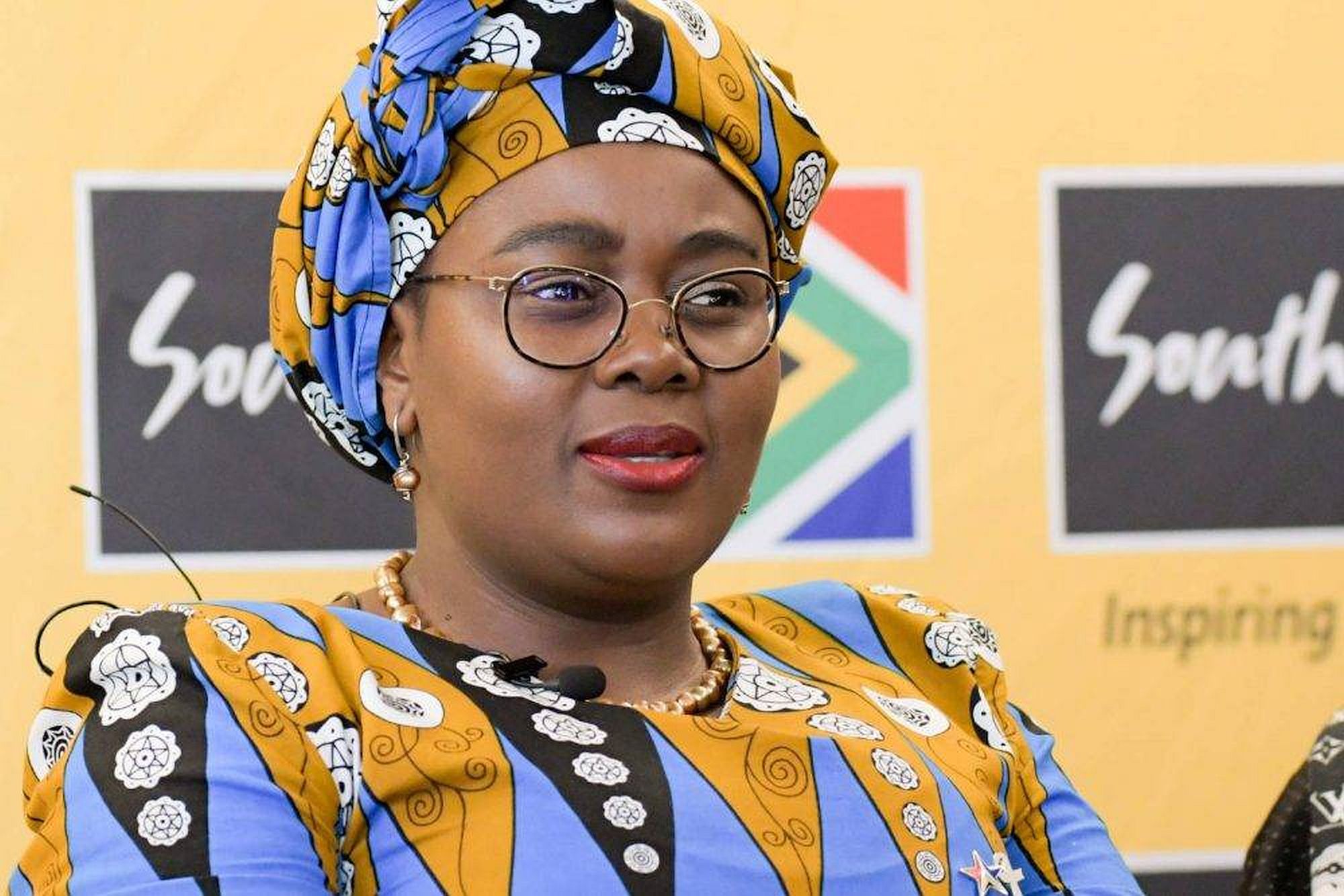
Justice Minister Mmamoloko Kubayi has attributed ongoing problems in South Africa’s judiciary system to the legacy of colonialism and apartheid, more than three decades after the country’s transition to democracy.
Speaking at a media briefing on Tuesday, Kubayi acknowledged that despite significant progress since 1994, the court system inherited from the apartheid era remains “largely intact”, continuing to plague the country with spatial injustices.
“The legacy of colonialism and apartheid continues to plague South Africa with spatial injustices and to impede access to courts for communities that reside in the areas that formed part of the defunct homelands and self-governing territories, as well as remote rural villages,” the minister said.
The government has now approved a two-phase plan to rationalise the country’s court system in an effort to improve access to justice for all South Africans.
The rationalisation process builds on the Interim Rationalisation of Jurisdiction of the High Court’s Act of 2001 and work that began in 2014 to restructure magisterial districts in the provinces.
In 2021, former justice minister Ronald Lamola established a committee chaired by retired deputy chief justice Dikgang Moseneke to examine the structure of South Africa’s high courts.
Cabinet has now approved the committee’s recommendations, which will be implemented in two phases starting from 1 July.
Phase one includes implementing immediate recommendations regarding magisterial districts and sub-districts, as well as gazetting and using courts where infrastructure is already available.
The guidelines for appointing acting judges have been reviewed and will be gazetted for implementation from 1 July. The minister also announced that a process has been initiated to effect a 20% increase in judicial posts to address capacity challenges across divisions of the High Court.
Phase two involves a phased approach to establishing additional local seats through building new courts or expanding existing magistrates’ courts.
Expansions are planned for the Gauteng Division at Palm Ridge, Free State Division at Welkom, North West Division at Rustenburg, Northern Cape Division at Upington and the Western Cape Division at Thembalethu.
Following consultations with Gauteng judge president Aubrey Ledwaba, the department has also initiated steps to establish a court in Kempton Park next to OR Tambo International Airport to deal with immigration matters.
“Though this initiative is not part of the recommendations of the rationalisation committee, we believe that the circumstances especially regarding immigration demand that we act swiftly,” Kubayi said.
The recommendation to move the seat of the Eastern Cape Division from Makhanda to Bhisho remains under consultation with stakeholders.
Kubayi emphasised that as South Africa celebrates the 30-year anniversary of the adoption of the Constitution, efforts to achieve the constitutional imperative regarding rationalisation must be intensified.
“As we move with consolidation of court administration and judicial governance, merging magistrates and judges into a single judiciary to enhance independence, we must also ensure that access to justice for all remains at the centre of our efforts,” the minister concluded.
ALSO READ: Free State SAPS commends judiciary as multiple perpetrators of heinous crimes face heavy sentences

