


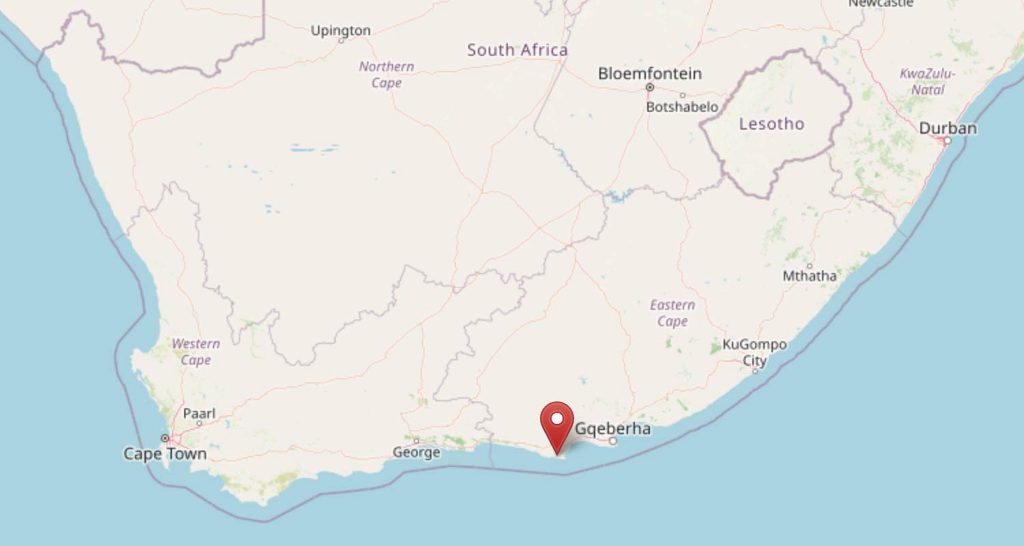
EASTERN CAPE – Nelson Mandela Bay Mayor Babalwa Lobishe has welcomed the Department of Forestry, Fisheries and the Environment’s decision to accept the Final Scoping Report for the proposed 5,200MW nuclear power plant at Thyspunt in the Kouga Local Municipality, describing it as a defining opportunity for the Bay and the Eastern Cape.
The decision allows the project to proceed to the full Environmental Impact Assessment (EIA) phase. It is not an authorisation to build, and the Department has identified several outstanding environmental assessments and uncertainties that must be addressed before a final environmental decision can be made.
“For too long, the Eastern Cape has been spoken about as a province of potential,” Lobishe said. “A project of this scale gives us the chance to turn that potential into permanent economic strength.”
NovaNews previously reported that Eskom Holdings held public meetings across the Eastern Cape in April to discuss the proposed plant, amid concerns among residents about safety, traffic congestion and potential impacts on marine life.
According to Eskom’s Draft Scoping Report, the proposed facility would have a capacity of up to 5,200MW, with a technology-neutral design allowing for large pressurised water reactors, small modular reactors and high-temperature gas-cooled reactors. The proposed design life is approximately 60 years, potentially extendable to 80 years.
The Final Scoping Report identifies Thyspunt as the preferred site over Bantamsklip in the Western Cape. However, the Department’s acceptance letter requires the EIA to provide an evidence-based comparison of both locations, including their environmental, heritage, social, economic and cumulative impacts.
Koeberg visit shaped confidence
The announcement follows an oversight visit to Koeberg Nuclear Power Station in the Western Cape by an Eastern Cape delegation led by Premier Oscar Mabuyane. The delegation included Lobishe, district leadership from Sarah Baartman, representatives from Coega, the Automotive Industry Development Centre and the Eastern Cape Socio-Economic Consultative Council, as well as Khoi-San traditional leadership.
The delegation was briefed on safety systems, environmental management, employment, local procurement and the facility’s relationship with surrounding communities.
“At Koeberg, I saw firsthand how a nuclear facility operates alongside a host community,” Lobishe said. “What we saw confirmed that nuclear power can coexist with coastal communities, tourism and a healthy environment when it is properly managed.”
She said the visit provided valuable lessons and strengthened her confidence in the region’s ability to support a project of this nature.
Economic opportunities for the region
Lobishe said Nelson Mandela Bay’s port infrastructure, automotive and manufacturing industries, engineering capacity and Nelson Mandela University positioned the metro to contribute to a development of this scale.
She identified energy security, construction and operational employment, local supplier development, skills transfer and supporting infrastructure as key potential benefits.
The Mayor called for local recruitment and skills development, particularly for young people in Nelson Mandela Bay and Kouga. She also highlighted opportunities for small, medium and micro enterprises and cooperatives in logistics, construction, hospitality and related services.
She said partnerships with universities and technical and vocational education and training colleges could help develop engineers, artisans and technicians, while investment in roads, water and other infrastructure could provide longer-term benefits to surrounding communities.
Environmental assessments remain outstanding
The Department’s acceptance letter, dated 14 August 2026, makes clear that substantial further work is required during the EIA phase.
Among the outstanding matters are detailed assessments of groundwater-dependent wetlands, dune systems, marine habitats, the chokka squid fishery, shoreline changes, water security and the potential effects of climate change. The Department also requires further investigations into desalination infrastructure, brine disposal, radioactive waste management, traffic, noise, heritage resources and the project’s socioeconomic impacts.
The EIA must also examine the environmental implications of different reactor technologies and associated infrastructure, including cooling systems, transmission lines, access roads and worker accommodation.
The Department further requires a more detailed assessment of the Thyspunt and Bantamsklip alternatives, noting that some specialist studies have identified information gaps and uncertainty regarding their comparative suitability.
Under the National Environmental Management Act, listed activities may not commence before environmental authorisation is granted.
“We welcome this scrutiny,” Lobishe said. “Development that ignores the environment and the people who live alongside it is not development we want.”
She urged residents, fishing communities, heritage organisations and businesses to participate in the next phase of public engagement, saying their input should help shape the outcome.
The City will continue engaging Eskom, Kouga Local Municipality, other state-owned enterprises, organised business, civil society, traditional authorities and the provincial government, Lobishe said, with the aim of ensuring the project’s potential benefits are shared across the region.
ALSO READ: Thyspunt nuclear proposal faces united community opposition



You must be logged in to post a comment.