

LONDON – A legal dispute over plans to expand the Wimbledon tennis championships is continuing through England’s courts, as the tournament welcomes the world’s top players this week.
The All England Lawn Tennis Club (AELTC), organisers of the only grass-court Grand Slam, wants to triple the size of its historic grounds. Local residents argue the plans threaten the area’s natural environment.
The dispute, which has been ongoing for five years, centers on the club’s attempt to expand its site to accommodate qualifying rounds. The AELTC has held a tournament at the venue since 1877.
Qualifying rounds, which concluded for this year’s championships on Thursday, are currently held several kilometers away at a leased courts complex in Roehampton.
“We need a permanent home for our qualifying,” AELTC chair Deborah Jevans said at a recent press conference.
“It’s important because if you look at Roland Garros, if you look at the US Open, you look at the Australian Open, all of them have their qualifying on-site. We’re the only one that doesn’t.”
She added: “We want it to be close to the main site, like the others, and we’re unable to do so until we go through these legal challenges.”
Residents oppose development
Wimbledon Park, a green space and lake created in the 18th century and sitting opposite the tournament site, is at the center of the battle.
Previously home to Wimbledon Park Golf Club, the AELTC wants to build 38 new tennis courts and an 8 000-seat stadium there.
The development comes as the Grand Slams, also held in Melbourne, Paris and New York, attempt to increase ticket sales for their qualifying weeks.
The US Open last year launched a new stand-alone mixed doubles competition held before its Grand Slam tournament and designed to feature more singles stars.
Meanwhile Australia in 2025 staged its inaugural “One Point Slam”, sudden-death contests consisting of just one point which pit professionals alongside amateurs and celebrity wildcards.
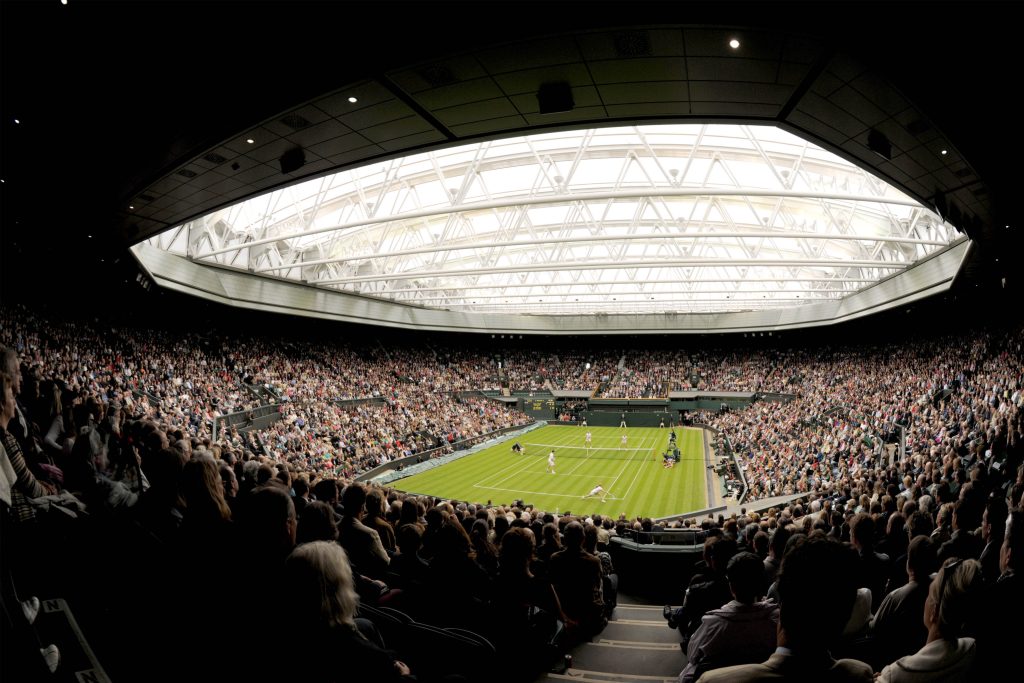
But Wimbledon’s attempt to use the park has met strong opposition from local residents.
They have formed the “Save Wimbledon Park” group, which currently has 25 members, to fight the proposals.
“The campaign started five years ago, when they launched the plans,” Christopher Coombe, a retired lawyer who has lived nearby for 34 years and is a regular spectator at the tennis tournament, told AFP. “We’ve got in their way.”
Jonathan Morrish, a fellow retiree and group member who has been a Wimbledon resident for 45 years, added: “We often use the analogy David against Goliath.”
“They are destroying one of their unique selling points: the beauty of their location,” he said.
“Imagine a stadium the size of the Royal Albert Hall dominating here,” Morrish added, referring to the 5 272-seat concert hall to the north in Kensington, as he gestured towards the threatened park.
He compares Wimbledon to “a nice village”. “It’s just madness wanting to build on green areas.”
Court challenges continue
The dispute mirrors the recent expansion of Roland Garros, the clay courts that have hosted the French Open for more than a century.
The French Tennis Federation, which organizes that annual tournament, battled in the courts for five years to build the 5 000-seat Simonne-Mathieu stadium and several other additions.
Concerns about that project centered on the impact on 19th-century greenhouses in the adjacent Auteuil gardens home to rare flora and fauna.
The federation eventually prevailed in 2017 and opened the new arena in 2019, increasing the size of its southwest Paris site by 50%.
In London, the Save Wimbledon Park campaigners argued the development should not proceed because a statutory trust exists under 19th-century legislation requiring the land only be used for “public walks” or as “pleasure grounds”.
ALSO READ: Wimbledon: A storied history of tennis excellence, strawberries – and the occasional streaker
Lawyers for the club countered that it was never subject to a trust and, if it was, it did not survive the club’s purchase of the freehold in 1993.
In March, the High Court ruled in favor of the AELTC, though Save Wimbledon Park has said it would ask the Court of Appeal to review the decision.
Meanwhile, the group has also challenged the planning permission granted in 2024 by the Greater London Authority.
The High Court also dismissed that claim, but the Court of Appeal is scheduled to hear that case in October.
Jevans said the project will bring a new 27-acre park, which adds 50% more public space, a lake boardwalk, children’s playgrounds and new multi-sport facility.
But she conceded that “depending on appeals and results, it could be a number of years before we’re able to move there”.
ALSO READ: Wimbledon grants Wildcard to seven time champ Williams




You must be logged in to post a comment.