


“You are not human, you are money-making machines.”
These were the words two men from Cape Town encountered upon arriving at a Cambodian scam centre. The two men, aged 19 and 30 and related to one another, were amongst eight people from Kraaifontein who were trafficked to Cambodia last year.
In a sit-down with TygerBurger, they could finally share their harrowing experience following the arrest of two alleged recruiters by the Hawks in Kraaifontein last week. The younger man was only 18 and had just completed matric when he was recruited.
The lure of false promises
Desperate for employment, he saw an advertisement on social media—call centre agents needed for a company in Thailand, all expenses paid, salary $400 plus commission, accommodation included.
ALSO READ: Social media becomes hunting ground for human traffickers in South Africa
The other man was unemployed with a young family to support. “I had just started my life, and this looked like a golden opportunity to go overseas, save some money, and return to South Africa to buy a house for my family. It would have been our chance to make a better life in a country where there are very few opportunities for us,” he says.
The 18-year-old applied first and departed the country, with his older family member following four months later.
“After we completed the applications, our air tickets were paid for and everything seemed above board. I never would have guessed that I was being trafficked.”
Journey into captivity
Upon arrival in Bangkok, Thailand, he was allowed through the Thai border on tourist visas before entering Cambodia on business visas. “I was then transported in a van and travelled for about 10 hours to the compound. This is where I started getting suspicious for the first time.”
After arrival, his passport was taken and his movements restricted. He was, however, able to track down his family member at the compound.
“There were Cambodian guards walking around with tasers, and it slowly dawned on us that we were trafficked and now captives. Fear arose quickly. We did not have our passports in a strange country, but I knew I had to stay calm and focused. I had to do whatever was required to keep us both safe.
“We were allowed to keep our mobile phones but coerced into contacting our families to tell them we were safe. At one point we were shown a video of an elderly Zimbabwean man being tortured with tasers, and we were terrified that harm would come to us and our families. We did what we were told.”
Appalling living conditions
The scam centre, allegedly run by Chinese mafia they say, consisted of six buildings of 26 floors each. Living conditions were appalling, with 15 people sharing one shower, one basin, and a squat toilet. “The mattresses were very hard and sewage pushed up into the room.”
They were given iPhones and instructed to telephone people in South Africa to lure them into elaborate scams, falsely claiming cases had been opened against them and demanding payment to avoid arrest.
“Their telephone numbers and ID numbers were provided to us. I often wondered where they got them from. All the victims were white retired people with money,” says one of the men.
Forced into fraud
The men worked 12 to 13-hour shifts per day and were given only one free meal daily. “We scammed people every day. One day I scammed someone out of R1.8 million and was paid about $400. I felt very bad about this but would repent at the end of each day.”
The younger man says he was often shouted at and belittled by guards if they did not meet their targets, and was forced to write out telephone scripts 50 times. They were paid in cash, and the money could be banked at an on-site facility that made electronic transfers to their South African bank accounts.
The food consisted of rice, noodles, and strange meats “like snake and frogs”. The men say there were people from mostly very poor countries across the world, many of whom chose to stay and work for the money to send to their families.
“There were people from all over Africa, and from India, Pakistan, Brazil, and Indonesia. We saw elderly people and young children and heard horrible stories of violence and abuse.”
The rescue
After a few weeks, the older man summoned the courage to call for help from his family in South Africa, who lodged a case with police. But It was a message to his brother in America that set their rescue in motion.
“My brother put us in contact with an American senator who in turn put us in contact with immigration police in Cambodia. After contacting them, they asked if we were being held captive and requested us to send them our location.”
Shortly afterwards, they were collected by immigration police and taken to a police station where they were kept in cells for two weeks. “Here too we had to sleep on thin mattresses on the floor and received only one meal per day consisting of rice and pork.”
According to them, they were extorted by police in order to receive better treatment. After receiving the correct documentation from Cambodian government officials, the men were taken to immigration offices and deported back to South Africa at their own cost.
Back home but traumatised
Back in South Africa, the men say they are grateful to be alive, though they continue to live with the trauma of their experiences. They remain apprehensive and fearful of judgement from their own communities, yet believe it is crucial for victims of human trafficking to speak out about their ordeals.
“It was a nightmare, and we still process it day by day.”
The two accused, Adam Douglas (44) and his wife Yolanda Douglas (50), appeared before the Bellville Magistrate’s Court on Monday on charges of contravention of trafficking in persons. The case was postponed to 26 February for a bail application. If found guilty, they face life imprisonment. It is alleged that they sold the men for R10 000 each.
ALSO READ: Two suspected human trafficking recruiters arrested in Kraaifontein
Global crisis exposed
A report published on 20 February by the UN Human Rights Office in Geneva graphically details the lived experiences of some of the hundreds of thousands of people trafficked from dozens of countries around the world into working in entrenched scam operations, mostly in Southeast Asia, as well as far beyond.
The report documents instances of torture and other ill-treatment, sexual abuse and exploitation, forced abortions, food deprivation, and solitary confinement, among other grave human rights abuses. Survivors also shared experiences of border officials aiding scam recruiters, and of threats and extortion by police.
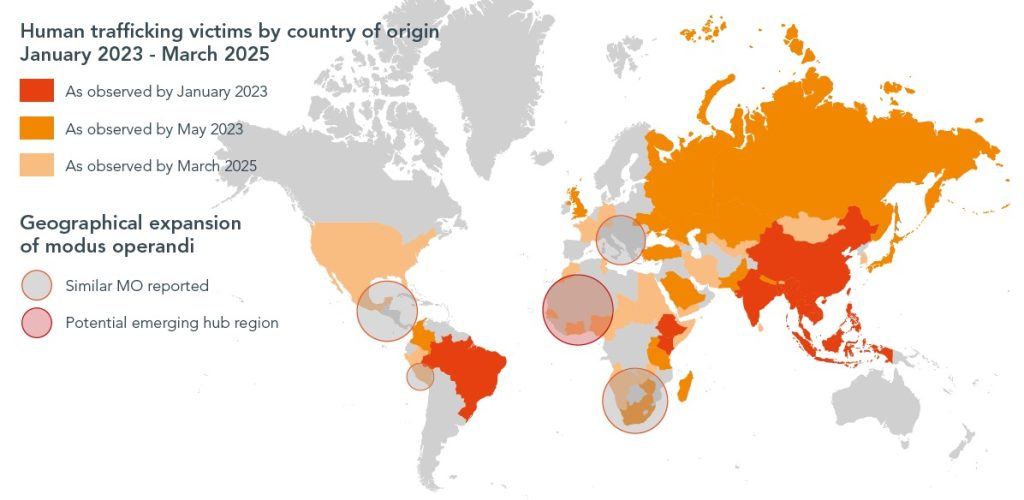
According to the UN press release, satellite imagery and on-ground reports show that nearly three-quarters of the scam operations are in the Mekong region, which have also spread to some Pacific Island countries and South Asia, as well as Gulf States, West Africa and the Americas.
“The treatment endured by individuals within the context of scam operations is alarming,” finds the report, based on interviews with survivors originating from Bangladesh, China, India, Myanmar, Sri Lanka, South Africa, Thailand, Vietnam and Zimbabwe. They had been trafficked into scam centres in Cambodia, Lao People’s Democratic Republic, Myanmar, the Philippines and the United Arab Emirates between 2021 and 2025.
Systematic abuse
Victims described being lured into scamming jobs under false pretences and then being coerced into perpetrating online fraud ranging from impersonation scams, online extortion, financial fraud as well as romantic scams.
The operations described are fluid, with some survivors sharing experiences of being held in immense compounds resembling self-contained towns, some over 500 acres in size, made up of heavily fortified multi-storey buildings with barbed wire-topped high walls, guarded by armed and uniformed security personnel.
“A victim from Sri Lanka related how those who failed to meet monthly scamming targets were subject to immersion in water containers, known as ‘water prisons’ for hours,” said the report, which updates a 2023 UN Human Rights report.
“Victims also recounted being forced to witness or even conduct grave abuse of others as a means to ensure compliance; one Bangladeshi victim said that he was ordered to beat other workers and a victim from Ghana recounted being forced to watch his friend being beaten in front of him.”
They told of people losing their lives as they attempted to escape, including falling from balconies and roofs in the compounds.
Failed rescue attempts were also punished severely, the report finds. One Vietnamese victim described how her sister was beaten, tasered and locked in a room with no food for seven days after her sister had tried to engineer her escape.
While most victims described receiving some wages, all those interviewed by UN Human Rights experienced a range of escalating deductions and none received the entirety of the promised salary. A Thai victim reported that they were ordered to meet steep scamming targets of some $9 500 per day to avoid fines, beatings, or even being “sold” to another compound with harsher conditions.
Call for action
“The litany of abuse is staggering and at the same time heart-breaking,” UN Human Rights Chief Volker Türk said. “Yet, rather than receiving protection, care and rehabilitation as well as the pathways to justice and redress to which they are entitled, victims too often face disbelief, stigmatisation and even further punishment.”
“Effective responses need to be centred in human rights law and standards. Crucially, that means explicitly recognising forced criminality within anti-trafficking laws and regulations and guaranteeing the non-punishment principle for victims of trafficking.”
“Victims of such abuses require coordinated timely, safe and effective rescue operations, respect for the principle of non-refoulement, as well as available support mechanisms to ensure torture and trauma rehabilitation and address risks of reprisals or re-trafficking.”



You must be logged in to post a comment.