
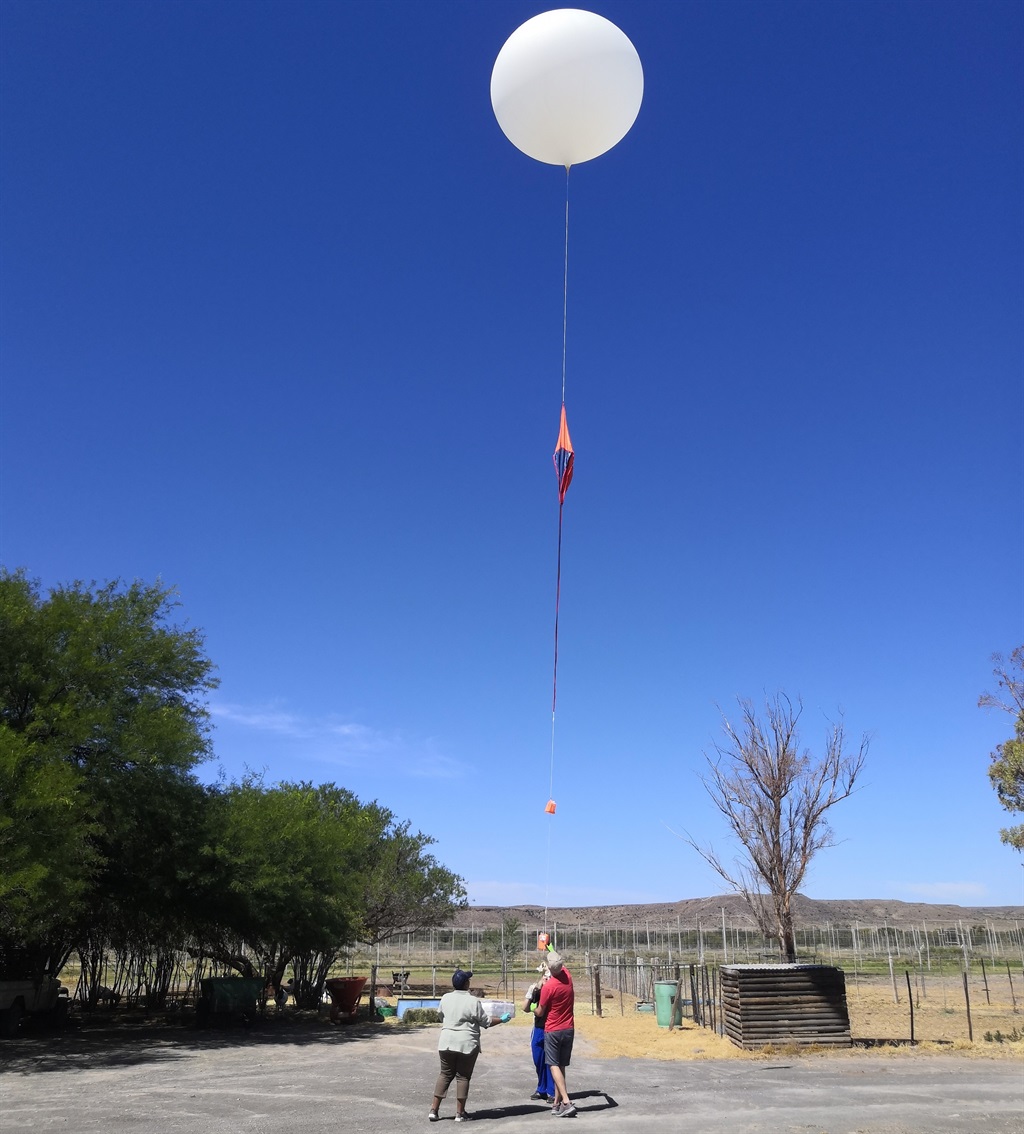
Scientists from the South African Weather Service (SAWS) and the German Research Centre Juelich are working together near Beaufort West in the Karoo to launch high-altitude balloons to measure the chemistry of the atmosphere, including pollutants.
These balloons can carry small measuring instruments up to an altitude of approximately 35 km, well above the range of aircraft, to investigate the atmosphere from the ground.
The challenges of such balloon launches are multifold as the latex balloon needs to be filled with enough helium to lift a 4kg instrument with a GPS tracker.
This balloon ascends to an altitude of 35km, while recording temperature, pressure, water content, methane, carbon dioxide and ozone amongst other things during the flight.
After bursting the team predicted where the parachute will drift to – finding out on which farmer’s land it has landed and trying to locate it on the farm. Very much a needle and haystack scenario.
Other challenges that have been experienced are sudden wind gusts breaking a balloon before it could even take off, and recovering the sensors after a particularly hard landing, all of which are time-critical during a thunderstorm.
Despite this, the first four launches have already provided valuable and precise information on the vertical distribution of the concentrations of water vapour, ozone, carbon dioxide, carbon monoxide, methane and many other trace gases which are gases in the atmosphere which have a small concentration with respect to oxygen and nitrogen.
The purpose of this project is to collect data about important pollutants and greenhouse gases in the atmosphere, which are extremely scarce in the southern hemisphere, especially at higher altitudes.
Normally, one has to rely on remote sensing instruments such as satellites, but even this sophisticated equipment requires independent verification, which is one of this project’s objectives.
The gases in question are of importance as they can absorb sun energy at these high altitudes, which influences surface weather. This is a new and exciting collaboration between the SAWS and the German Research Centre Juelich.
Some of the benefits of this collaboration include to further the team’s understanding of atmospheric processes; to improve satellite products by providing an independent point of comparison; and, in the longer term, to help improve long-term weather forecasts as well as projections of future climate change.
The SAWS looks forward to further collaboration and the incorporation of crucial information in its climate database.