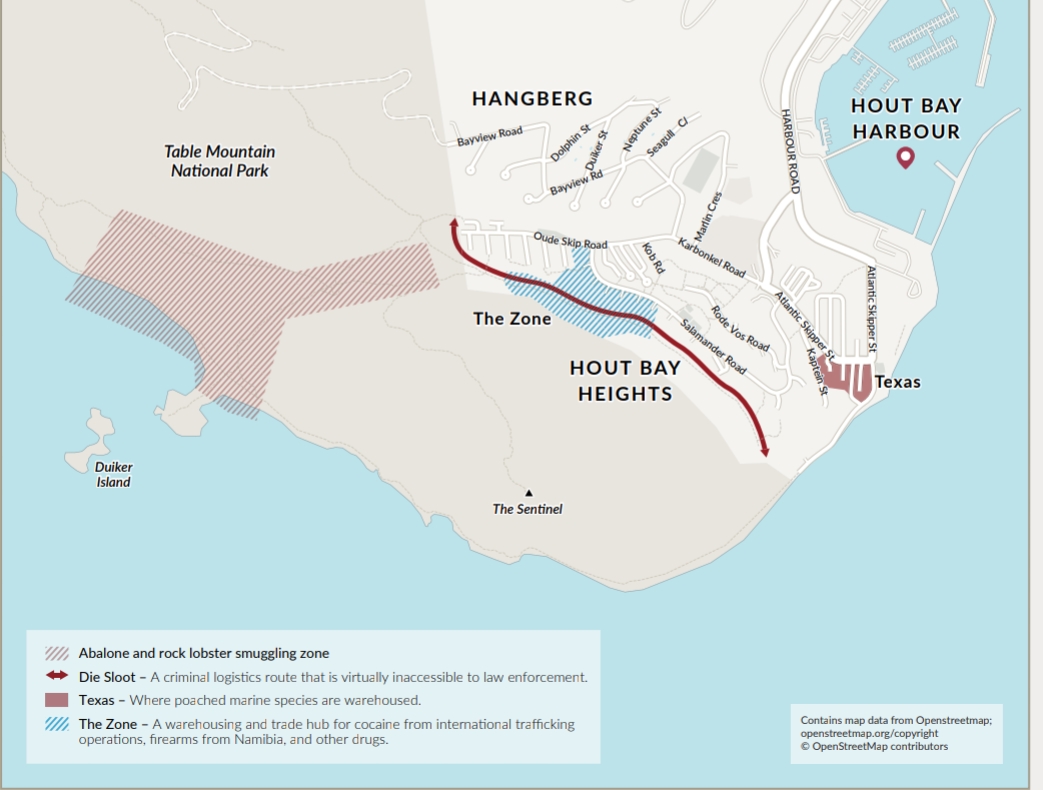
New intelligence has identified Hout Bay harbour as a key transshipment point for international cocaine, with alleged links to South American cartels, Balkan intermediaries and Namibian smuggling routes.
The findings appear in the Western Cape Gang Monitor, a quarterly publication by the Global Initiative Against Transnational Organised Crime (GI-TOC). GI-TOC is a Geneva-based research organisation. Its South Africa Observatory tracks gang dynamics in the province.
GI-TOC published the ninth issue in June 2026, covering the period March to May 2026.
According to GI-TOC, criminal groups operating in and around Hout Bay have “embedded themselves in harbour, fishing and poaching economies.” They use the working harbour as a logistics node for transnational drug flows.
Murder linked to missing cocaine
The most serious allegation concerns the 2024 killing of a local figure identified only as “Jaggers”.
GI-TOC researchers say “Jaggers” was kidnapped and killed after a cocaine consignment went missing in international waters off the Western Cape coast. The report alleges Colombian cartel involvement in the killing.
No arrests have been confirmed in connection with the case.
Poachers used to collect drugs at sea
The report describes a system in which abalone poachers operate illegally in waters around Hout Bay. Criminal groups allegedly use these poachers to collect cocaine consignments from vessels offshore. They move drugs ashore under cover of their poaching runs.
GI-TOC researchers refer to an internal scheduling system called the “Boksie system”. The report says this system allocates poaching slots among participants.
Smugglers primarily export illegal abalone from Western Cape waters to markets in East Asia, according to the report.
‘Parallel authority’ in Hangberg and Imizamo Yethu
Beyond the drug trade, GI-TOC says the gang at the centre of Hout Bay’s criminal economy has built what the report describes as a “parallel authority”. This gang finances community projects. It also runs extortion and protection rackets across Hangberg and Imizamo Yethu.
The report notes extortion arrests in the area as recently as April 2026.
GI-TOC also flags the recruitment of children into gang logistics as runners, lookouts and couriers. This deepens what it calls the communities’ economic dependence on illicit networks.
The Hout Bay findings form part of a broader picture. The report paints organised crime as outpacing state responses.
R823 million army deployment ‘minimal impact’
In March 2026, the government deployed the army to the Cape Flats in an operation valued at R823 million. GI-TOC says community sources report the deployment has had minimal durable effect on gang structures or violence.
The report argues enforcement-only approaches cannot succeed. It calls for intelligence-led investigations into gang leadership, finances, and firearm and drug supply chains. These investigations must coordinate across police, port authorities and fisheries officials.
“Progress should be measured by the weakening of gangs’ recruitment, income generation, territorial control and community support,” the report states. “Not by arrests and seizures alone.”
GI-TOC is calling for precision, multi-agency operations focused on Hout Bay’s harbour infrastructure. Without this, the organisation warns, the harbour’s role as a drug gateway will only deepen.
- The Western Cape Gang Monitor, Issue 9, is published by the Global Initiative Against Transnational Organised Crime. The full report is available at globalinitiative.net
ALSO READ: Cape Flats army deployment had limited impact, GI-TOC finds