

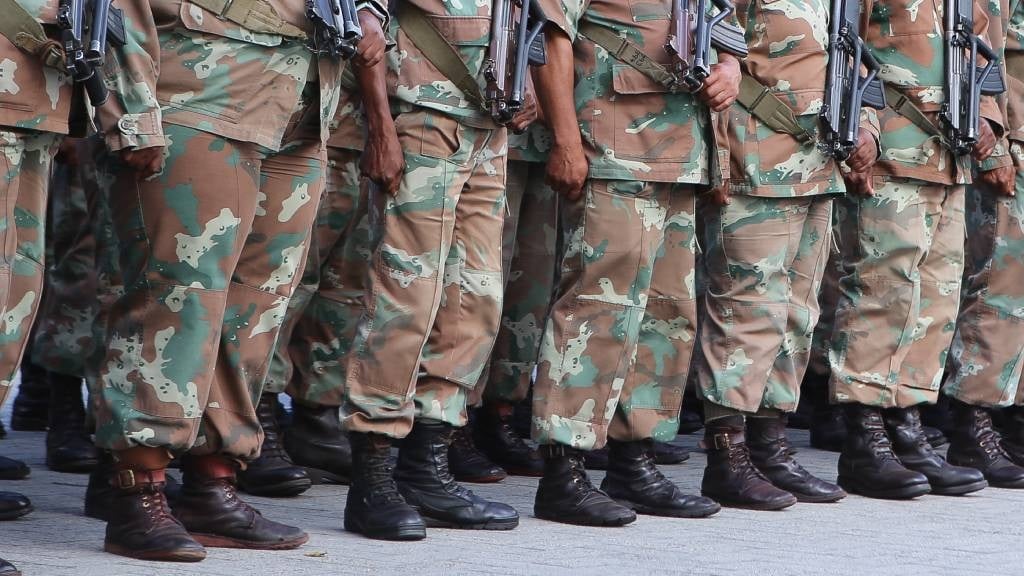
The army deployment to the Cape Flats in March produced “limited durable results” against gang activity, according to the latest Gang Monitor report.
The ninth issue of the Global Initiative Against Transnational Organized Crime (GI-TOC) report, which was published on 30 June, gives suggestions on what should be done instead.
According to the report, the army’s presence did bring about extra scrutiny on prostitution and sex trafficking and the issue also highlights gang dynamics and transnational criminal links that make the case for a different approach.
What the GI-TOC recommends
On the South African National Defence Force‘s deployment to the Cape Flats, the report argues that more targeted and sustained interventions are needed.
It recommends intelligence-led investigations that go beyond street-level enforcement to target gang leadership, financial flows and supply chains, including drugs, firearms and links to the harbour. It also calls for better coordination among police, fisheries authorities and port authorities.
Crucially, the report argues that progress should not be measured solely by arrests and seizures. Instead, success should be gauged by reductions in gangs’ ability to recruit members, earn illicit income, control territory and command community support.
Why the ground-level evidence matters
The report also addressed the structural conditions that sustain gang power. It found that when senior gang figures are killed, organisational structures often remain intact, supply lines survive and retaliation cycles continue.
It also documented the expansion of gang economies into sex trafficking and the deepening of transnational criminal logistics through nodes such as Hout Bay’s Hangberg area.
Gang succession: the death of Sanie American
Ighsaan ‘Sanie American’ Davids, described in the report as a senior figure and major drug supplier to one of Cape Town’s most prominent gangs, was shot in Kensington in April and died in May. Despite initial concern from the police’s Anti-Gang Unit about potential internal fragmentation, the monitor finds that the Americans’ internal structure remained intact after his death.
According to the GI-TOC monitor, the gang will remain under the control of the family with younger members taking on more prominent roles. It found that drug and firearm supply lines also remained in place, including weapons sourced from a relative in Durban.
A close friend of Davids told researchers: “That guy in Durban won’t trust anyone other than family.”
The report notes that two of Davids’s alleged killers were shot in Kensington one week after his death and that gang members in Kensington, Bonteheuwel, Hanover Park and Mitchells Plain are threatening further attacks on a rival gang in retaliation.
The succession shows what the GI-TOC report identifies as a central limitation of enforcement-only approaches: removing individuals from a gang’s hierarchy does not dismantle the networks, finances and family ties that hold the organisation together.
The cycle of retaliation
The monitor distinguishes between “blood debts”, obligations created by spilled blood, and “blood feuds”, which are rooted in kinship ties. The report said that failure to retaliate is seen within gang culture as an invitation to encroachment. Retaliation is both a strategic calculation and, the monitor notes, a matter of “honour”.
The Sabela term “Ghazie optel”, meaning “to pick up blood”, or to retaliate, reflects the cultural weight of these obligations. Sabela is a secret language used by the Number gangs, formed from a hybrid of Afrikaans, isiXhosa and isiZulu.
A community worker in Hanover Park told researchers: “They are priming him to take revenge.”
The report records a mass shooting in Goodwood in November last year, described as retaliation, in which two people were killed and two were injured. The assassination of Faghrie ‘Faghas’ Augustine in Maitland in January 2026 is another documented retaliation.
These patterns of retaliatory violence, the GI-TOC argues, will not be broken by temporary military presence. Its recommendations for intelligence-led investigations targeting gang leadership, and social interventions aimed at reducing recruitment, are presented as the longer-term alternative.
Sex trafficking and gang economies
The monitor also documents how drug trafficking, extortion and sex trafficking have become increasingly interconnected in the Western Cape’s gang economies. According to the report, Nigerian syndicates, complicit landlords and gang protection and taxation networks are all part of suburban sex-trafficking operations.
One landlord is alleged to own as many as 48 properties linked to these networks.
A gang member told researchers: “Anyone that works there must pay … the girls and the pimps as well.”
A sex worker described conditions in these networks: “The environment is brutal for women.”
Another sex worker, speaking under police protection, explained how traffickers use drug credit to bind victims: “They give them the drugs on book [on credit].”
Some sex workers earn approximately R1 500 a month, according to the monitor. Operations led by the Hawks freed roughly 25 victims across Brooklyn and Milnerton between May and June 2026. A specific operation in Milnerton on 24 June freed 15 victims; the rescued women were aged 21 to 26. One figure, known as “Boksie”, is described as controlling access to abalone poaching, permitting individuals to operate on a schedule and allegedly reporting those who poach outside their allotted period to the police.
ALSO READ: Gang Monitor says defections fuel Cape Flats violence