

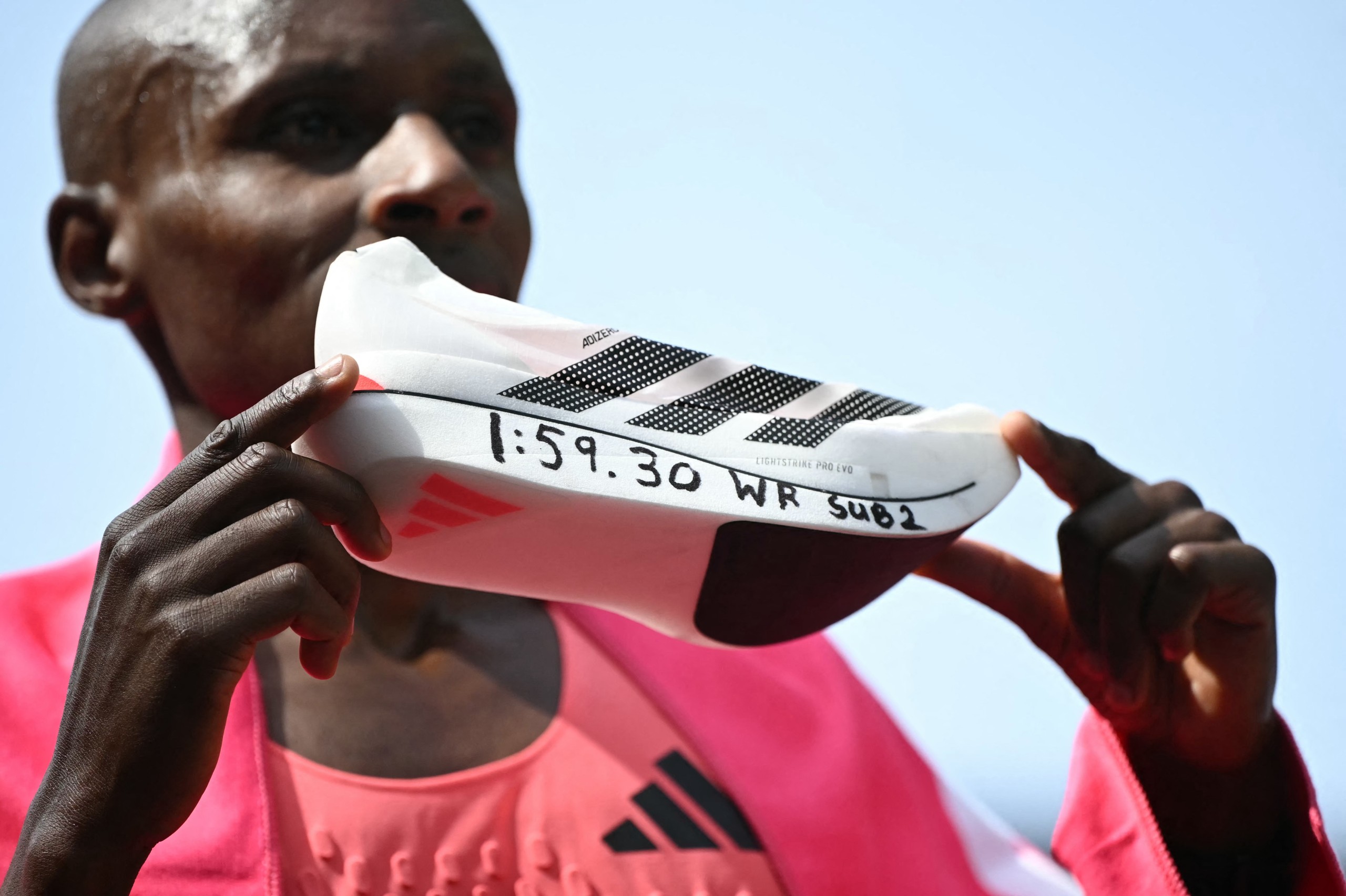
LONDON – Kenya’s Sabastian Sawe became the first man to run a marathon in under two hours in official competition, clocking 1:59:30 to win the London Marathon on Sunday 26 April.
The time improved by 65 seconds the previous world record of 2:00:35 set in Chicago in 2023 by Kelvin Kiptum, who died in 2024.
Sawe finished ahead of Ethiopia’s Yomif Kejelcha, who also ran the race under two hours.
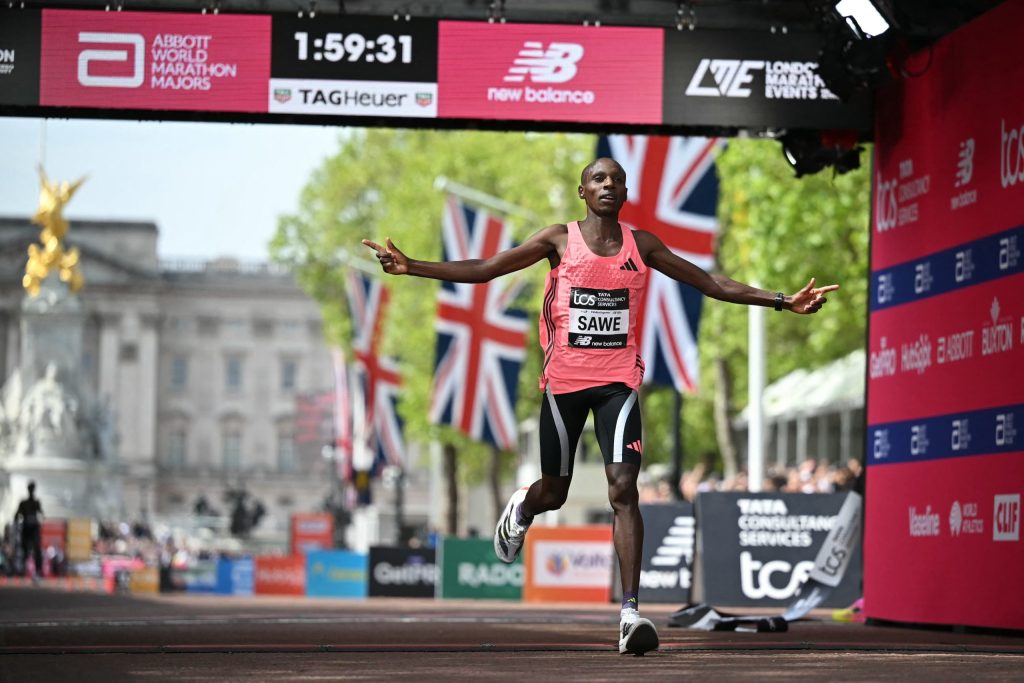
“The goalposts have literally just moved for marathon running and where you benchmark yourself as being world class,” said BBC pundit Paula Radcliffe, who held the women’s marathon record of 2:15:25 from 2003 to 2019.
“I did think that mark could be beaten, but not today. It is a lesson to everybody out there. We say don’t go out too fast and they went out smartly and paced it really well. Smart racing brought it to the line.”
The two-hour barrier has long been a goal of elite marathon runners, including Kenya’s Eliud Kipchoge.
In October 2019, Kipchoge ran 1:59:40 in Vienna, but the time was not ratified as a world record because he ran with specialised shoes, standard competition rules for pacing and fluids were not followed, and it was not an open event.
Kenyan dominance
Kenyan Paul Tergat’s time of 2:04:55 in the 2003 Berlin Marathon was the first ratified world record over the 42,2 km distance.
Ethiopian Haile Gebrselassie twice bettered that mark, both times in Berlin, running under 2:04:00.
The record then returned to Kenyan hands, first with Patrick Makau and then Wilson Kipsang and Dennis Kimetto setting new marks.
Kipchoge set new standards in Berlin in 2018 and 2022. Kiptum set the previous record a year later.
Kipchoge posted a photo of Sawe alongside one from his 2019 Vienna attempt on social media.
“Today is a historical day for marathon running,” Kipchoge said. “Breaking the sub-two-hour barrier in the marathon has long been a dream for runners everywhere, and today, you’ve made that dream come true.”
Seeing Sawe and Kejelcha both run under two hours was “proof that we are just at the beginning of what is possible when talent, progress and an unwavering belief in the human potential come together,” Kipchoge added.
‘Day to remember’
BBC commentator Steve Cram, a former world 1 500 m champion, noted that Sawe’s training only started properly in January after an injury.
“The question marks were still here and he had a great field against him,” said Cram. “Absolutely incredible, I’ve never seen anything like that. What a finish. You would say that is unbelievable but we’ve just seen it.”
Sawe said it was a day to remember. “To break the world record is something I have dreamed about for a long time, and to achieve it means so much to me and to the sport of running,” he said.
“It reflects the hard work behind the scenes, the support of my team and the role of innovation in helping me push beyond limits. I’m honoured to be part of a new chapter for the sport.”
ALSO READ: Steyn’s champion mindset powers historic title chase
Sawe has been an outspoken advocate of doping tests in Kenya.
The country worked to clean up its image after a string of doping scandals around the 2016 Rio Olympics led to the nation being declared non-compliant by the World Anti-Doping Agency (WADA).
More than 140 Kenyan runners, mainly long-distance athletes, have been sanctioned for drug offences since then.
Sawe called on the Kenyan government, Kenya’s Anti-Doping Agency and WADA to act.
“WADA would not make an issue on the doping failings in Kenya if everything was okay. I feel it is time we combat doping, which has been something like cancer, to save our nation,” Sawe previously told AFP.
Sawe has undergone frequent drug tests and was tested 25 times before competing in last year’s Berlin Marathon, according to the BBC.



You must be logged in to post a comment.