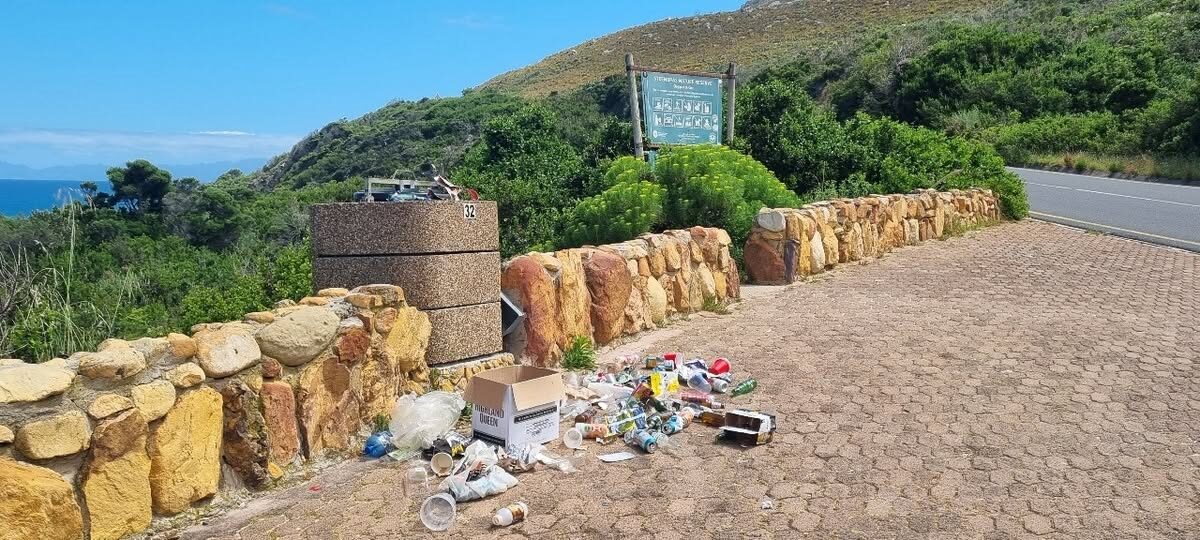

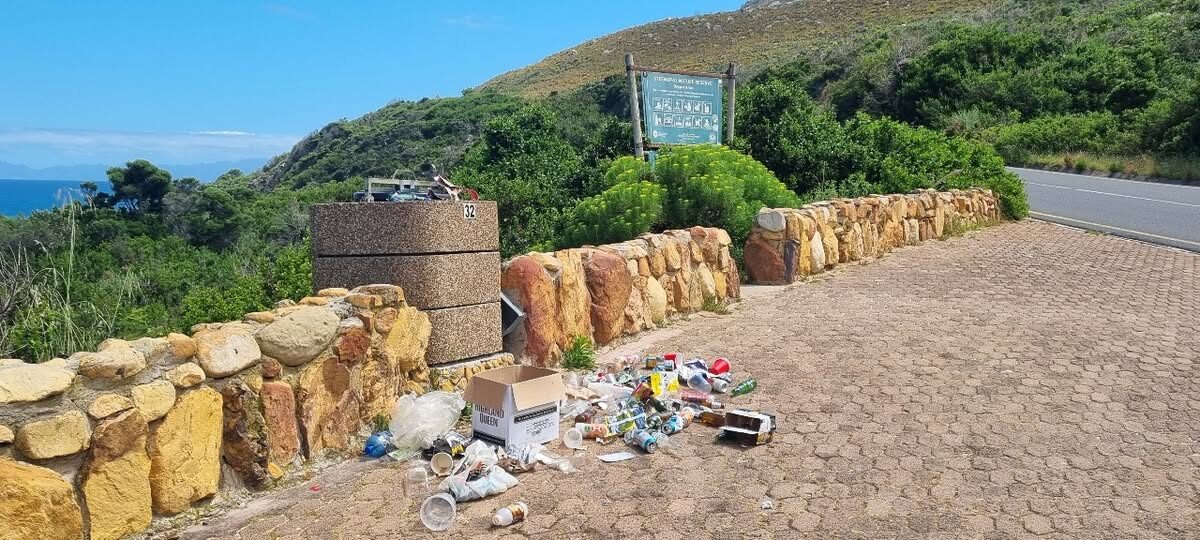
Provincial Minister for Infrastructure promised Clarence Drive’s baboon-resistant bins would be maintained and regularly emptied. Months later broken bins, overflowing rubbish and baboons remain on the road. Now the department says more frequent collections are unaffordable.
Earlier this year the Rooi Els Conservancy filed a complaint with Western Cape Infrastructure Minister Tertuis Simmers about ongoing problems with roadside bins along Clarence Drive between Gordon’s Bay and Rooi Els.
Then, an audit done in June found 23 bins either had broken or missing lids or defective and missing baboon catches. This after the minister publicly committed, in February, to assessing whether a different waste-management strategy was needed, saying “the immediate focus is to ensure that existing baboon-resistant bins are properly maintained and emptied regularly.”
The Conservancy had called for the bins to be removed entirely. However, following the minister’s commitment, a new road-maintenance contractor was appointed in April to work on the bins. But the problems remain.
“Bins continue to overflow,” the Conservancy pointed out, “litter continues to pollute the surrounding environment and baboons continue to feed from the bins and are regularly drawn onto the road.” It added that the baboons had even learnt to open some of the excising catches and none of the bins can be considered completely baboon-resistant.
More than just about bins and baboons
According to the Conservancy this is more than just about bins and baboons; it argued the bins could prove more detrimental to both motorists and humans, the baboons for various reasons.
It said “the bins are contributing to environmental pollution”, that baboons could become habituated to human food and that increased wildlife activity on the road would become a potential road-safety hazard.
To combat this the Conservancy listed demands it believed would be the “best long-term solution”.
These are:
– removing the bins and introducing appropriate “carry in, carry out” signage,
– increasing routine collections and adding more during weekends, public holidays and peak tourism periods,
– replacing broken and missing lids,
– installing effective baboon-proof mechanisms on all bins and
– completing the promised assessment of the bin infrastructure and broader waste-management strategy [while] implementing the resulting changes.”
Moreover, the Conservancy has asked that Simmers respond to its demands by Friday 21 August, to allow time for the response to be made public before local government elections on 4 November. And while awaiting response from the minister it has launched the OPPAD app “for road users to photograph and report broken or overflowing bins and wildlife attracted to waste.”
These reports will be “added to a map and photo wall” as evidence which will be used “to build pressure on the provincial government,” the Conservancy said.
“Everyone who uses Clarence Drive is encouraged to report bin-related issues they see along the route.”
The department responds
On 13 August the Department of Infrastructure responded to the formal complaint on baboons and waste management on Clarence Drive.
In response to baboon proofing it said it would install new lids and anti-baboon mechanisms. This would begin with 10 bins in August and subsequently the rest.
On waste collection it rejected the request for more frequent collections, citing affordability and its mandate.
Both responses left scepticism and disputes from the Conservancy.
First, the Conservancy was sceptical because the “the proposed mechanism appears very similar to the existing mechanism, which baboons have learnt to open.” Furthermore, it has called on the department to “demonstrate that the new design is genuinely an improvement and is effective and safe for baboons prior to installing them.”
Secondly, it has challenged the department’s response on waste collection. The Conservancy points out that the response “is not consistent with Minister Simmers’ February commitment to assess whether ‘additional or alternative bin infrastructure or a revised waste-management strategy’ was required”.
The Conservancy awaited the minister’s response to these objections and concerns.