
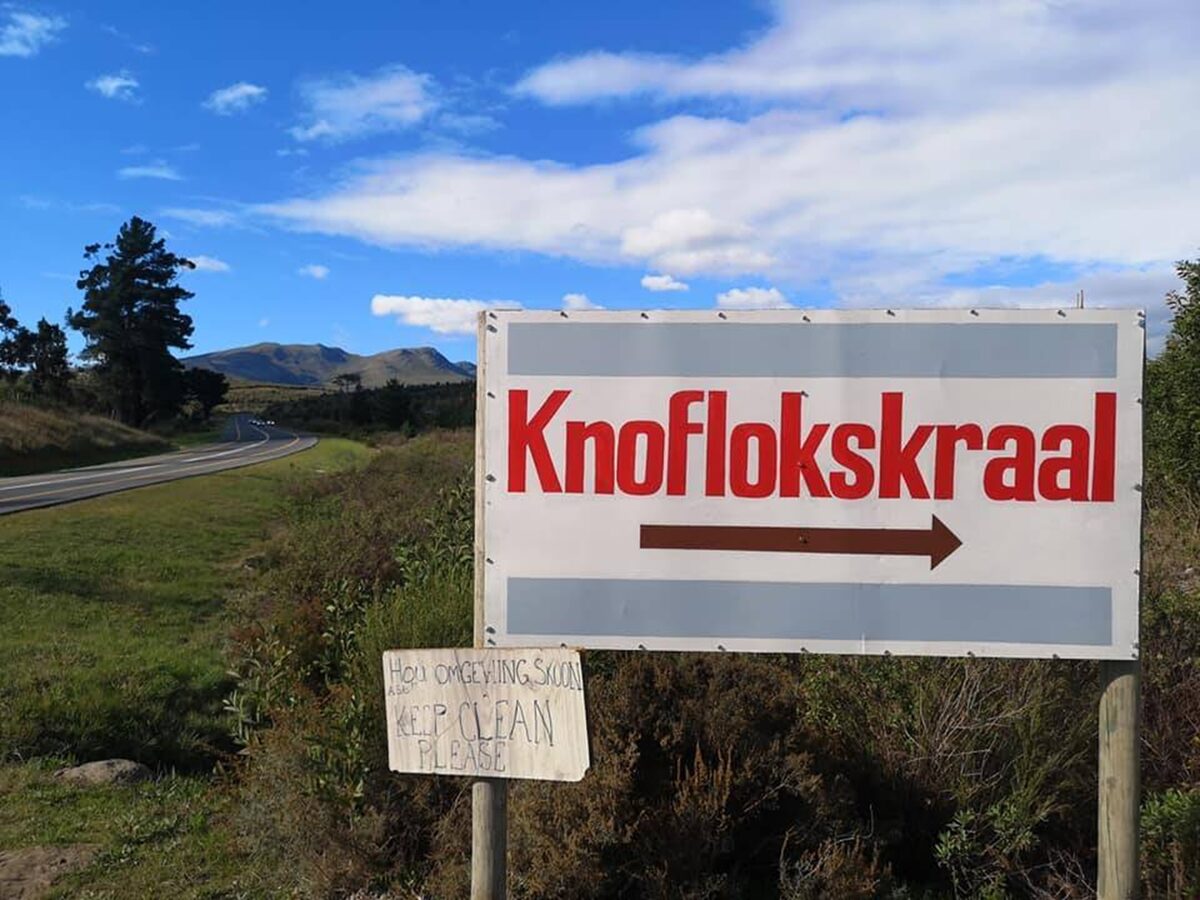
Four years after Parliament ordered that residents not be forcibly removed from Knoflokskraal, the future of the settlement is once again uncertain.
Years of engagement, existing court orders and attempts to contain the occupation have failed to stop the settlement’s expansion, prompting a new legal bid to prevent further development on state-owned land.
The Department of Public Works and Infrastructure (DPWI) is preparing an application to the Western Cape High Court to contain the occupation of approximately 2 000 hectares of state-owned land near Grabouw. This follows six months of investigations and unsuccessful attempts to reach an agreement with those living there.
The proposed court action has renewed questions about the community’s future, the government’s plans for the land, and how residents’ circumstances will be considered in resolving the dispute.
Thousands of structures have been erected since the first residents moved onto the property during the Covid-19 lockdown in late 2020.
Public Works and Infrastructure Minister Dean Macpherson said the department plans to submit its application on 19 October. It seeks to prevent further occupation, construction and unlawful land transactions across the six properties that make up the settlement.
How did Knoflokskraal reach this point?
The land was historically earmarked for forestry and economic development.
The first seven occupants arrived in November 2020, seeking to establish a self-sustaining Khoisan community. Residents cited ancestral connections to the land and economic hardship, and the occupation expanded rapidly.
According to the department, the number of structures grew from approximately 382 in May 2021 to 3 800 by February 2022, and to 4 880 by August 2022.
In 2021, the government obtained court orders to contain the occupation on three properties. Despite these measures, the settlement continued to grow. The provincial government confirmed there was no active, formal land claim over the property at the time.
In November 2022, Parliament’s Portfolio Committee on Forestry, Fisheries and the Environment resolved that the approximately 4 000 existing residents should not be forcibly removed. It also called for consultation with residents, better coordination between government departments and measures to address the community’s lack of basic services. The resolution sought to prevent further groups from joining the settlement while government worked towards a solution.
Why have previous efforts failed?
In August 2025, the Western Cape government convened an intergovernmental meeting involving national, provincial and local authorities and community representatives. A social facilitation process was proposed to establish residents’ circumstances and inform a lasting solution.
Discussions with the Knoflokskraal Community Task Team subsequently led to an in-principle agreement to establish a social compact in December 2025. According to the department, the agreement was ultimately rejected amid divisions between competing community leadership structures.
The department also encountered resistance during attempts in May 2026 to install containers at access points for community engagement and information-gathering. Authorities reported that a container was set alight, a security guardhouse was damaged and a security officer was assaulted. These incidents form part of the department’s account of why earlier interventions failed.
In June, whistleblowers reportedly provided information about an alleged system of subdividing and selling portions of state-owned land. The DPWI says plots were allegedly sold for approximately R1 500 each, and that it submitted a criminal complaint affidavit to police in July.
The government has also raised allegations of extortion, intimidation, illegal levies and organised criminal activity. These remain allegations and not established findings of guilt.
In April, Macpherson said he also wants to implement measures to restore law and order at Knoflokskraal. At a press conference, he cited allegations of drug-related activities, intimidation of emergency services, criminal syndicates and illegal land sales for as little as R1 500.
John Michels, former deputy mayor of Theewaterskloof and currently a Member of Parliament for the National Coloured Congress (NCC), said earlier this year that the party “strongly condemns the department’s shameful and inhumane conduct, in which vulnerable communities are subjected to apartheid-style tactics of intimidation, forced removals and state surveillance under the false pretext of ‘law and order’.”
The NCC has called for an immediate halt to removals and says it stands with the residents of Knoflokskraal.
What does the new court application seek?
The DPWI says it has spent more than R58 million on private tactical security between April 2021 and June 2026, and a further R5,47 million in sheriff’s fees related to court orders.Its new application seeks to prevent further expansion and construction, prohibit unlawful land transactions and allow an independent social facilitator to establish who lives at Knoflokskraal, when households arrived, and what socioeconomic vulnerabilities or cultural and heritage claims exist.
Macpherson says the immediate objective is containment, not eviction, and that affected residents should have an opportunity to present their cases before the court determines the way forward.
The central question is whether the proposed legal intervention can achieve what previous court orders and negotiations have not: stop the occupation from expanding while establishing a lawful and sustainable solution for those already living there.