

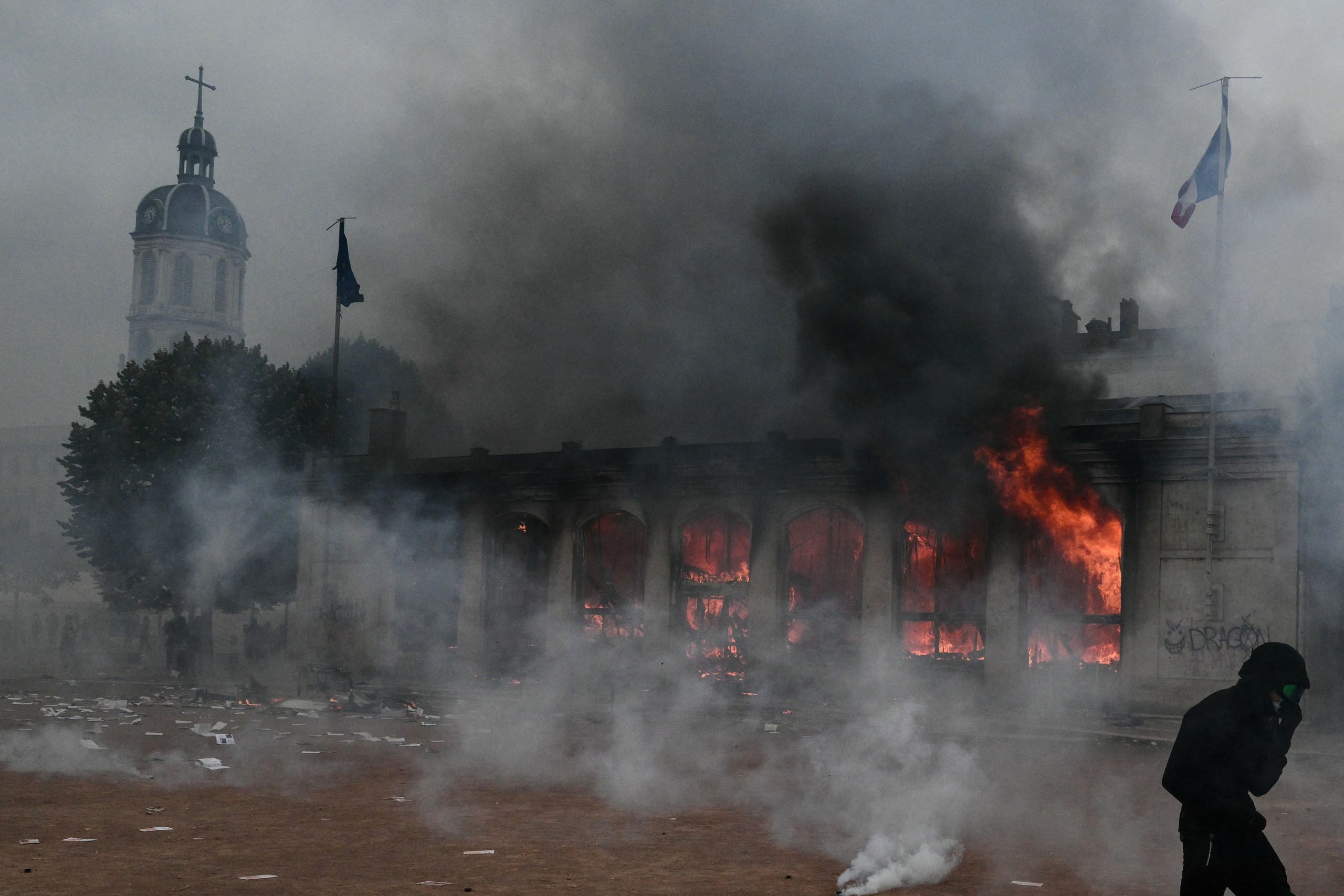
PARIS, FRANCE – Clashes broke out between police and protesters in cities across France on Saturday, 1 October, as tens of thousands of people took to the streets in some of the country’s most violent protests in years over rising costs and declining public services.
Some 272 people had been arrested by mid-afternoon after violent incidents involving hooded individuals, including in Paris, Marseille in the south, Rennes in the northwest, Toulouse in the southwest and Angers in the west, the Interior Ministry said.
“Such actions include attempted looting, confrontations with law enforcement, the setting of fires to street furniture and the targeting of seats of power and media outlets,” the ministry said, blaming the unrest on what it described as the “ultra-left”.
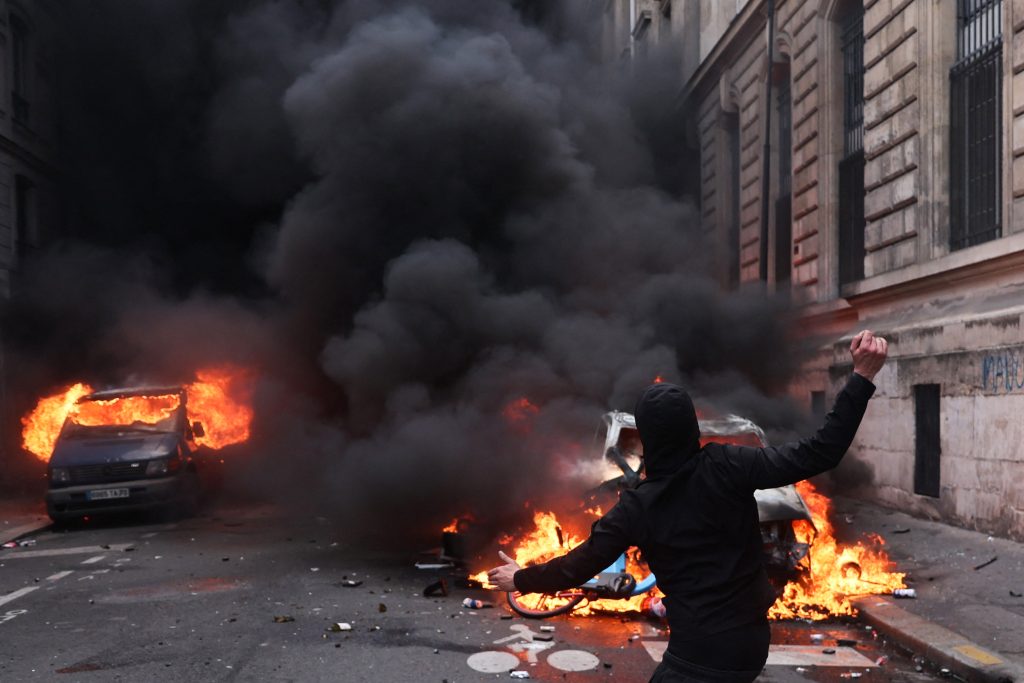
In Lyon, in east-central France, protesters set fire to a tourist office in a central square where groups of hooded youths threw projectiles and mortar fireworks at police, who responded with tear gas, dispersal grenades and a water cannon, an AFP reporter witnessed.
Protesters broke into the town hall of Marseille, France’s second-largest city, before being forced out by police. “We’re taking the Bastille,” one demonstrator shouted as masked protesters rammed the door of the mayor’s offices with security barriers, in reference to the 1789 storming of a fortress during the French Revolution. The mayor said the town hall had been vandalised and that additional police were being sent to the city following talks with the prime minister and interior minister.
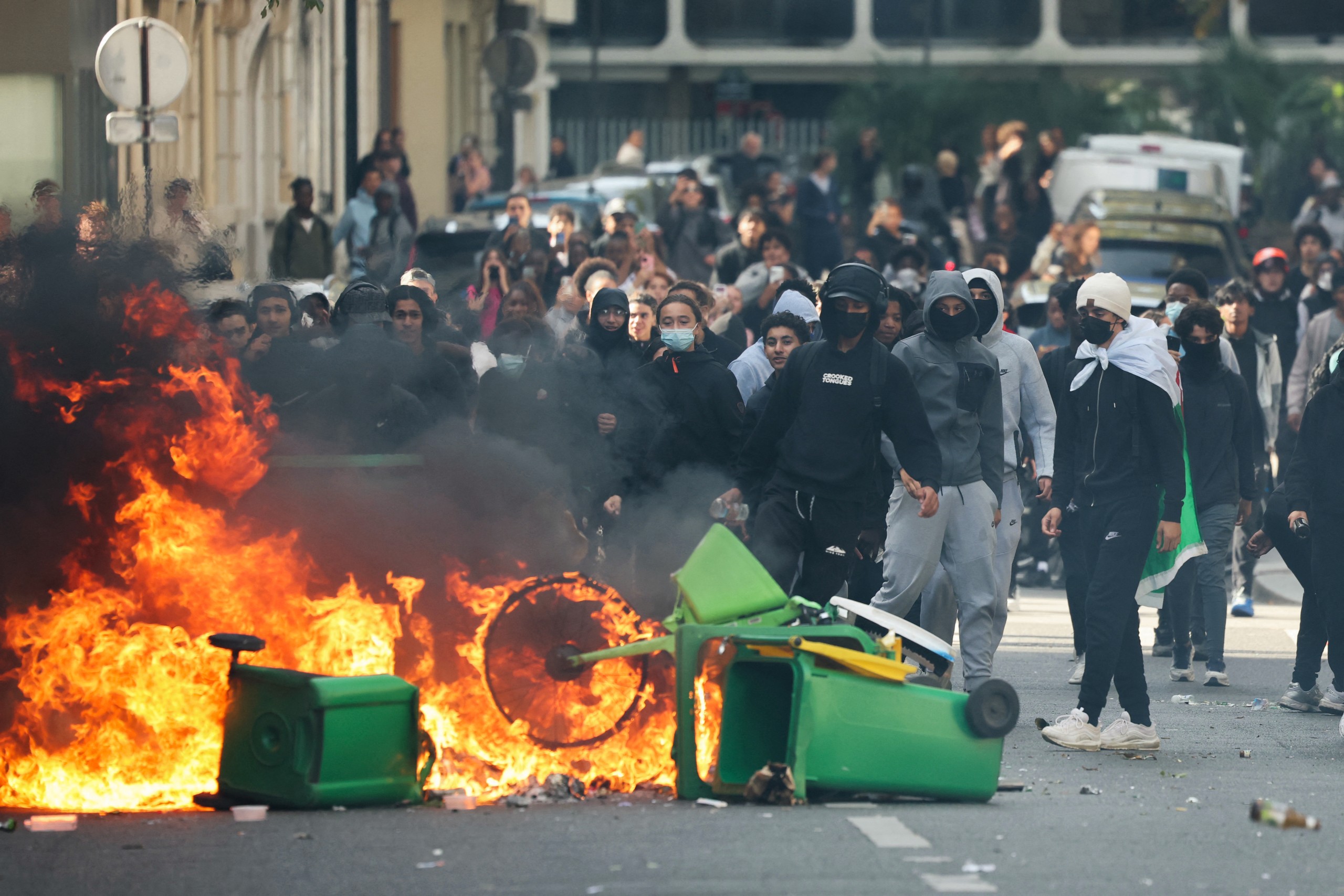
In Paris, police fired a water cannon and tear gas after hundreds of protesters, most wearing face masks and some setting off fireworks, confronted them at several locations. The offices of French broadcasters CNews and Europe 1 in western Paris had windows broken when protesters threw projectiles.
About 100 people walked towards the start of the protests shouting “All cops are bastards”, according to a Reuters witness.
A large police presence was visible in central Paris, especially near landmarks such as the Champs-Elysées and the Arc de Triomphe, which were excluded from the routes of two authorised demonstrations. Protesters in high-visibility vests blocked streets, recalling the Yellow Vest movement that marked President Emmanuel Macron’s previous term in office.
The protests began last month at high schools in Paris’ poor northern suburbs, where anger over teacher shortages and shabby facilities evolved into a broader movement focused on inequality, public spending and living standards.
“We are fighting because the cost of living is too harsh, because the price of fuel is too high, because high school pupils are being violently attacked and hurt all over the country just for trying to protest and ask for more teachers and decent learning conditions,” said Lola, a 19-year-old protester in Paris.
More than 32 000 protesters had taken part in some 140 actions nationwide outside Paris shortly after midday, a source at the interior ministry told AFP.
The country’s Yellow Vest movement, which emerged in 2018 in opposition to diesel taxes before expanding into a wider protest against living costs and inequality, had called for the “yellow and youth” demonstrations. The movement subsided after Macron announced billions of euros in tax cuts. Calls on social media for veterans of previous protest movements to join the demonstrations appeared to have broadened participation.
Yannick Maillou, a teacher from La Crèche in western France who participated in the Yellow Vest movement, said several gathering points had been organised locally for Saturday’s protests, with labour unions also encouraging participation.
Police response under scrutiny
Police tactics have drawn criticism following a series of injuries among demonstrators, including a teenager who lost a hand after picking up a stun grenade. Prime Minister Sebastien Lecornu said more than 900 police officers had also been injured in previous protests.
The police watchdog is investigating at least two dozen allegations of police violence. France suspended the use of stun grenades during the student demonstrations, but Interior Minister Laurent Nunez said they could be used on Saturday.
The protests are piling pressure on Macron’s government after weeks of student demonstrations that turned violent at times. The president, who urged calm on Friday evening, is entering the final stretch of his presidency amid a fragmented political landscape and growing pressure over the economy.
Around 45 per cent of French people are worried about the cost of living and inflation, according to a survey of 2 000 people published earlier this month. Purchasing power in France has dwindled since 2024, while the price of fuel has soared since the start of the US-Iran war earlier this year.
The eurozone’s second-largest economy is struggling to rein in its public debt, projected next year to reach more than 120 per cent of GDP – double the EU limit of 60 per cent. France’s efforts to reduce public debt have failed to reassure investors, pushing government borrowing costs to their highest levels in more than two decades.
France’s far-right and far-left parties have both seized upon the unrest. Far-right presidential candidate Marine Le Pen, who is eyeing her best chance at seizing power in next year’s vote, accused “rioters” of poisoning the protests.
“Looting, pillaging, attacking police – rioters have once again sullied the October 17 demonstrations over the cost of living,” she wrote on X, adding the protesters’ demands had been “hijacked by the far left.”
Jean-Luc Melenchon, leader of the far-left France Unbowed party, has backed the student protests and marched in one demonstration Tuesday supporting them.
Sources: AFP, Reuters
ALSO READ: Anti-immigration protesters target wrong people, Macassar leaders say


You must be logged in to post a comment.