

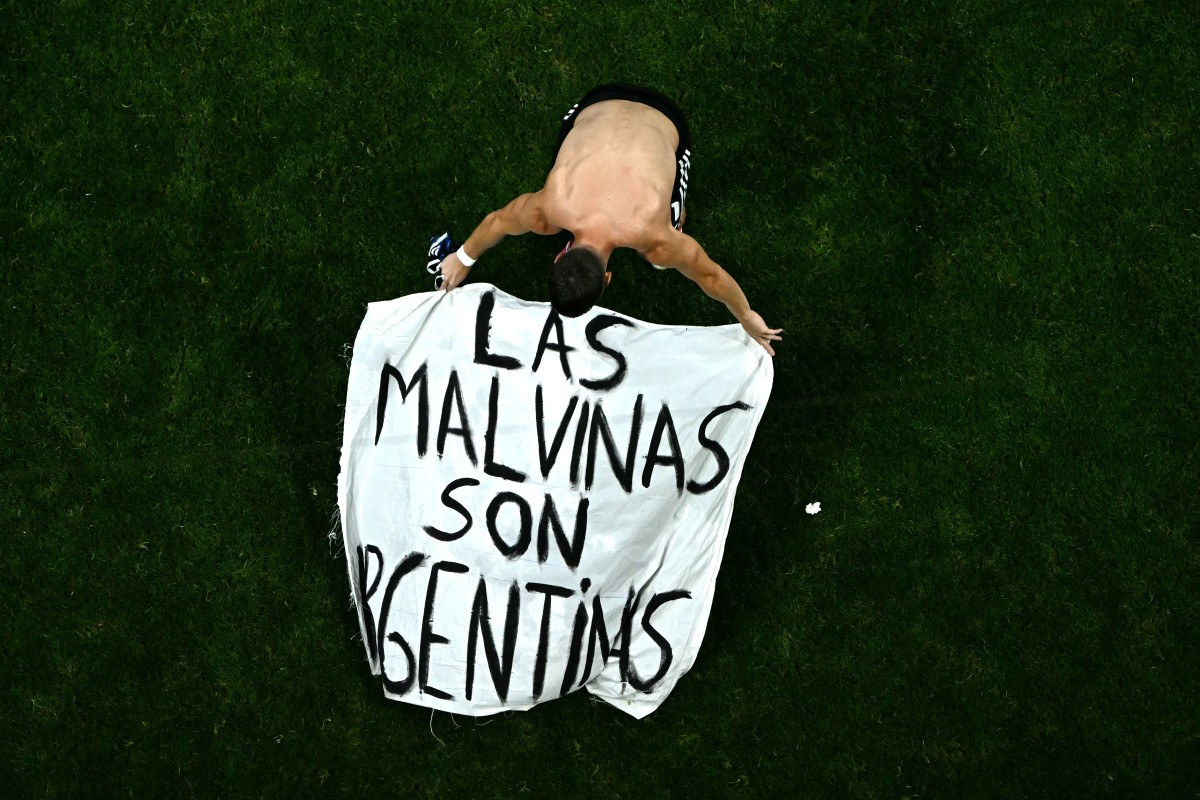
FIFA will assess match reports before deciding whether to sanction Argentina’s players for displaying a banner declaring “Las Malvinas son Argentinas” (The Falklands are Argentine) following their dramatic 2-1 World Cup semi-final victory over England in Atlanta on Wednesday evening. The politically-charged gesture has ignited a diplomatic firestorm between Buenos Aires and London, with British ministers demanding action whilst Argentina’s president defended the display as “perfectly valid and legitimate.”
The global governing body released a statement late Thursday confirming they were “assessing the match reports” after British Business Minister Peter Kyle branded the flag-waving an “egregious violation” of FIFA rules explicitly banning political symbols on the field of play.
“As is standard procedure, FIFA’s independent disciplinary committee is currently assessing the match reports and considering the relevant circumstances before deciding on potential further steps based on the FIFA disciplinary code,” the statement declared, stopping short of confirming immediate sanctions.
British government demands FIFA action
Prime Minister Keir Starmer’s Downing Street office backed Kyle’s calls for disciplinary measures, delivering a pointed message that mixed sporting disappointment with territorial determination. “The World Cup might not be ours, but the Falkland Islands definitely are,” a Downing Street spokesperson stated, drawing a clear line between football rivalry and sovereignty disputes.
Kyle elaborated on the British position during a BBC television interview, emphasising the fundamental principle that sport and politics should remain separate spheres. “Politics needs to be separate from football. In fact, the World Cup has one of its central tenets that politics is separate from football,” he insisted.
Precedent exists for FIFA sanctions
This isn’t Argentina’s first offence regarding Falklands messaging at FIFA-sanctioned events. The Argentinian Football Association was fined £20,000 (about R442 800) in 2014 after players posed before a banner carrying the identical message ahead of a friendly against Slovenia. FIFA ruled the gesture breached regulations on “political action” and team misconduct, establishing precedent that could inform their decision-making process regarding Wednesday’s incident.
Historical wounds reopened
The Falkland Islands sovereignty dispute dates to Britain’s 19th-century occupation of the South Atlantic archipelago, which Argentina claims as rightful territory. The conflict exploded into military confrontation in 1982 when Argentina invaded the British Overseas Territory, prompting then-Prime Minister Margaret Thatcher to dispatch a naval taskforce that reclaimed the islands after a brief but bloody war claiming 649 Argentine and 255 British lives.
Argentina’s president defends players
Argentine President Javier Milei robustly defended his nation’s footballers, characterising the banner display as an expression of deeply-held national sentiment. “It’s a feeling that exists within all Argentines,” Milei told El Observador radio station. “The Malvinas are Argentine, we’re going to recover them, and we will do it through diplomatic means.”
Vice President Victoria Villarruel had already inflamed tensions before kick-off by branding the English “usurping pirates”, inflammatory rhetoric that set the stage for Wednesday’s politically-charged celebrations.
Diplomatic fallout extends beyond football
The controversy has spilled beyond sporting circles into active diplomatic confrontation. After the match, Argentina’s Foreign Minister Pablo Quirno filed a formal protest over British warship HMS Medway’s presence near the Falkland Islands, voicing on X “the strongest rejection” of what Buenos Aires characterised as the vessel’s “unconsulted and illegal” passage through Argentine territorial waters.
FIFA faces delicate balancing act
FIFA now confronts a delicate balancing act between enforcing regulations designed to keep politics separate from football and navigating the sensitivities of a sovereignty dispute that remains profoundly emotional for both nations. The 2014 precedent suggests sanctions are likely, but the scale and nature of punishment will be scrutinised by both governments as carrying wider diplomatic implications.
Argentina’s progression to Sunday’s final against Spain ensures the controversy will linger throughout the tournament’s climax, with global attention focused on whether FIFA demonstrates the courage to sanction one of football’s superpowers on the eve of their biggest match.

