TEXAS, US – Tesla CEO Elon Musk has unveiled a redesigned Roadster sports car equipped with rocket thrusters that can briefly leave the ground – but industry experts and regulators are raising serious doubts about whether the vehicle will ever become a practical reality.
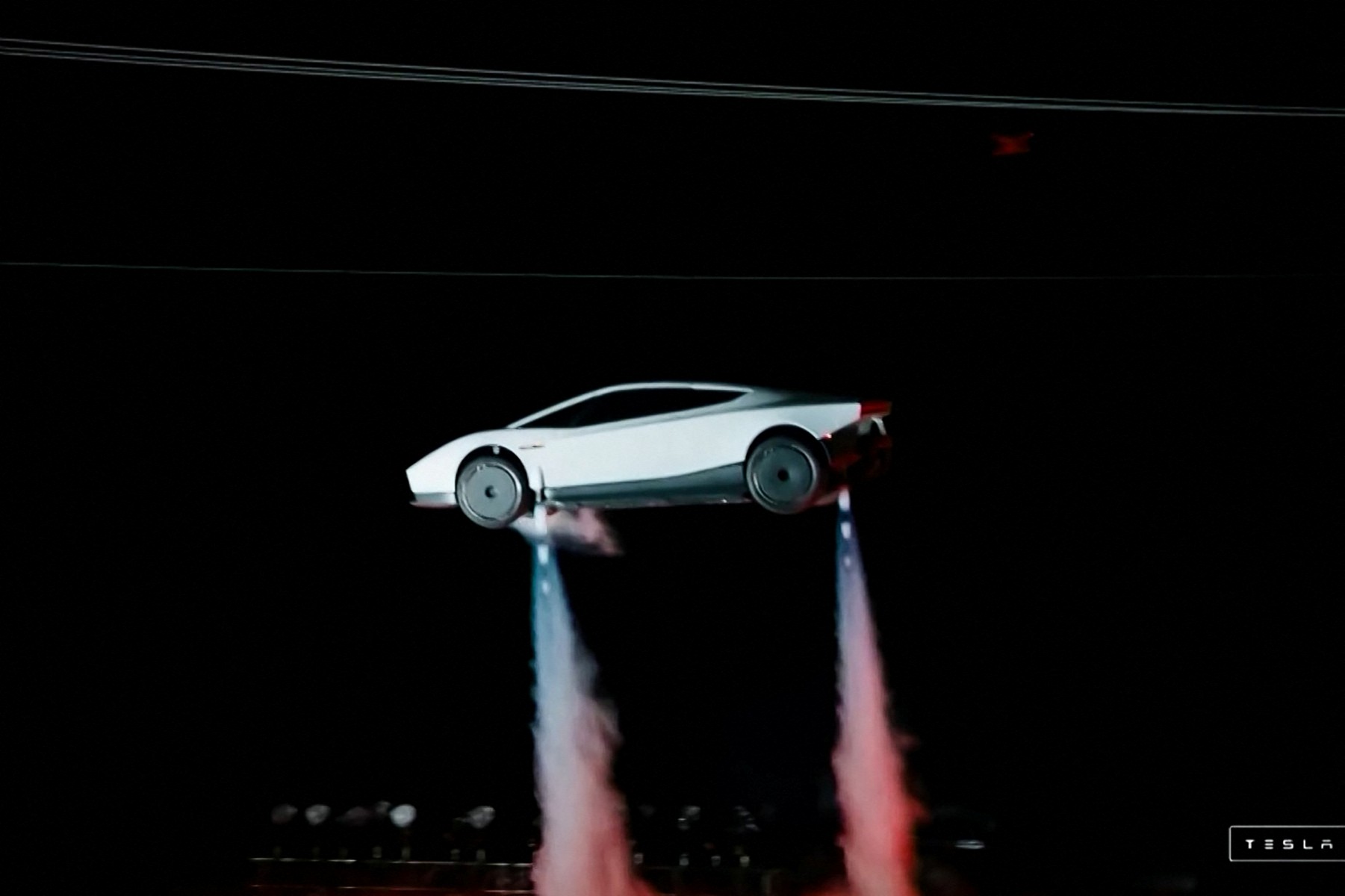
During a livestreamed demonstration at SpaceX’s McGregor facility in Texas on Thursday 15 October, a remotely operated Roadster prototype performed dramatic aerial stunts, jumping over a line of Tesla vehicles while rotating in mid-air.
“This can basically fly like a rocket,” Musk told viewers, describing the vehicle’s SpaceX-developed cold-gas thruster system. The demonstration showed the car using approximately 600 litres of compressed air stored in carbon-fibre tanks, firing through 10 directional nozzles to achieve brief controlled flight.
But the spectacle has drawn sharp criticism from aviation experts and automotive analysts who say the technology faces insurmountable regulatory, safety and practical hurdles.
‘Charlie and the Chocolate Factory stuff’
Matthias Schmidt, an independent automotive analyst, dismissed the project as “Charlie and the Chocolate Factory stuff that will never see the light of day”, characterising it as a marketing stunt rather than a viable product.
Michael Thompson, CEO of flying car company Skyfly, was equally scathing. “This is a stunt,” Thompson said. “The technology does not materially advance practical flying cars.”
Thompson explained that compressed-gas thrusters can provide precise control for only seconds before the gas is exhausted, making sustained flight impossible. “Once the gas is gone, there is no continuing thrust,” he said.
The demonstration itself raised red flags. Musk acknowledged the vehicle was left unmanned “to make sure we don’t kill anyone” – hardly a ringing endorsement of its safety credentials.
“This is not necessarily a safety-optimised car,” Musk admitted during the event, adding that it would “be an actual car that’s on the roads” despite regulatory uncertainty.
“I’m not sure it’s necessarily legal in all jurisdictions, but there will be such a car that someone can own,” he said.
The engineering impossibility
Industry experts point to fundamental engineering contradictions that make road-legal flying cars extremely difficult to achieve.
Road cars must be heavily built to withstand crashes and rough surfaces, while aircraft must be as light as possible to achieve efficient flight. Combining both requirements in a single vehicle presents enormous technical challenges.
Battery energy density poses another major obstacle. The European Union Aviation Safety Agency has identified heavy batteries as a critical barrier for electric aviation, as they reduce useful payload and flight range.
Tesla’s own specifications reveal significant compromises. The Roadster’s advertised range has dropped from roughly 620 miles in earlier announcements to “more than 300 miles” for the latest version. The Rocket configuration – the only version with full thruster capability – is single-seat only, with the passenger seat sacrificed to accommodate the thruster system.
Regulatory black hole
The legal status of Tesla’s flying Roadster remains deeply unclear, with both aviation and road-safety regulators seemingly uncertain about jurisdiction.
The US Federal Aviation Administration told CBS News and Politico that Tesla’s vehicle does not meet the FAA’s definition of an aircraft, meaning the agency does not currently treat it as requiring conventional airworthiness certification.
But that does not make flight automatically legal.
Aviation expert Michael McCormick said a vehicle weighing more than about 250 pounds (approximately 113.4 kilograms) that operates in the air would normally face FAA approval and national airspace requirements, while a standard driver’s licence would likely be insufficient to operate it.
Scott Miller of San José State University warned that leaving the ground creates “a whole set of regulatory issues”. State and local rules may govern where the vehicle can take off and land, with many jurisdictions requiring aircraft to use airports or designated helipads.
Tesla’s own website acknowledges these problems, describing the Rocket version as “not approved for public road use” and available by invitation only.
Purpose-built electric vertical take-off and landing aircraft from established manufacturers have spent years working through FAA certification processes. NASA research has identified numerous safety requirements including crash prevention, occupant protection in the event of power failure, emergency landing capability, weather handling, noise management and airspace integration.
The U.S. Government Accountability Office has emphasised that the advanced air mobility industry must demonstrate that aircraft are safe, reliable and quiet, and that operations are acceptable to the public.
Show car or real product?
Tesla says the Roadster will begin production in 2028 – eight years after the original 2020 delivery promise for the second-generation model first shown in 2017.
The company is accepting reservations requiring deposits of around R823 755 ($50,000 ) for the standard Performance version and R4 118 775 ($250,000) for the Thrust version with limited thruster capability. The full-capability Rocket version is invite-only with no disclosed price.
But the demonstration left critical questions unanswered. Tesla has not disclosed flight duration, maximum altitude, operating range with thrusters active, or how the vehicle would handle system failures while airborne with passengers aboard.
The Verge’s assessment was blunt: the demonstration was visually impressive, but the Roadster is unlikely to become a vehicle that an ordinary buyer could realistically own, park, land and operate legally.
What Tesla claims
Despite the scepticism, Tesla is marketing three versions of the Roadster:
- Performance (“Road Ready”): two seats, active aerodynamics, claimed acceleration of 0-100 km/h in under 1,6 seconds, range above 483 km.
- Thrust (“Race Ready”): two seats plus rear cold-gas thrusters, claimed 0-100 km/h in under 0,9 seconds.
- Rocket (“Air Ready”): single-seat, perimeter-mounted thrusters enabling brief aerial manoeuvres, not approved for public road use.
The company claims the vehicle can exceed 370 km/h and demonstrated acceleration of approximately 0,81 seconds from 0-100 km/h during the event.
Whether any version will actually reach customers in 2028 – or ever – remains an open question that even Musk himself seems unable to answer with certainty.
SOURCES: Fortune; The Independent; WIRED; The Verge; CBS News; POLITICO; Federal Aviation Administration (FAA).
ALSO READ: France accuses Musk of ‘online harassment’ of European leaders