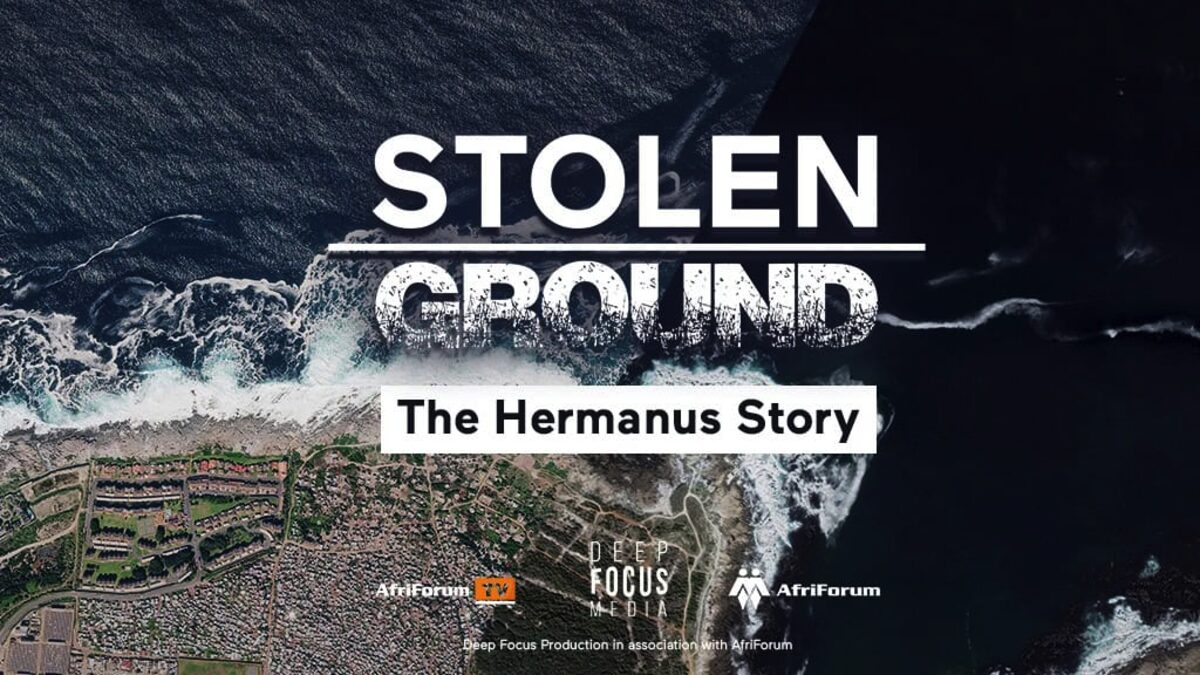
On the eve of the release of the documentary film about the 2018 unrest in Hermanus, Stolen Ground: The Hermanus Story, the leader of the Land Party is demanding that his contributions can not longer be used.
Gcobani Ndzongana, Chief Leader of the Land Party stated in a letter that after the initial request to interview him, he conducted an investigation into the film maker, his links and his associates.
“I discovered that your views are aligned with right-wing groups in South Africa, including AfriForum. Although I became reluctant to participate, I proceeded with the interview on the understanding that you would voluntarily disclose any association with AfriForum, given my well-known and strong opposition to that organisation. AfriForum and I have a long-standing adversarial relationship, which I have never concealed,” Ndzongana said.
“Even while I was criticising AfriForum on camera, you did not have the courage to disclose that DeepFocus Media is associated with AfriForum. This demonstrates that the interview was conducted in bad faith. You knowingly failed to disclose your relationship with AfriForum, aware that I would have refused to participate had I known. I therefore formally notify you that if you include my interview, my image, my voice, or any of my views in the documentary (or any related production), I will seek legal recourse.”
Land occupation
This film by Joe Emilio’s Deep Focus, is going to be hosted by AfriForum and reignites the debate over Schulphoek land occupation and the milkwood forest.
Stolen Ground: The Hermanus Story, is set to premiere tomorrow night, 29 October, at the AfriForum Teater in Pretoria. The film revisits the events that tore through Zwelihle and the broader Hermanus community eight years ago, when residents demanding housing and services clashed with police, occupied vacant land, and set a satellite police station alight.
The documentary is the second installment in the Stolen Ground series, produced by filmmaker Joe Emilio through his production company Deep Focus (also referred to as DeepFocus Media). The first film, Stolen Ground: The Tygerberg Raceway Story, examined the 2020 occupation and destruction of a raceway in Kraaifontein and reportedly reached more than 200 000 viewers. A BackaBuddy crowdfunding campaign for the sequel set a goal of R400 000 to fund the investigation into land invasions in both Hermanus and Grabouw.
Emilio hosts the YouTube channel “NewsFlash w/ Joe Emilio”, where the official trailer for the Hermanus documentary was published on 26 October. The trailer describes 2018 as the year when “violent protests, political turmoil and a controversial land invasion” changed the coastal town forever.
AfriForum’s role and allegations
AfriForum announced the premiere on 14 October, framing the documentary as an investigation into how “a protected milkwood forest in Hermanus became the site of a massive land grab”. The promotional material alleges that behind the destruction of Schulphoek lies “a tangled web of political interests, intimidation, manipulation and allegations of blackmail”, calling it “a story of failed leadership, political opportunism and the hidden forces that shaped the fate of an entire community”.
The Overstrand Municipality has described the current Schulphoek project as a formal, regulated housing-development and environmental-authorisation process, and has said that “no final decisions have been made”.
AfriForum’s involvement in the Hermanus land dispute, however, predates the documentary. In March 2018, when the first wave of protests erupted after residents marked out plots on vacant land near Zwelihle, the organisation’s Overstrand branch approached the South African Human Rights Commission to act as intermediary, saying communication between the municipality and residents had broken down and that government had promised Zwelihle housing as far back as 2005.
Small group
By July 2018, when a second wave of unrest was triggered by the erection of a fence between Zwelihle and Sandbaai – seen by residents as segregating the predominantly black township from wealthier, mostly white areas – AfriForum’s Thomas van Dalen, Training Manager for Community Safety and a Hermanus resident, issued a blunt assessment.
“The situation in Hermanus is a clear attempt by a small radical group to destabilise the political situation in Hermanus – and eventually the whole of the Western Cape,” Van Dalen said. “It is unacceptable that a small group of radicals keep the 35 000 residents in Zwelihle hostage. It is time for the community of Zwelihle to stand up, isolate the rioters and take back control of their residential area. The solution does not lie with the politicians or the police, but with the community itself.”
At the time, AfriForum identified the “radical group” as approximately 200 supporters of Ndzongana, describing him as an employee of the Department of Correctional Services. The organisation deployed neighbourhood-watch members in nearby suburbs to assist police and prevent rioters from entering those areas. Elmarie van Dalen the chairperson of the Overstrand branch of AfriForum in 2018 said the neighbourhood watches were “of much help to the police and proof of the value that well-trained, organised neighbourhood watches can add in these situations”.
Ndzongana was the most prominent leader of Zwelihle Renewal, a community organisation that emerged during the 2018 protests and was described by the Daily Maverick as an unelected but locally influential leadership structure. He later became leader of the Land Party and has been described as a co-founder of the EFF in the Western Cape.
ALSO READ: No riots planned by ZR
In March 2018, Ndzongana called for a march to the Hermanus Magistrates’ Court demanding the release of arrested protesters, writing on the Zwelihle Renewal Facebook page: “demand the release of those who are arrested” and “It’s all shut down no work for your safety.”
When a fence was erected between Zwelihle and Sandbaai in July, Ndzongana allegedly called for its removal. He was arrested on 11 July 2018, accused of incitement and malicious damage to property after allegedly joining roughly 500 residents in tearing down the fence. His bail was denied on 27 July, with the magistrate acknowledging his role as a community leader but saying leadership had to be exercised lawfully.
The 2018 events: A brief timeline
The documentary covers a period that began on 22 March 2018, when residents of Zwelihle marked out plots on three vacant sites, including land near Schulphoek Road, demanding that the Overstrand Municipality provide water, sewerage and electricity. After the municipality refused and structures were removed, protests escalated into violent unrest, with damage to the Zwelihle satellite police station and library, the burning of a municipal worker’s house, blocked roads and 26 arrests for public violence.
The principal target was the approximately 48-hectare Schulphoek site, which residents considered suitable for housing but which had been sold to a developer for a luxury development in 2010. Under pressure, the developers sold the land back to the municipality in May 2018.
The site is also home to a protected milkwood forest – a vegetation type classified as endangered under the Overstrand Environmental Management Framework. A 2018 report warned that housing development could require a new environmental-impact study, a process estimated to take up to three years. As of May 2026, the Overstrand Municipality said the project was still proceeding through the regulated environmental-authorisation process.
For many Hermanus residents, the events of 2018 remain raw. The documentary’s arrival, eight years later, ensures that the debate over land, housing, environmental protection and political accountability in the town is far from over.
- AfriForum Teater confirmed that they are going ahead with the premiere tomorrow night.