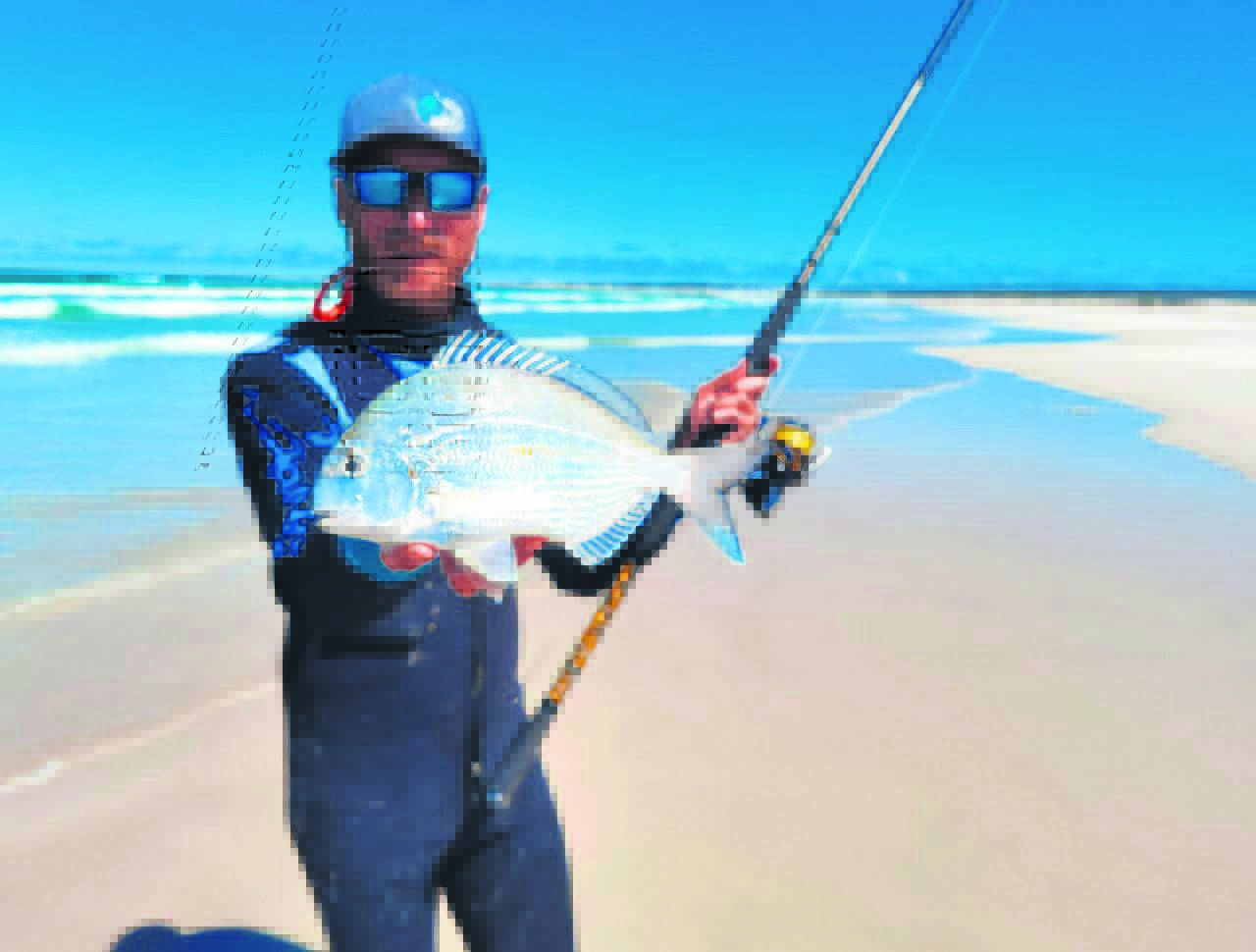

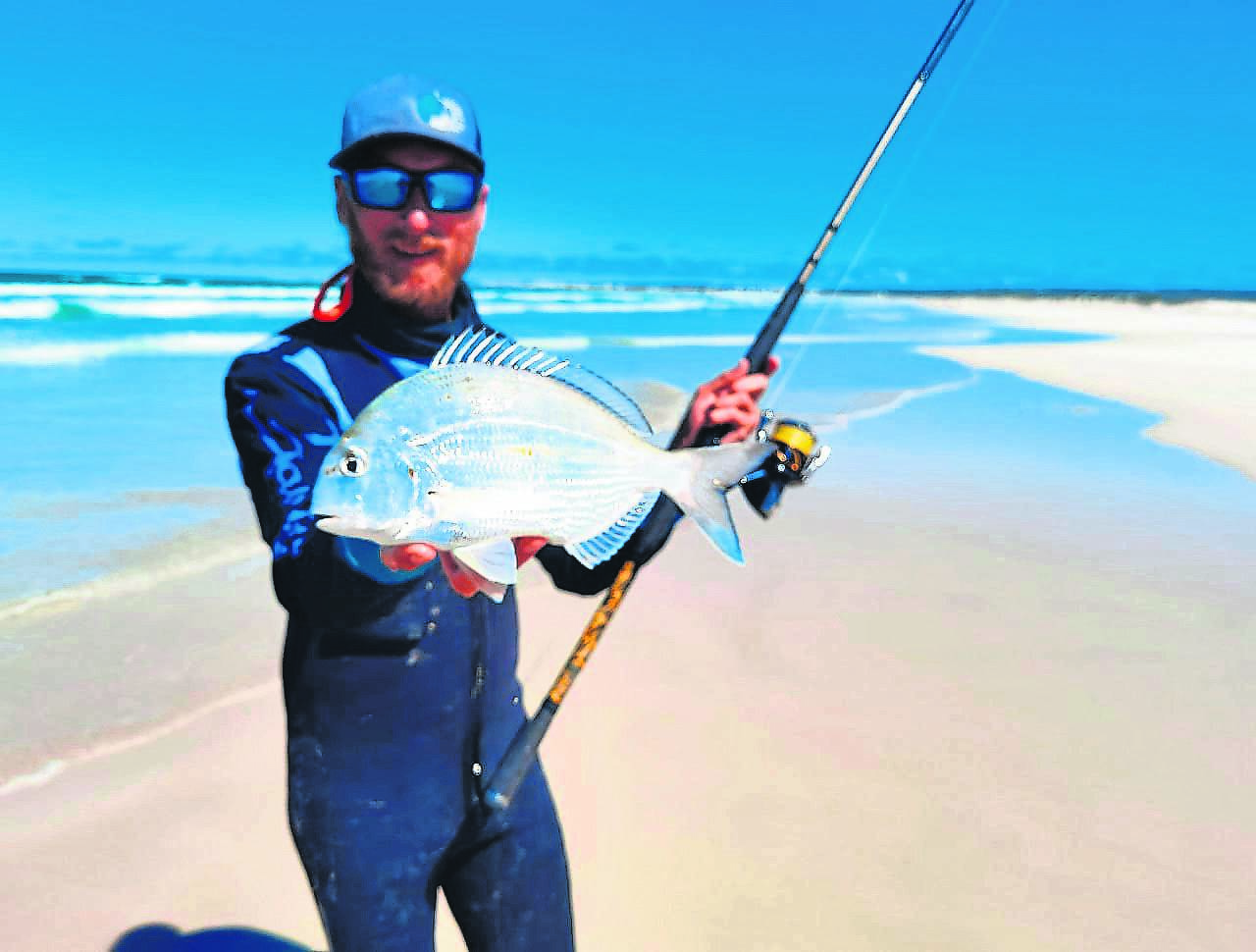
Let’s discuss the technical differences between rocky areas and beach areas, as they are definitely not all the same and require certain adjustments to tackle and trace set-ups.
)
Rocky areas
When one goes to target rock dwelling species, it’s important to consider the type of rock and formation you’re fishing. Not all rock fishing is the same; as an angler you will run into various rocky situations in different areas, which all require a different approach and set-up.
Areas such as Strand reefs are notorious for swallowing sinkers as if there is no tomorrow. The reefs are jagged and sharp, full of cracks and crevices with redbait, mussels and sea urchins scattered all over. You will find broken lines, sinkers and lures all over.
For this type of fishing you need to upgrade your main line, leader line and hook snoots, or else you will spend more time retying leaders than actually fishing.
Make sure your base set-up is strong enough, so when your sinker gets stuck you mostly break only your sinker off –and not the entire leader, trace and fish!
You will then encounter areas such as Arniston and the Kelders, which are of sandstone formation, big pot holes and ledges with mostly rounded rocks. This type of rock is more forgiving, and allows you to fish a much lighter set-up, which is nice as you get the opportunity to target different species such as steenbras and belman between these outcrops.
)
Bamboos and rocky outcrops
Places such as Pearly Beach and Brandfontein have this type of structure, where the fish tend to lay very close to the bamboo patches and rocks; as soon as you get the bite, they tend to run straight into the bamboos. This usually ends in tears for the angler.
You will need to upgrade your set-up so that you can hit and hold the fish to stop you from getting hung up.
There are many more rocky situations you will encounter, which I unfortunately can’t discuss all here. I recommend that you be proactive, study the area you are fishing and adjust your set-up accordingly. You will land far more fish this way.
Fishing on the beach takes time, patience and hard work, but with today’s modern rods, reels and especially super thin braids, it can really be simple and enjoyable.
One does not need to wade neck-deep into the ocean and throw your bait miles into the sea. Edible fishing, especially, is very technical and one can be rewarded with big fish in very shallow water.
)
Types of beaches
White, clean and sandy beaches can look like the best place to fish. One can certainly fish super-light and not worry about being cut or broken off on any structure.
But fishing in this scenario can be difficult and requires one to be able to identify the various banks, gutters, channels, currents, colour and other factors that the fish use in this area to hunt their quarry. I like to go really light, like 20 lb braid to a 40 lb braided leader and 10 kg nylon leader and hooksnoot. The fish are more wary as they are out in the open, so one must consider all the technicalities.
)
Sandy beach with scattered rocks and reef
Have you ever been fighting what you believe to be a beautiful fish when all of a sudden, 10 minutes into the fight, your heart drops as the fish swims over a portion of submerged rock and cuts you off?
It’s not always avoidable, but ensure you study the signs carefully, identifying rocks in the water and make the necessary upgrades to your leader and set-up, which could mean landing that fish of a lifetime. This situation calls for an upgrade in leader, nylon leader and trace set-up.
Some beaches have bamboo outcrops, which are lightly growing into a sandy bottom, one can often fish right next to or into these patches because the bamboo actually pulls out the soft sand. You must ensure your set-up is sufficient to handle the pressure of pulling out the bamboos. This type of fishing is very rewarding, but is also difficult and frustrating.
As an angler, you will certainly come across many different scenarios, so it’s important to adapt and change your set-up constantly. This avoids frustrations of breaking off fish, sinkers and traces. The correct leader set-up will ensure you land more fish and maybe even that fish of a lifetime when it comes around.
This time of the year is a good time to fish, and anglers are still catching numerous kob, elf and geelbek along the coast. There have also been good signs of the first winter fish arriving, with good-sized steenbras, galjoen and belman caught.
V For any questions, a chat or to get some beautiful fresh sardines, visit us at Fishing Republic at 73 Beach Road, Helderberg Centre, Shop 6 in Strand. Alternatively, call us on 072 552 4400, send an email to Kegan@fishingrepublic.co.za or follow us on Instagram @fishingrepublicstore.