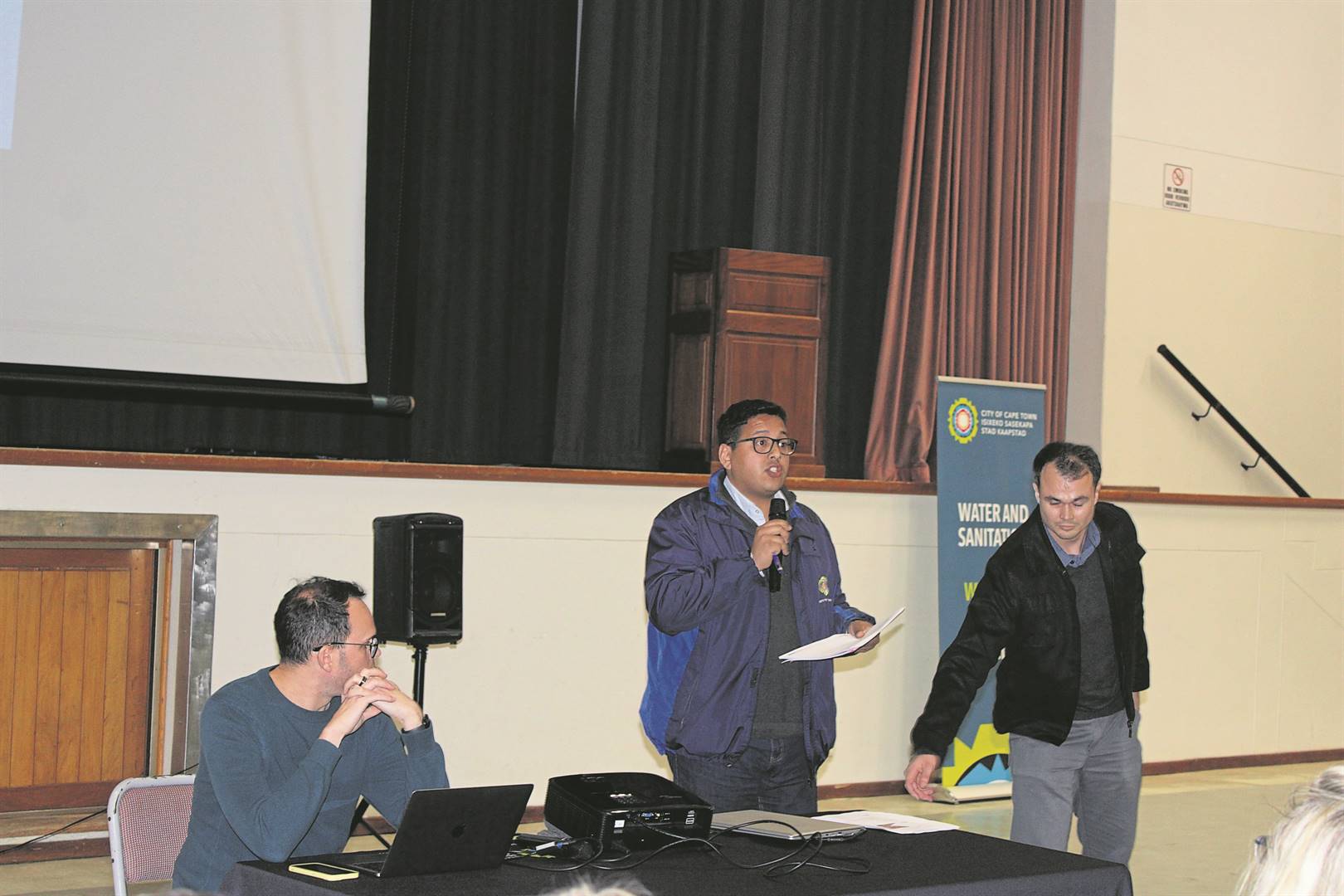

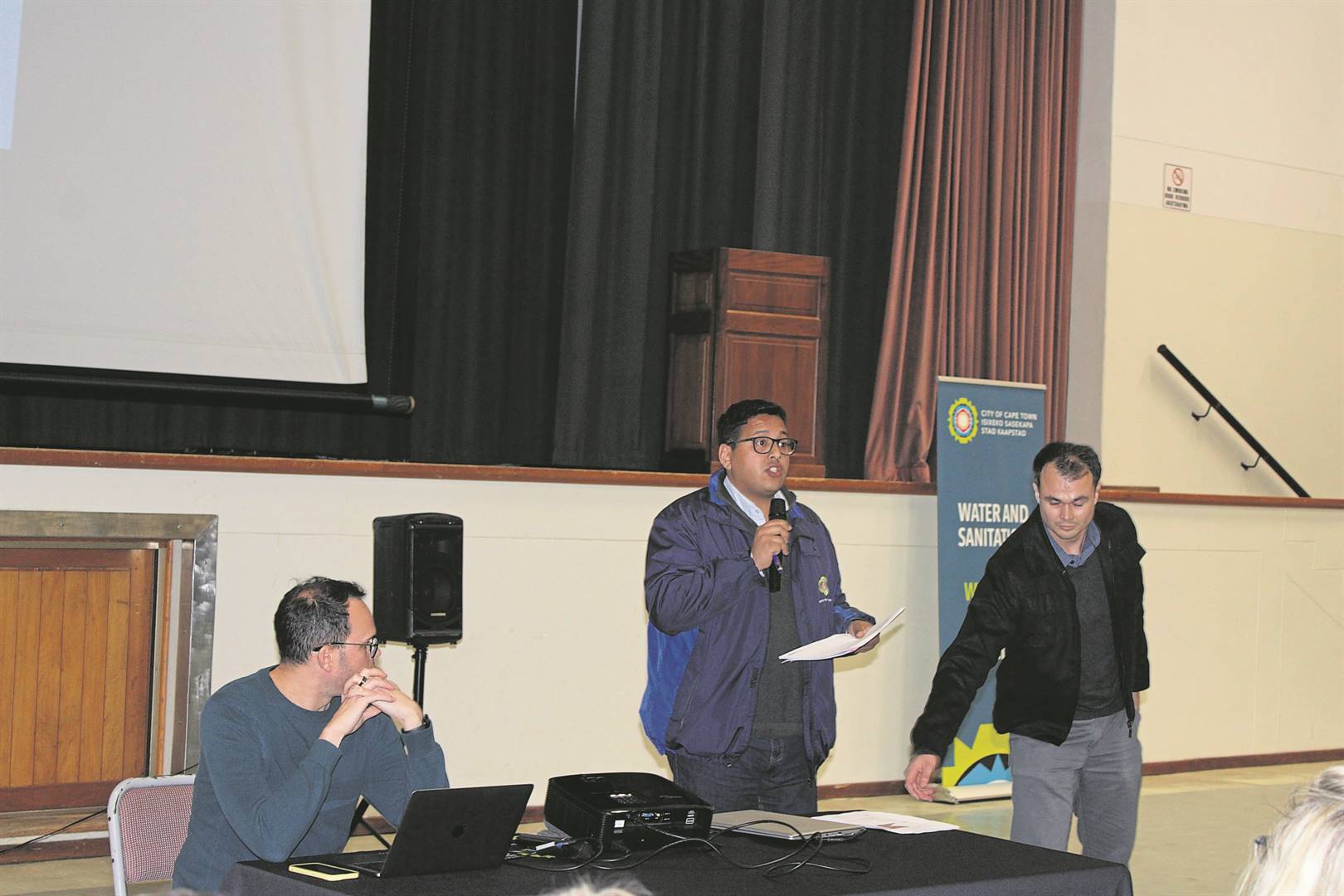
An urgent meeting between City of Cape Town officials and residents of Strand, which took place last Wednesday evening (6 September) seemed to address concerns of the public somewhat relating to ongoing sewage overflows and sinkholes, but nevertheless concerns remain on the ability by the City to resolve the issues within the next year.
“This is an urgent matter,” said Councillor Zahid Badroodien, the City’s Mayoral Committee member for Water and Sanitation, “for the Trappies pipeline has aged significantly and has reached capacity, the ingress into the system has worsened, and today we are sharing information as to what we are dealing with, what we are doing about it right now, and the plans we have budgeted for interventions.
“We want you to ask the questions because we do have all the right officials here today,” he said as he opened the meeting, which took place at Strand Town Hall.
He assured residents the “crisis situation” was being taken seriously by the City, and showed that according to records taken from January to August this year, hundreds of sewage pipe bursts had occurred in Strand, with the bulk concentrated around the Lochnerhof vicinity, which was the main area of concern.
A City official then presented technical details of the Trappies sewer, showing descriptions, depths, diameters and ages of sections of the network as well as reasons behind collapses, interventions and the realities of resultant sinkholes, overflows and beach closures, among other effects.
“The pipe is deteriorating at levels we never expected at all,” a City official admitted, adding that just last year R22 million was spent on repair work alone along a 900 m section.
R23 000 per metre
It was stated the soonest the City will be able to address the issue is early next year for it has to follow processes and procure materials from Europe as it plans to use Cured in Place Pipe Technology (CIPPT). The cost of this was around R23 000 per metre and in total would amount to well over R50 million.
The manager for Sewer Reticulation, Pierre Maritz, also assured residents that work is going on behind the scenes and that the City was committed to moving forward in finding solutions to the issue at hand.
When the floor opened for questions, a number of residents expressed frustration at the lack of environmental as well as health and safety warnings that are put in place when spillages occur, as well as concerns related to the pollution of the Soet River, which runs through Strand. Another resident, who identified himself as a Civil Engineer, pointed out that since 2019 at least 28 sinkholes have occurred within a 2 km radius.
He said three weeks after reporting a sinkhole there was no action, and although the contractor eventually came to the site there has been frequent sewer overflows for the previous 14 days and much worse on days when it rains.
“As a civil engineer I can do the calculations and I estimate that between five to 20 million litres of sewage has been spilled onto the beach and into the ocean over the two weeks. Three pumps are running over 12 hours per day, one of which is almost running 24 hours, but still the sewage level in the pipeline is not dropping. Today a fourth pump was added. Unfortunately, the surcharging of the Trappies pipeline has been experienced on most days this winter by the residents in the area.”
The resident also pointed out a number of shortfalls in the current response by the City to sewage problems, such as a failure to make use of the Gordon’s Bay Waste Water Treatment Works, problems with repairing pipelines with concrete and the loss of capacity in the pipe with every sinkhole repair.
Survey not possible
With regard to the CIPPT proposal to resolve the issue, he asked: “Do you know the internal condition of this pipeline and is it conducive to this method? No survey or inspection of the pipeline is possible as it is currently flowing full most of the time. The pipeline section is not uniform due to the 28 sinkhole repairs under difficult conditions and more sinkholes will be happening as can be observed on the road surface.
“CIPPT will not sufficiently increase the strength of the ailing Trappies Pipeline. It was mentioned that the soffit in places is only 6 mm thick.”
After proposing a solution that entails a similar approach to a pipeline in Milnerton, where the construction of a new bulk sewer in Montague Gardens makes use of microtunnelling technology.
“This pipeline is 4 km long, almost double the length of the 900 mm section of Trappies,” the engineer asked. “Why can’t this be done for the Trappies pipeline? I am concerned that the City of Cape Town is planning on spending R60 million on CIPPT of the Trappies Bulk Sewer, but that we will end up in five years’ time with the same sewage overflows and the risk of sinkholes and pipe collapses occurring.
“We have the chance now to do the right thing and stop spending millions on fixing sink holes. It does not help putting a plaster on a knife wound.”
The City acknowledged all comments and suggestions and assured residents that these would be discussed and considered ahead of a follow-up meeting scheduled to take place within 10 days.