

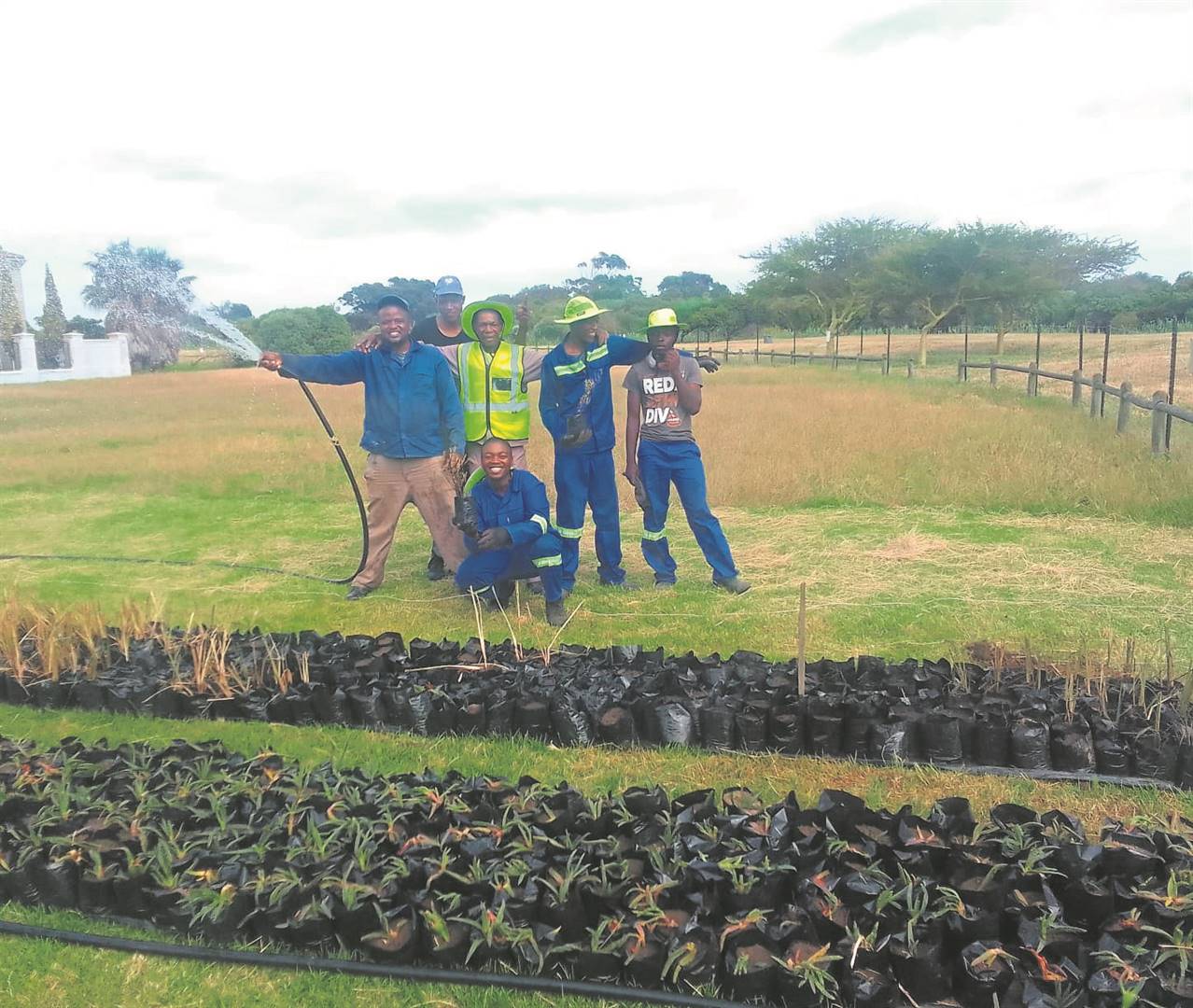
Experienced gardener Temba Cimilanga (54), originally from the Eastern Cape, is leading a team of six on a search-and-rescue mission to collect plants from the banks of the Lourens River as part of the City’s flood-alleviation project.
He and his team have created a nursery on the river banks with the goal of saving 150 000 indigenous plants. Cimilanga has been nurturing plants from the age of 14, so his experience runs deep. “When I feel sick, I touch a plant and it makes me better,” he says.
In his team are Michael Gege, Nkosie Tawas, Ayabonga Cubaletiki, Samkelo Batyi and Luvo Ngedle. They are employed by the award-winning landscaper, Chris Devine, owner of Blue Wood, who has a history of saving plants from river banks ensuring an almost 100% survival rate. His goal is to save plants unique to the area.
Devine said credit is also due to the City of Cape Town, especially Wayne Davids, Civil Engineer Technologist in the Catchment, Stormwater and River Management branch whose foresight and energy initiated the project.
The rescue operation has roots: Chris was involved in collecting wild almond, yellowwood and other trees, bullbs and sedges, which he propagated and then planted in the upper reaches of the river.
According to the chair of the Lourens River Conservation Society, Steven Louw, Chris continued to water the trees long after the contract ended, a commitment which he said showed caring.
Steven said the Conservation Society had a number of concerns, noting that large trees had been uprooted and packaged and wondered if there was sufficient expertise on site to determine which plants to rescue and which to leave.
Chris said that wattles, which were invasive, were being removed, but willows and oaks, although not indigenous, were beloved by the community, and could stay. It seemed that the borer beetles which attacked the alien trees, such as oaks, did not cause damage to indigenous trees.
Interestingly, the decline in oak trees, due to the beetle infestation had an impact on squirrels as acorns were their food source in the winter. Squirrels were hazardous to local birdlife, he said, and even preyed on baby owls. Chris, who lives in a forest frequented by owls, was hopeful that this correction in nature would play out in favour of birdlife.
This was also his intention for the riverbank near Victoria Park, which he predicted would be more beautiful than currently. Replanting of the bullrushes enabled the river water to be filtered before going out to sea. He proposed a wetland for the top area. This would absorb the shock of floodwaters, improve diversity by attracting ducks and frogs, and also discourage squatting.
A senior member of the Lourens River Conservation Society, Richard Lewis said he was concerned that the contract to rehabilitate the area next to Victoria Park would not be completed by the next rainy season and he foresaw masses of topsoil being carried down to the Strand Beach, which could be a calamity
Steven said the river and beach were treasures of the area to be carefully nurtured.
- Anyone interested in supporting the Lourens River Conservation Society is invited to their jumble sale on Saturday 2 December in front of Woolworths at the Circle Centre in Somerset West from 08:00 until 12:00.
- For more details from the Search and Rescue, contact Temba Cimilanga on 063 9299 656.

