

Aimed at bridging the gap between matric and university mathematics, two local organisations have joined forces to introduce a one-of-a-kind pilot project that seeks to teach coding as a 21st-century educational skill.
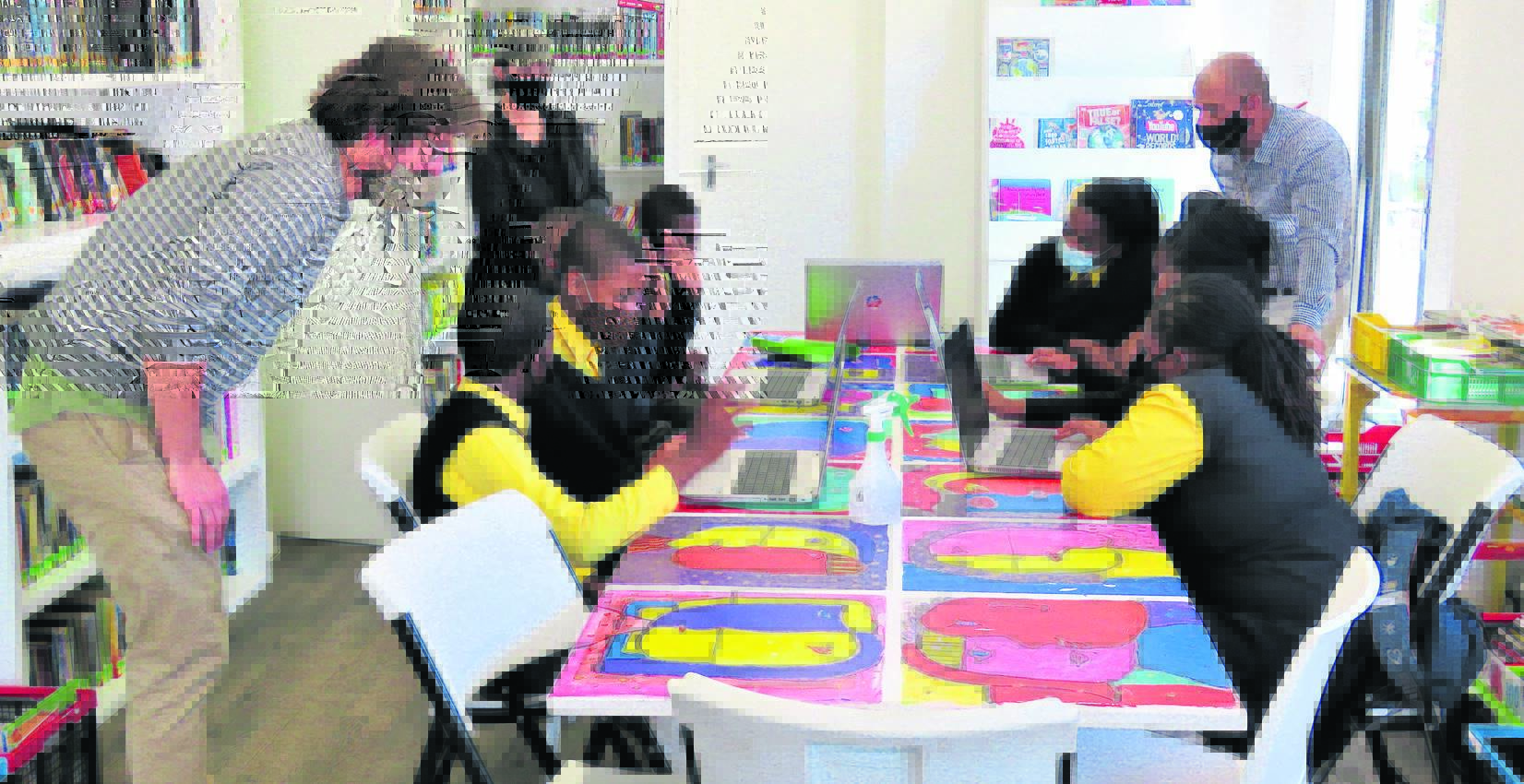
The Papillon Foundation and Imibala Trust are collaborating to provide coding training for impoverished high school learners, including a group of 18 learners from Simanyene Secondary School in Nomzamo. Using laptops donated by Papillon, Imibala introduced these Grade 10 learners to Scratch, a free programming language and online community where learners can create their own interactive stories, games, and animations last year.
The project was inspired after The Papillon Foundation, a registered NPO celebrating 21 years of community work, relocated to the Western Cape in 2018 and its founders, Stephen and Marian Smith took a vested interest in the Imibala Trust and decided to dedicate their support. The Somerset West organisation, which works with school-aged children whose lives are affected by impoverished circumstances, is also a registered NPO and uniquely also celebrates 21 years of success.
“Due to Papillon’s successes over the years with accredited computer training for previously disadvantaged adults and children, Stephen approached Theo Willemse with the idea of starting a coding training project for learners from schools supported by Imibala,” Marian related. “The idea was welcomed and Papillon loaned nine new laptops in preparation for the start-up in the third term of 2021,” said Marian.
“The coding project gained momentum as Imibala gathered an expert team headed by Kirsten Conradie, resulting in students who are excited and enthusiastic.”
Marian further explained the aim is to see if the big gap between Grade 12 and university mathematics can be closed.
“We find many students drop to mathematical literacy. We hope to keep those doing pure maths motivated and not be tempted to drop the subject, ensuring they achieve the marks they need. We want to ensure their foundation is solid so students do not get a shock in their first year at varsity where so many fail so badly.”
Marian further explained that the group learners from the township high school have been beneficiaries of the Imibala Trust since 2016, when they were selected in Grade 4 for a Grade 5 to 7 online mathematics intervention at Imibala’s Learner Advancement Centre, equipped with 22 computers, internet connection and an experienced educator with more than 20 years’ experience in the field of maths.
“The learners needed to show interest in computer literacy and basic programming through the introduction of coding,” she said. “The vast majority of them had taken pure mathematics at the end of their Grade 9 year, which Imibala motivated them to do as it provided them with the necessary support through to matric, and many tertiary institutions require pure mathematics for those learners who wish to study coding.”
As Grade 10 learners last year they were introduced to the world of programming with the “Scratch” environment, developed by MIT. This is a multimedia environment that runs through the web browser (and is therefore accessible from anywhere in the world). Scratch is a visual programming language, so all the programming constructs are tangible and invites playful engagement.
“With this environment the students are enabled to create their own stories and games with their own code,” Marian explained. “There is a great variety of supplied media, but they also record their own sounds and use their own self-created art.
“We follow a principle of ‘Embodied Programming’. In the first two lessons we introduce algorithms and conditional logic without even using a computer! Preferably in nature and using signs, navigation and environmental awareness to help lay the pathways that map to program flow in our minds. Programming can easily become rote memorisation, so it is very important to establish a foundation of a deeper level of understanding of the concepts. And we do this by connecting physical skills in real life such as navigation with the way code is executed. With this the lessons learnt may be more easily transferable to new modern programming languages if the student wishes to continue on the path of coding.”
Marian says while The Papillon Foundation recognises that not everyone is destined to be a professional computer programmer, but the value of encouraging creativity and free play is a far greater treasure to cultivate. “If we can keep students excited and engaged during the course, we open doorways to other ways that computer use can feature strongly in a student’s future. The skill of exploring and experimenting is a fundamental part of a student’s future toolkit wherever it is applied. So while we try to sketch out a direction for each lesson, a priority is to enable the students to play with as much freedom as possible within the constraints.”
According to Marian, the foundation emphasises working from group down to individual level. Broken down: work and demonstrate to the entire group, split into subgroups until the individual masters the skill, going further by firstly working together.
“Coding has exploded around the world and is fast becoming a subject as important as mathematics and science. The world has changed rapidly and our pedagogy needs to change too. We want children in Imibala to have full access into any field they wish to enter so we nurture talent and interest, and ensure our children can study whatever degree they are passionate about.
“The two volunteer facilitators, Pieter Holtzhausen and Randall Erasmus, are fully equipped and have the necessary skills and experience to convey this to the learners who are so eager to learn more about programming.”
Holtzhausen has a PhD in Applied Mathematics from Stellenbosch University and a masters in Engineering and Computer Science, with years of experience in programming. Erasmus has a National Diploma in Information Technology and Software Development, with similar experience.
The learners, now in Grade 11, have progressed and look forward to a shift in focus to a more structured, outcome-based programme to prepare them for the Java certification exam in matric. “This course is designed by an experienced programmer with an emphasis on getting learners both exam and industry-ready,” said Marian. “This prepares learners for career paths such as establishing their own small businesses, creating web sites, and application and game development.”
Funds are being raised to cover the cost of the examination scheduled to take place in 2023. Furthermore, Panerai has donated 22 tablets towards the expansion of the project.


