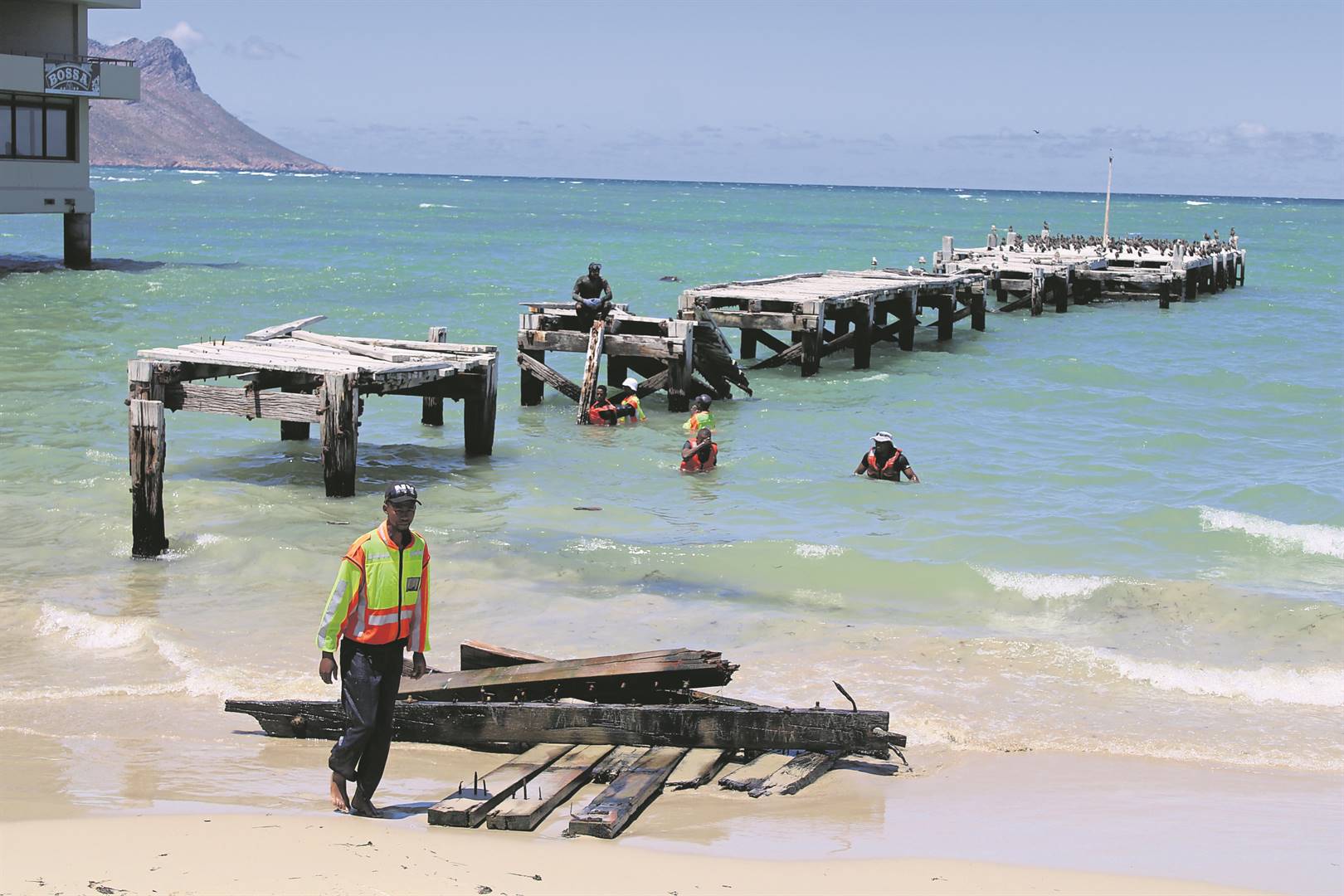


Demolition of derelict sections of the Strand jetty, which started on Monday (5 December), marked the end of an era for the community, many of whom reacted with dismay and disappointment that one of the Helderberg’s most recognisable landmarks would soon be no more.
Although only sections of the dilapidated structure are being removed, the entire shape of the linear jetty is now dotted with gaps and it appears to be only a matter of time before the rest follow suit.
A sense of nostalgia engulfed many locals who grew up in Strand, as they recalled wedding ceremonies on the jetty, photo shoots, fishing lessons and casual strolls at sunrise and sunset.
“There are many childhood memories of that jetty, so I’m sad to see it in that state and losing it forever,” one reader commented.
Another said: “Demolish the entire structure all in one go, not just half of it – then it just becomes a new challenge for naughty kids, with worse incidents.”
According to a statement from the City of Cape Town, the loose, deteriorated and damaged components of the jetty will be removed and dismantled in the interests of public safety. If all goes as planned the project should be complete by next Thursday (15 December), before the start of the annual festive season.
“The Strand Pavilion will remain open to the public during this time,” the statement read. “However, a section of the parking area will be temporarily unavailable to accommodate the heavy machinery while the work is ongoing.
Council obtained a demolition permit which allows workers to dismantle and remove the derelict and unsightly sections of the jetty. “Those who are familiar with the jetty will know the wood structure is beyond repair. We will remove the upright wooden supports, supporting beams and boards, as well as all the loose, rotten and partially detached boards, and collapsed footing.”
Several years ago Future Strand was at the forefront of efforts to champion the repair of the structure. “Numerous meetings were held, scoping of the Strand beachfront development of the City was completed and a feasibility study conducted,” said Daantjie Malan of Future Strand.
“We obtained all permissions, followed all regulations and obtained a three-year permit for the reconstruction of the jetty, but we had no funds. When the permit expired the City informed us they would take over the project.
“But now we’re devastated. It’s a sad day indeed that none of our suggestions were taken into consideration. We were never consulted about this demolition and now one of Strand’s icons is basically lost forever.”
Jan Swart, a wood scientist formerly of the Faculty of Forestry at Stellenbosch University, said the Jarrah eucalyptus wood that makes up the jetty is only found in Australia and the composition of the wood allows it to last in water for decades.
“At the time of the consultations to preserve the jetty, we assisted with all the technical knowledge required, including that of a specialist architect and chemist, all of whom had the expertise required for such a project.
“A similar 1,8 km jetty in Australia is a major tourist attraction, and it was envisaged that this could be replicated in Strand. Everything was in place for the project, except for the finances as this would cost up to R20 million. The lack of funds brought the project to a halt.”
According to Eddie Andrews, deputy mayor and Mayoral Committee member for Spatial Planning and Environment, it is of vital that the derelict parts of structure be removed before the start of the festive season, when many people, particularly children, flock to local beaches.
“Children sometimes jump off the jetty and can get seriously injured as some of the rotten wood as well as rusted nails, are under water,” Andrews pointed out.
“The City is compelled to ensure it does all it can to ensure the safety and security of the coastal amenities.”
He, however, didn’t elaborate as to why no community consultation was undertaken before the decision was reached.
“This is not a sudden decision. The City applied to the South African Heritage Resources Agency (SAHRA) for a permit in 2018 already, which would allow us to remove only those sections that are derelict and unsafe. The City is, therefore, not demolishing the jetty, but only acting in accordance with the permit we have obtained from SAHRA to remove those parts or sections of the jetty that pose a present public safety risk.”
Andrews restressed that the cost involved in repairing the jetty is too high and unaffordable. In addition, maintenance costs will also be exuberant given its locality and the material.
“A wood structure of this nature will require ongoing and expensive maintenance to preserve and ensure it is safe to use. Also, the City is now following an approach where derelict amenities within the coastal zone will not be replaced, but demolished to allow the natural area to return to its original state.”
Asked what would be done with the wood removed in the process, which is highly valuable especially in the antique market, Andrews replied: “The wood will be stored and safeguarded at a City facility for future use.”