

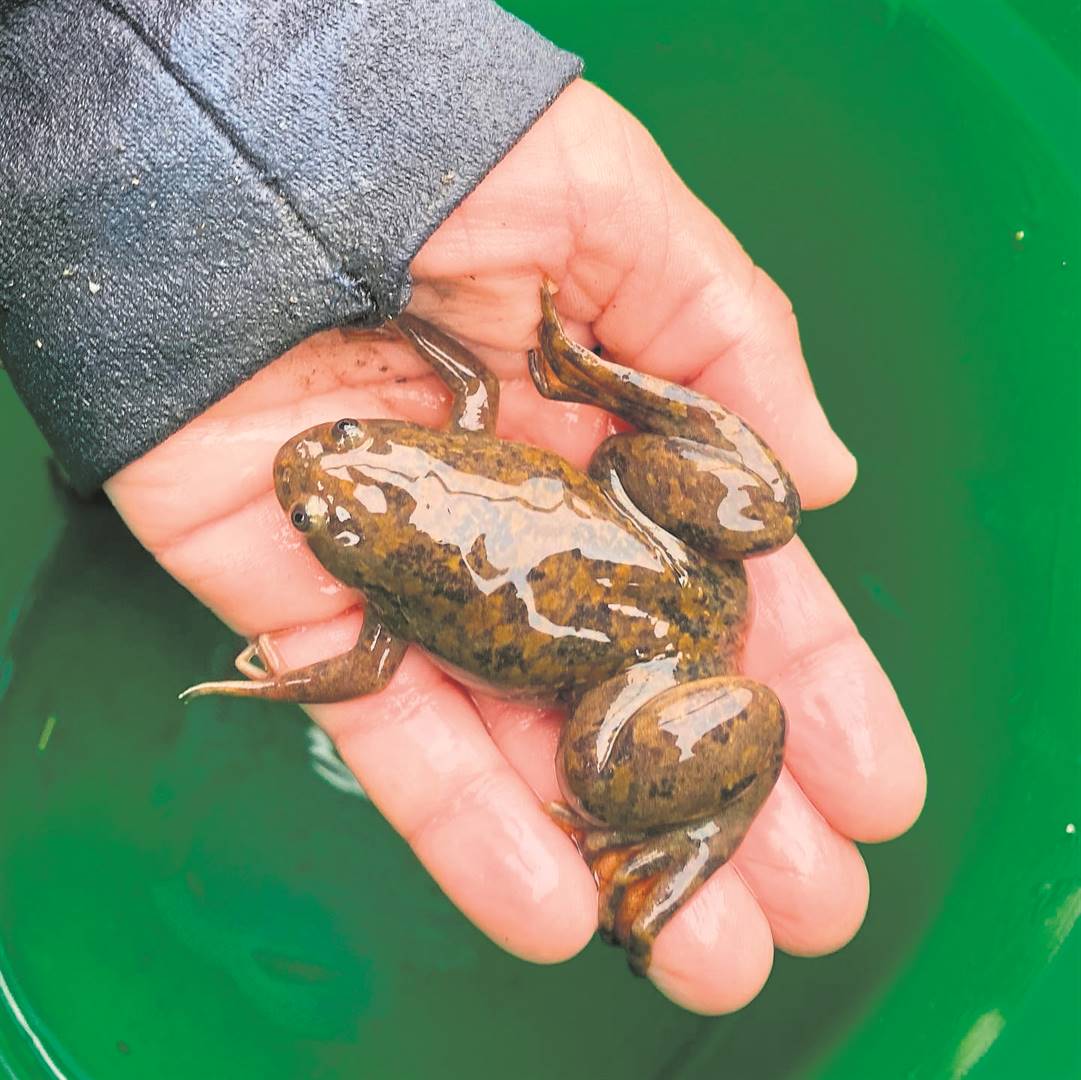
A minor frog dispersal that occurred during intermittent rains two weeks ago over Paardevlei, Somerset West, and another on Saturday night (4 March) is a prelude to a much larger dispersal anticipated as soon as the first good rains of the season arrive this month, when thousands of frogs are expected to cross the R44 and Heartlands Precinct towards the dam at The Sanctuary Shopping Centre.
Almost two years ago the frog dispersal spurred the formation of Frog Friends, a group lobbying for their conservation, particularly protection from being killed and invading homes, and educating the public on the significance of this conservation effort (“Migrating frogs squished on R44”, DistrictMail, 11 March 2021).
So far the group has managed to successfully put in place an emergency-response protocol when dispersals occur, in collaboration with City of Cape Town departments and Traffic Services. It was also instrumental in securing the installation of “frog crossing” signs with emergency numbers along the R44 Broadway Boulevard intersection with De Beers Avenue. (“Frog crossing signs at Paardevlei”, DistrictMail, 20 September 2021).
One of the group’s founders, Elma Pollard, stated this week it had raised some funds for the herpetologist André de Villiers’ survey of the area, which was used to conduct various educational events and frog trapping sessions with groups such as the Scouts, Eco Rangers and Voortrekkers. “Now we know what we’re dealing with and roughly where they are, we need the City to contain the dispersals, which pose a serious traffic hazard every year.”
expertise to solve frog problem
“Frogs on the road can cause motorists to brake suddenly and swerve on a very slippery road covered in frog remains, which also wastes valuable City resources,” Pollard explained. “We also understand these frog dispersals are problematic to residents and businesses in the Heartlands Precinct, where they enter buildings and fall into swimming pools, dying. We have been called out to help find solutions to this problem. The point is that Paardevlei belongs to the City, so it will need to protect wildlife surrounded by developments.”
In response to these concerns, Deputy Mayor and Mayoral Committee member for Spatial Planning and Environment Eddie Andrews said the City’s Environmental Management Department was involved in discussions on the Common Platanna (Xenopus laevis) migrations in 2021.
“The area in question is not part of the City’s Biodiversity Management conservation estate, and we therefore can only assist in providing advice,” he clarified, adding that existing research indicates this species is able to undertake substantial migrations at different times. It is thought large-scale migrations are in pursuit of more favourable habitats (from temporary to more permanent water bodies).
“To provide a way forward and implement interventions, more information and studies are required. On 10 June 2021 the City recommended that the herpetologist include in the assessment the frog migration as well as to consider alternative options to the solve the mass killing of the frogs during the migration/crossing at Broadway boulevard. It was also recommended that a cost benefit analysis of the options be included, for example costs of a tunnel crossing underneath Broadway Boulevard versus costs of interventions at Paardevlei to limit frog migration/crossing Broadway Boulevard.
“A proposal for ‘the terrestrial vertebrae survey of the Paardevlei and Sanctuary area’, drafted by the appointed herpetologist was submitted to the City at the same time. This was, however, only a proposal and not the actual survey as discussed.”
Asked if a wall would be considered to block the pathway of the frogs, Andrews replied more studies and information would be required with regard to this problem, and the challenge can be solved only once the movement and reason for it, and the species of frogs have been confirmed.
“It would be recommended to assess the feasibility of a suitable underpass to allow for fauna movement across the R44, or to assess the means of removing the need for the migration (ie creating a suitable, natural waterbody within a safe precinct on the same side of the road from which the migration originates).
“The potential motivation for the migration (such as reduced water levels, increased predation, and so on) would have to be determined to create a suitable alternative.”
tunnels to get to water bodies
According to Pollard, Frog Friends were told that building tunnels would be exorbitantly expensive, so best another way be found. “However, André de Villiers (herpetologist) reckons the only solution would be to build tunnels under the road,” she said, and Frog Friends are also proposing two possible solutions:. That the flimsy fence around Paardevlei is replaced by a wall to contain the frogs and herd them to the one waterpipe underneath the road though which the frogs could safely hop to the Sanctuary dam, in front of the Paardevlei traffic entrance, and . Since the frogs disperse from temporary to permanent water bodies, for the City to make Paardevlei Dam more permanent, and instead of draining it to control weeds the other solution may be to stop draining the Paardevlei during summer months and remove the weeds manually as it does in other water bodies in the Helderberg.
“The Frog Friends are keen to have a combined meeting with the City and the Heartland Precinct management. We have requested a meeting with the local Councillor but to date have been unsuccessful,” said Pollard.
The Common Platanna (Xenopus laevis) is a locally indigenous species to the Western Cape and Cape Town. It is not a threatened species and can be very common in a suitable habitat. They are very adaptable and make use of almost all watercourse types.
.

