
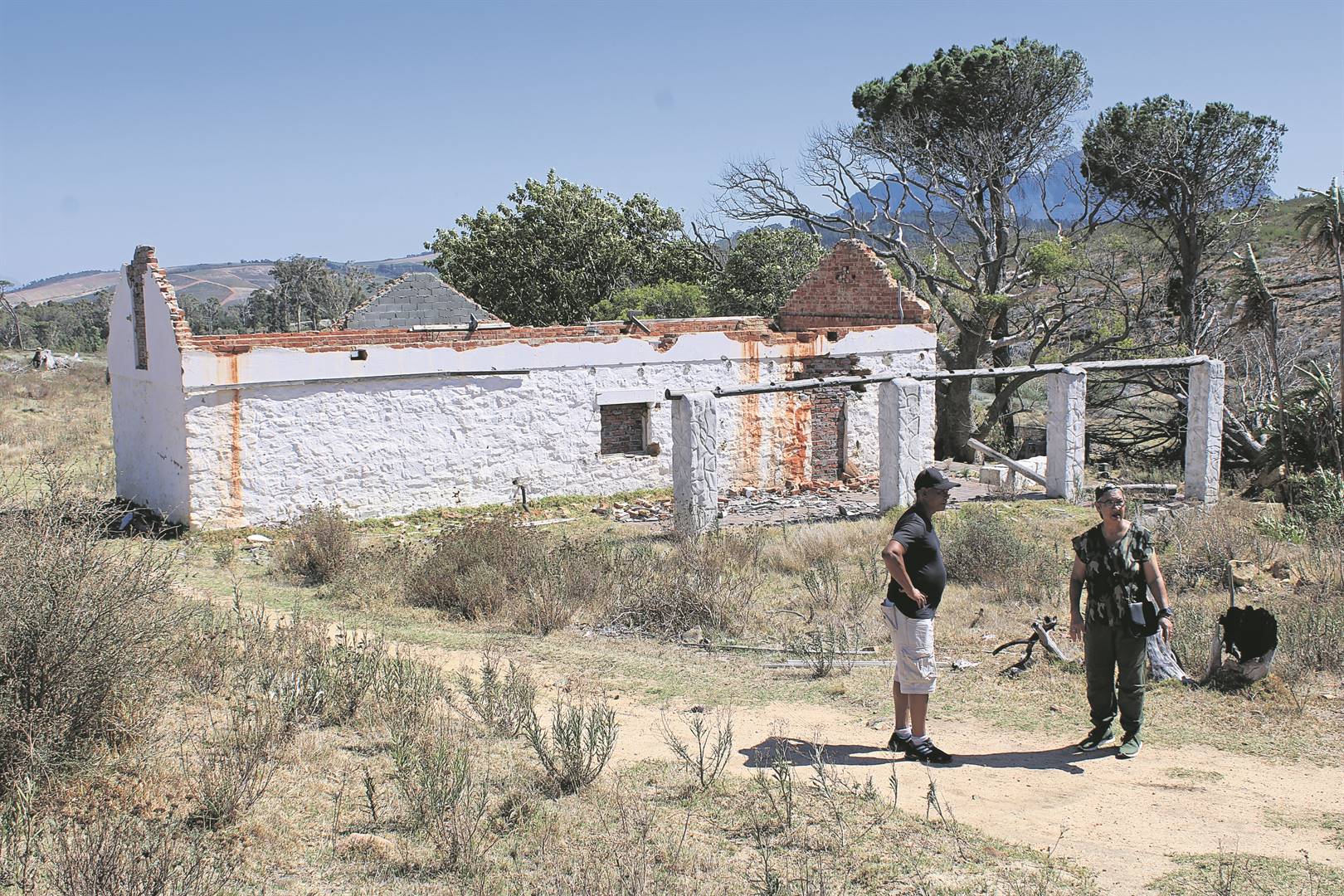
An 17th century old Toll House in Sir Lowry’s Pass is in a state of total disrepair and neglect, and local community members are concerned that the preservation of this piece of history hangs in the balance.
It is situated near the Knorhoek Estate Farm in the foothills of the Hottentots Holland mountains on the slopes of Sir Lowry’s Pass, and the old toll house bears witness to a pass used more than a century ago to head East out of Cape Town. It is where travellers and their cattle used to rest before taking on a dangerous journey up and over the mountains.
A site visit by DistrictMail accompanied by local community members showed the architecture of a bygone period, a premises clad in clay bricks and further damaged by most recent fires which occurred in 2017, which also destroyed the Bezweni Lodge not too far away. School visits to the area are also not uncommon, as well as visits by tour groups on Heritage Day.
A Helderberg resident Carol Misrole said that she’s always been fascinated by old buildings and the history that goes along with them.
“This monument really speaks volumes of our history and it’s sad to see how it’s been destroyed over the years,” she said. “Surely there’s something here that can be salvaged, restored and perhaps repaired to preserve this heritage.” Misrole says many residents probably do not even know of its existence, although it is something could spark interest among tourists. She also expressed concern that if the structure was completely destroyed it would be history that’s lost forever.
According to Michael Janse van Rensburg, Chief Executive Officer of Heritage Western Cape, the Toll House is a significant historic structure and protected in terms of the National Heritage Resources Act, No. 25 of 1999.
He agreed that upkeep and ongoing maintenance appear to be a factor.
“Since the building is older than 60 years and has heritage significance tied to the establishment of the pass, a suitably qualified architect with appropriate heritage expertise should be brought on board by the owners of the property to advise on suitable remedial work and any proposed restoration.
“Such work must be approved by HWC before work commences,” he advised, and added that the state of disrepair could affect its heritage status in the long run, especially “if it continues to deteriorate to the point where significance of the resource is lost, and where restoration can no longer resolve attrition of features such as authentic fabric and form, due to deterioration”.
He said that it is important to have the appropriate expertise to advise on the conservation work required to restore the building, but to also make it fit for use.
“The nature of its use would be for the landowner to decide. What is important is that the significance of the structure and historic context is not lost but promoted”.
Van Rensburg also confirmed two cannons further up from the toll house are also protected in terms of heritage legislation.
“The property is privately owned and in terms of the Protection of Personal Information Act, the City is not at liberty to divulge the details of the owner,” Eddie Andrews, Deputy Mayor and Mayoral Committee Member for Spatial Planning and Environment said.
The owner of the property is, in fact, Dutch entrepreneur Hank Maris, who is said to be currently in the Netherlands. A request for comment sent to one of his associates was not responded to at the time of going to print.
Andrews said turning the building into a tourist site depends on the landowner’s willingness to do so or not, but that he did obtain approval some time ago for the rezoning and subdivision of the larger parent property (Casa Maris) and the area in the immediate vicinity of the toll house has been identified as a ‘Toll House and Chalet Area sub-precinct’.
He said: “The Environmental Impact Assessment Report dated March 2012, which accompanied the application for rezoning, stated the intention of the then land owner/developer to refurbish the Toll House as a tourist facility with a restaurant and accommodation (in the form of chalets).
“The Western Cape Department of Environmental Affairs and Development Planning did indicate at the time in the Environmental Authorisation decision that the Site Development Plan for the Toll House Precinct must be approved by Heritage Western Cape (HWC). However, the applicant still needs to submit a Spatial Development Plan for consideration. It is unclear what the intention of the current land owner/developer is in this regard.”
Rob Young-Pugh of the Helderberg Renaissance Foundation (HRF), which is affiliated to Heritage Western Cape and also works towards, identifying & conserving Helderberg heritage and the environment, stated that there is extensive correspondence on a similar problem building in Sir Lowry’s Pass (the Chapel) between HRF, councillors, CoCT and land owners.
“It is an uphill battle to get these heritage assets protected and restored,” he said.
For Misrole and others it’s never too late to rescue the old toll house and preserve it’s stories.
“Our people failed to take action over the past few decades to restore this site, and I feel it’s time that we take the lead and as a community put all our efforts forward to restore its glory,” she concluded.