

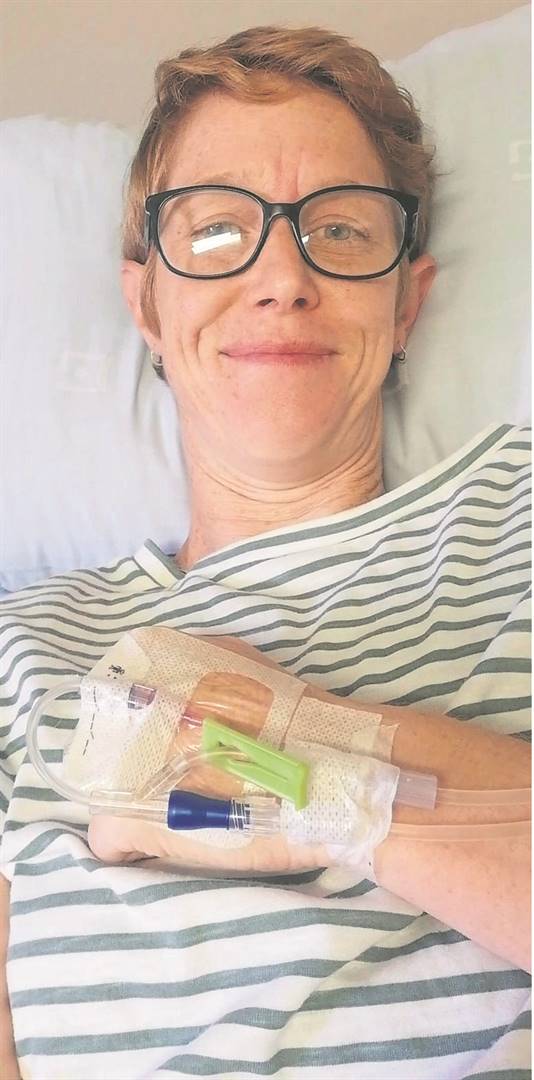
The ability to help others, provide answers to burning questions and reveal a true-to-life experience of what can be expected.
This, apart from potential success, is what has inspired a Somerset West advocate for Multiple Sclerosis (MS) to undergo breakthrough treatment while keeping online video diaries of the entire journey.
Claudia Dieckmann has been granted the gift of hope and will be undergoing a haematopoietic stem-cell transplantation (HSCT), which is aimed at halting the progression of the potentially disabling disease by rebooting the immune system. The 41-year-old in an introductory video diary insert posted to YouTube on Monday 17 January, gave insight into the anticipated “HSCT adventure” made possible thanks to valued donations collected through a fundraising campaign championed on the Back-a-Buddy online crowdfunding platform.
“To be able to elect to have, qualify and undergo this procedure is going to be a life changer,” she said. “My family have been incredibly supportive in the build-up to the treatment as fundraising half a million rand is not an easy task. Family, friends and many people I have never met have been extremely generous. I know my family will continue to be supportive during and after the procedure. For this, I count myself extremely fortunate.”
Claudia was diagnosed with MS nearly 11 years ago. Being a Marketing Manager working in a corporate environment at the time, she assumed that she was stressed and over-tired. However, after a number of in-hospital tests MS was confirmed in September 2011.
Claudia could no longer do the job she was hired to do and has been unable to return to the workforce ever since. Furthermore, she battles with vision, walking, balance, and other health problems. “I used to have a very well-paid job that I enjoyed and was quite capable of doing things. MS has taken that away from me as well as the ability to do the many physical activities I loved. I can no longer run, hike, cycle, focus to hit a moving ball nor do something as simple as use a skipping rope. However, I can still swim, and this activity has been my saving grace and preserved my sanity for the past 10 years.”
Claudia explained contemplating the treatment – which she was aware of, but never mentally ready to consider – after still noticing a steady decline in her abilities despite being administered various disease modifying drugs and living a healthy lifestyle for the past decade. She explained: “I just could not continue being reliant on medication that is designed to delay progression of MS and eventually having to face the possibility of becoming more disabled and probably ending up helpless and in a wheelchair. I’m under no illusion that this will be a crazy roller-coaster ride and there will be a long recovery period. But, if successful, it will halt the progression of the disease and I will not continue to become more disabled. Best case scenario, my current stage of disability will improve. Worst case scenario, the treatment will not work for me. It is a gamble I am willing to take.”
According to Claudia, HSCT, also referred to as a bone-marrow or stem-cell transplant, comprises an intense chemotherapy treatment that aims to stop the damage MS causes by wiping out and then regrowing a better immune system by means of an autologous transplant (using her own stem cells that have been harvested from the bone marrow or blood prior to the commencement of the treatment). The procedure takes about six weeks, is high-risk, but potentially yields great rewards.
“The potential for success and being able to plan for a future outside of a wheelchair is just too big to ignore,” reckoned Claudia, who is a proud advocate of MS and committee member of Multiple Sclerosis South Africa (MSSA), and gladly shares her story with others.
Asked whether she had any words of wisdom to share or come to some profound realisation through lessons learnt during her inspiring journey, she said: “Words that I heard from others and that have resonated with me are, ‘It’s a no-brainer.’ I am making a video diary of the journey to document the process using Facebook and YouTube. This will hopefully help others; answer questions others may have and show everyone the ‘warts and all’ of what to expect if they choose to have this treatment.”
Claudia will be posting live videos on YouTube regularly from the hospital, where she will be in isolation for a four-week recovery period following the transplant, for everyone to see the effects of the procedure and give hope to other MS sufferers. She further shared her hopes for her treatment journey to help convince medical insurance companies to recognise HSCT as a viable treatment and financially support others to undergo the procedure for their MS. Especially as her medical insurance has declined to contribute.
Claudia has already started preparations for the procedure scheduled to take place at Mediclinic Constantiaberg, which specialises in stem cell transplantation, on Wednesday 23 February. For video times, visit her Facebook page.