
Proper maintenance of the sewerage infrastructure by the City of Cape Town and the construction of an additional pump station for a rapidly expanding seaside village are solutions the Harbour Island Master Homeowners’ Association is calling for from the City.
This hopefully will ensure the ingress of sewerage from the main municipal pump station serving the entire community into waters of the blue-flag residential marina will be prevented.
The spotlight, once again, is on the decades-old problem due to the malfunctioning wastewater system after continuous sewerage spillages provoked residents’ ire, with many questioning the luxury waterfront estate’s blue-flag status.
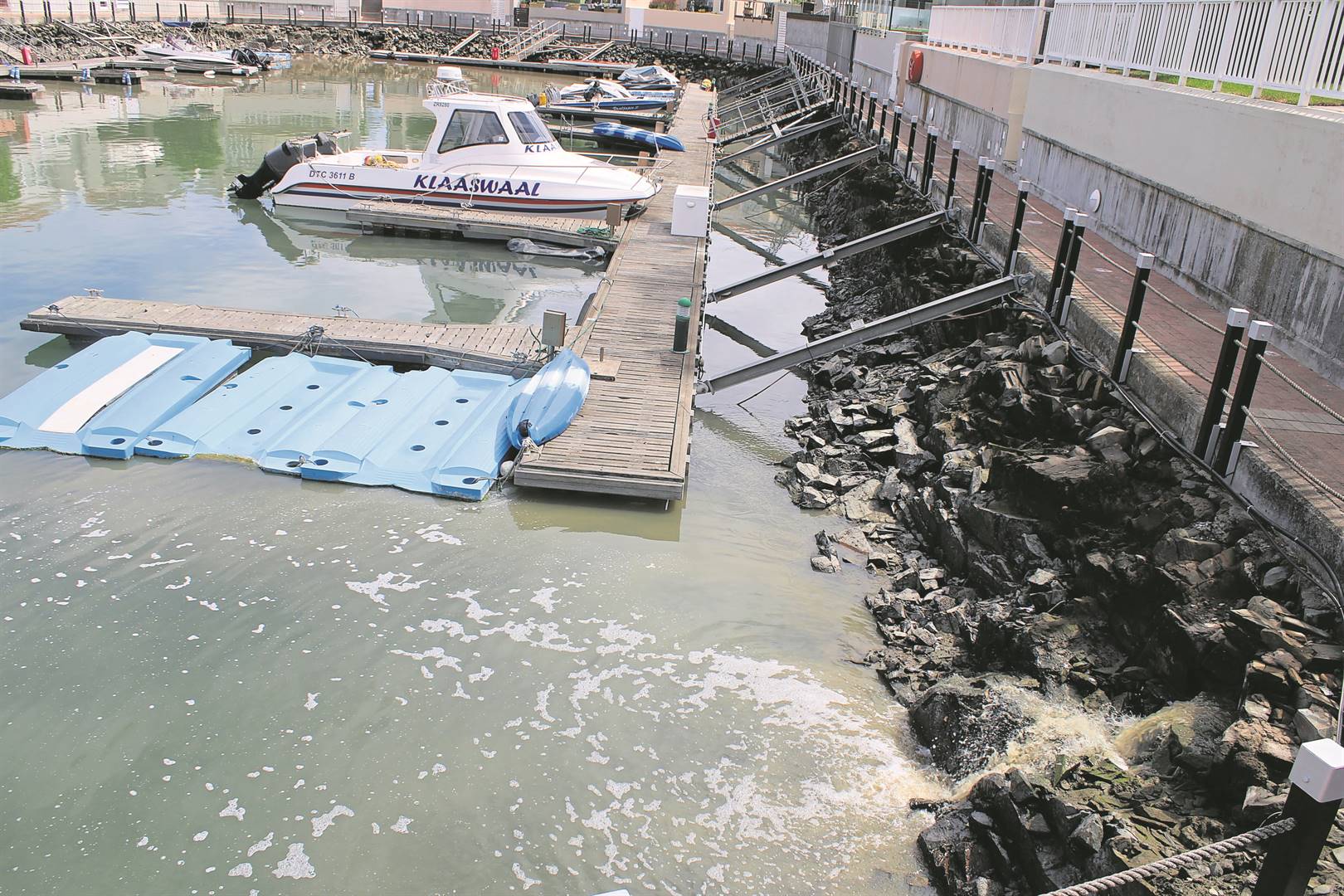
In recent weeks readers have alerted DistrictMail to a sign erected at the mooring, warning that the polluted water is unfit for swimming and any water activity. This after raw sewage spilled into waterways from Saturday 29 January to Tuesday 1 February. This was preceded by the marina’s biggest spillage to date last July, which resulted in the flooding of an underground basement, walkways and a residential unit via the toilet as well as the derailment of the sale of an apartment in the vicinity of the pump station.
DistrictMail was also called out to the site last Thursday (3 March) when sewage spilling from another location in Faure Marine Drive gushed into the private waterways via stormwater drains, causing an unbearable stench.
ROOT CAUSE
In response to initial enquiries, the board of directors of the homeowners’ association said the private waterways of Harbour Island were not permanently polluted, but pollution occurred when the main Gordon’s Bay pump station – located between Harbour Island and Faure Marine Drive – malfunctioned because of “a serious lack of maintenance by the City”. In a statement, the board accused the City of illegally dumping sewage from the pump station directly into the stormwater channel.
Zahid Badroodien, Mayoral Committee Member for Water and Sanitation, confirmed the failure of the pump station outside the residential complex on Monday 31 January, adding the problem was addressed by the Water and Sanitation maintenance teams which, on accessing the pumps, found both were clogged with rags – one pump sheared off the bolts on the slider and dropped into the sump, while the other pump lifted and was dislodged from its foot.
He said: “It is suspected the imbalance on the impellers caused the pumps to vibrate excessively at a high speed and dislodge from their positions. The pumps were reinstated in their positions and the pump station is operating as per design.”
Badroodien claimed sewer overflows in the area are caused by foreign objects dumped into the system, leading to blockages and affecting pump station capacity. He said pump stations are designed to process toilet waste and paper.
Foreign items such as cloth rags, sanitary pads and wet wipes clog and overload the pumps, causing them to fail. “To manage the problem the pumps at the facility are cleaned weekly, but this intervention is not enough to keep the infrastructure working in the way it’s meant to,” Badroodien pointed out.
Frequent failures occur at the pump station, particularly in winter, when solids in the pipelines are washed into the sumps and cause premature breakdowns. “Also, during load shedding the generator often fails to start due to several reasons. This is currently being addressed by the Electrical Unit,” he added.
Badroodien disputed claims that sewage flows or is dumped into the water, reiterating these incidents only occur when the pump station malfunctions. In this case, wastewater operations are required to mitigate the spillage using vacuum tankers. “If flows are excessive, wastewater will spill into the stormwater system to allow that faulty pump equipment/components can be replaced timeously.”
ACTION DETAILED
Asked which actions the City has prioritised to remedy the problem, Badroodien cited the installation of a third pump for additional capacity, improvement of telemetry for early warning systems of malfunction and the fitment of automated screens for the removal of solids.
But the association’s board members said they had done everything to prevent pollution on their side and called on the City to deal with “its” problem, which may become an issue for the broader Gordon’s Bay community.
“Over the past 15 years Harbour Island has continuously addressed this problem with the City, its ombudsman and recently relevant provincial departments,” one representative related. “At great expense we have taken various measures to prevent the ingress of sewerage.”
They gave insight into certain measures taken at the estate’s own cost following recent spillages, including additional wastewater piping and the installation of a sluice to better control the spillage into the marina. The representative labelled the situation “unacceptable”, for Harbour Island is a blue-flag marina and residents, especially those living in units in the vicinity of water basins who are adversely affected.
One such resident expressed his concerns for general health and well-being, also questioning how the marina managed to maintain its blue-flag status when it regularly battles sewerage spills.
The board representative, however, countered this, saying a huge effort because of the marina’s status and in prioritising residents’ health is focused on prevention and finding a solution.
According to Tevya Lotriet, national coastal coordinator for the Wildlife and Environmental Society of South Africa (Wessa), blue-flag status is not necessarily an assurance that everything at the site will run perfectly, all the time, but rather a management tool to ensure when issues arise there’s a plan for mitigation, including adequate communication.
“At the very last level of enforcement, there is the leverage of having the flag removed by the National Jury if the blue-flag site is not able to show a suitable response,” she said. “Essentially blue-flag measures the site’s readiness and response to environmental issues.”
Lotriet explained there are 38 criteria a marina needs to comply with for blue-flag accreditation. These are categorised as imperative (must comply) or guideline (preferred but not mandatory).
“In terms of our blue-flag processes, the short-term management of the site is done through the raising (compliance) or lowering (non-compliance) of the flag at the site,” she said. “At the end of the season and upon new application for blue flag for 2022-’23, all issues of the season are assessed by the independent National Jury and the site is then re-awarded or denied the blue flag based on how they have responded to these non-compliances.
“The annual inspection at Harbour Island is yet to take place and will likely be conducted later this month. Any issues picked up will be noted and discussed at the National Jury meeting.”
In the event of a sewage spill, Harbour Island follows the blue flag protocol by lowering the flag and informing Wessa and marina residents. Once remedied and fully compliant again, the flag is raised. “Harbour Island has recently put measures in place to prevent the impact of future sewage spills into the marina waterways.”
Members of the Harbour Island Master Homeowners’ Association met up with City officials including Badroodien on Tuesday (8 March) and confirmed a follow-up meeting in four weeks time to discuss a plan of action.
YOUR ACTION
Blockages and overflows will continue as long as the culture of dumping foreign objects in the sewers exists, Badroodien said, urging residents to refrain from this illegal action and report illegal connections.
To report a transgression, visit www.capetown.gov.za/servicerequests.