
The sun is rising later in the mornings now, there is a distinct crispness in the air and a noticeable change in wind direction. Winter is upon us and with it comes some of the best fishing on our coastline.
I personally cannot wait for the winter to start! The edible fishing really heats up, with a variety of species presenting the angler the opportunity to fish different areas and formations.
Anglers alike are starting to put away the summer gear, changing rods, reels, leaders and traces to start targeting the abundant winter species which will start visiting our coastline as water temperatures start to drop.
This week I would like to discuss and break down the differences between fishing the rocks and fishing the sand in winter.
Specifically looking at what to target, the bait to use to target those species and the adjustments you need to make to your tackle, with my main focus on the guys and girls who have recently started fishing with or changed to a “grinder” setup from a standard multiplier setup.
I get a lot of people who struggle with leader and trace set-ups to suit the fish, the area and the formation that they are fishing.
The beauty of winter fishing is that one is afforded the opportunity to fish for species which frequent both rocky areas as well as 100% sandy beaches, and some fish prefer a mixture of both.
So how do you set yourself up?
Let’s start with a general look at the most common species one would be targeting in each zone. Of course you can encounter all kinds of species in rocky and sandy areas.
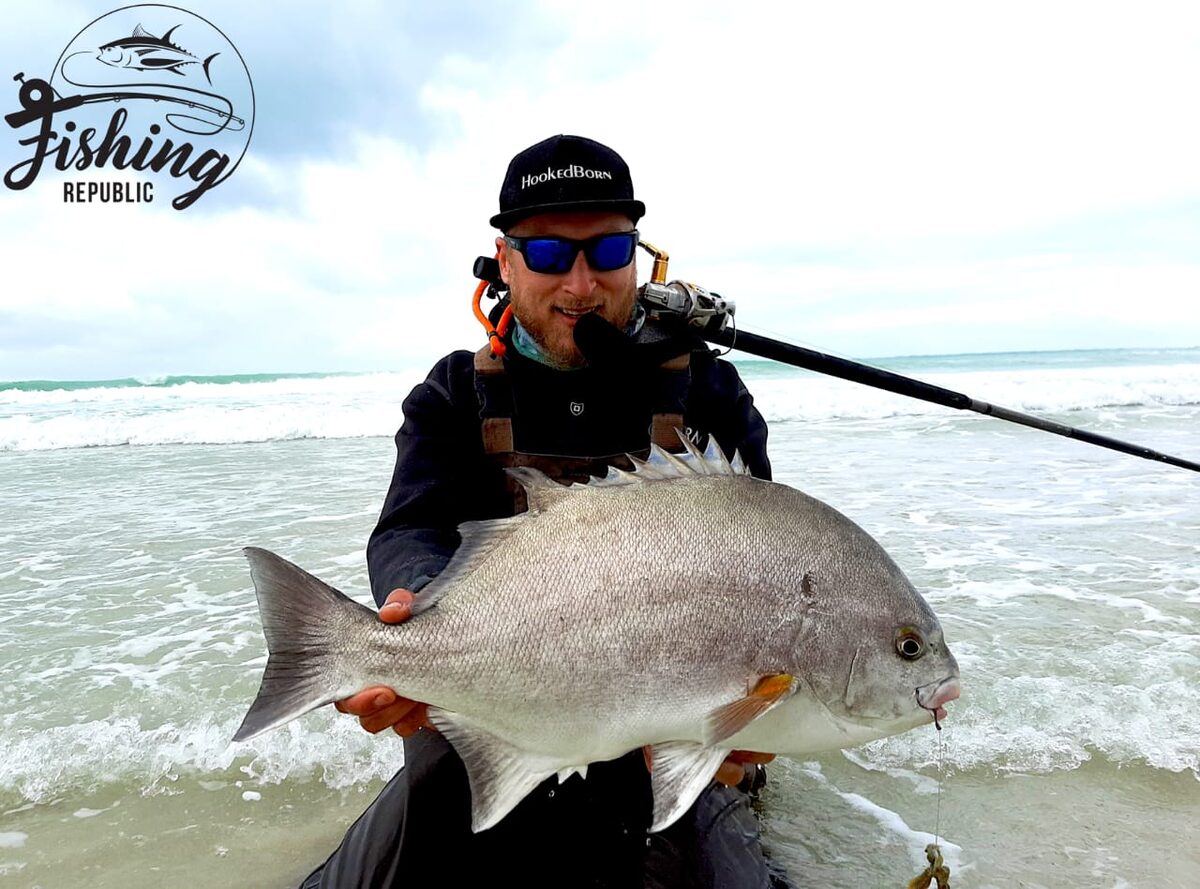
Rocky areas: Galjoen, das, stump, wildeperd, mussel cracker, red roman and many more.
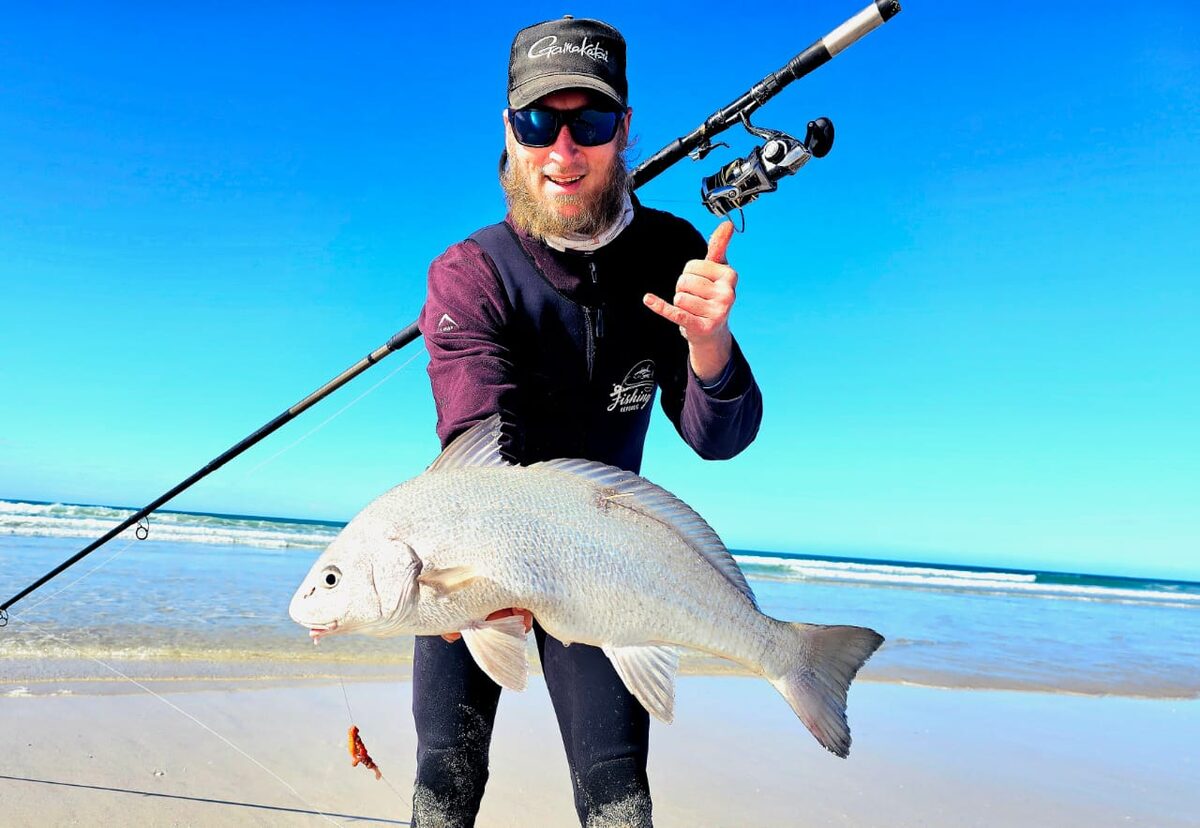
Sandy areas: white steenbras, belman, kob, grunter, stump and the odd big galjoen.
Once you have identified the species and the area you want to target, it’s time to look at your tackle setup and what bait you will be using to target that species. It’s important to target that specific species and do everything you can to catch it, don’t go with the mindset of catching anything that swims.
Let’s look at tackle set-up, for not everyone has a rod and reel suited to every application so what can you do to your one setup to make it work for the rocks and the sand?
Rocky Areas
If you have decided you want to target fish in a rocky area, then the first place to start is your braided leader – whether you fish with 20 lb or 50 lb on your reel it doesn’t matter – the same applies.
Upgrade your braided leader. If you are fishing for galjoen and smaller reef species I would suggest a minimum of an 80 lb braided leader, you can go up to a 100 lb or even 120 lb. If you are fishing areas where mussel cracker are prevalent, onto your braided leader you should fix a 1 m piece of nylon. I prefer maxima ultra green and fluorocarbon for all my leaders. This piece of nylon should be at least 60 mm up to 80 mm for extremely foul areas. This short piece of nylon is extremely important and has saved me on many occasions, it adds abrasion resistance, very importantly, a little stretch and it’s less visible than braid to the fish.
Your hook snoot for fishing galjoen or smaller reef species is generally between 0.55 mm (15 kg) and 0.65 mm (18 kg) in thickness. One can of course go lighter, but at risk of being cut off by a bigger fish on the mussel banks or ledges. Baits include rooiaas, white mussel, prawn, and worm type baits.
I have found that a 2/0 circle hook will catch you all sizes of galjoen and reef species and still handle a bigger fish when it comes along. I will never forget fishing in a storm with my good friend Trystan Vercuiel, he was fishing with a 2/0 gamakatsu in line circle and some red bait when he got absolutely flattened by a proper fish, after a solid battle he managed to land a mussel cracker of over 10 kg on that 2/0. A quality hook is a very important tool.
If you are targeting mussel cracker then one needs to step up your game. You should then fix a proper 150 lb to 250 lb braided leader onto your main braid followed by a 0.90 mm to 1.2 mm nylon section of 1 m to the front of that. Your hook snoot should be minimum 0.80 mm up to 1.0 mm with a strong type of hook ranging from 6/0 to 10/0 depending what bait and area you are fishing.
Fishing on sandy areas
Being able to identify and find the fish in the holes, gutters or sandbank on a clean white beach can be difficult for the inexperienced eye. It takes many years of experience and time at the water to successfully and consistently catch fish on a open stretch of beach.
When you fish a clean white beach with no rocks, one can really downscale on the tackle and leaders. I prefer to fish 20 lb and or maximum 30 lb braid as my main line. I then really downscale my leaders to 40 lb or max 50 lb braided leader which I then connect to a thin 10 kg or 12.5 kg maxima leader line.
When one fishes for belman and steenbras it is very important to fish light! I really like to fish a 10 kg fluorocarbon hook snoot, especially on those super clean and flat days when it seems nothing is happening.
These fish are comfortable feeding in the shallow water on worm and prawn, so best baits are indeed worms, prawns, crabs, mussels and sometimes clean white chokka.
If there is bamboos or grass in the water then one can upgrade your leader to 80 lb or 100 lb. But in most cases this is not necessary. The thinner your leader setup, the less current and wind drag there is. There is there is no need to bully a fish on the beach, take your time, a decent soft drag and a little patience and you will land your fish. Stay tuned for Part Two of this series next month!