

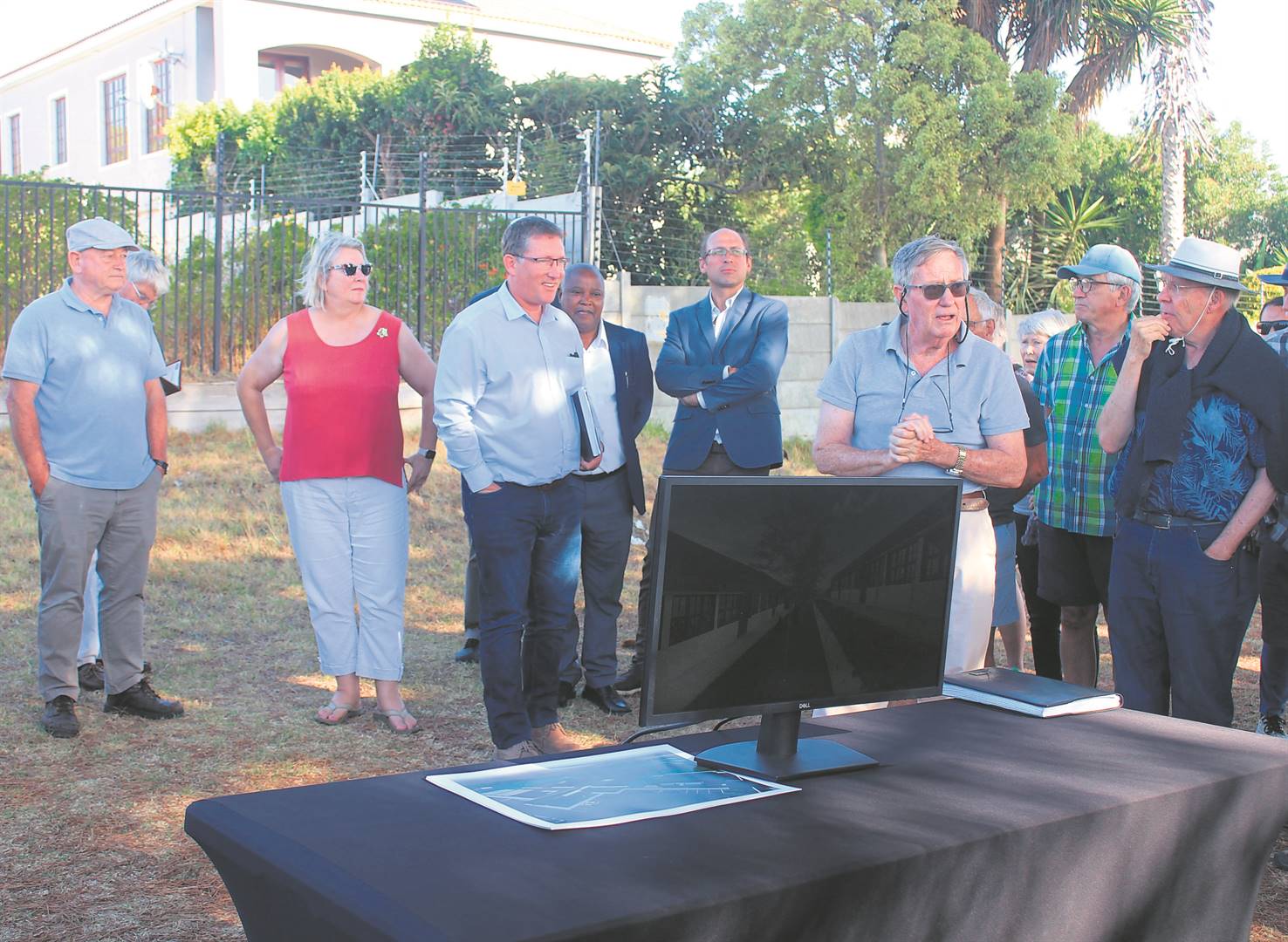
“The last high school built in Somerset West was Parel Vallei High School in 1985, 40 years ago, which highlights the urgent need for another such facility.”
So said member of Provincial Parliament Benedicta van Minnen at a public meeting about the potential new high school in the pipeline for the Somerset West community.
The meeting was held at the proposed school development site, an open parcel of land above the dam located along Steynsrust Road, last Thursday (13 February). She was joined by Ward 15 councillor Gregory Peck and Gerrit Coetzee, director of Physical Resource Planning and Property Management at the Western Cape Education Department (WCED), among other representatives of key role-players.
Coetzee addressed a large crowd of interested and affected residents, many of whom attended the meeting, confirming that its purpose was to introduce the new school-build project planned. He said the intention is to build a high school with a capacity of just over 1 000 learners, 30 classrooms plus two specialist classrooms, a multi-media room, full admin block, and a hall and sports field.
While there will be a focus on science, technology, engineering, and mathematics (STEM), Coetzee said the school is intended for academic subjects, not vocational training.
“The school is also intended to be a fee-paying government school, similar to other schools in the area. While the district office typically handles the establishment of the school, residents will be involved in setting up a school governing body, which determines the admission policy including the medium of teaching and shapes the school’s character,” he explained.
Planned start date
According to Peck, a boundary discrepancy, where rates and taxes were being paid to the City of Cape Town for the property (erf 6840) actually being located within the Stellenbosch Municipality, is delaying project document sign-off and potentially pushing back the planned construction start date in March. With construction typically taking about two years, a definite opening date cannot be committed to due to factors beyond control, he added.
A staffer of Moffett and Moffett Architects confirmed the design brief, noting the site’s slope and proposing terracing to minimise visual impact. He further noted that all stormwater issues had been resolved.
“The project is part of the department’s rapid build programme, which aims to build high-quality brick-and-mortar classrooms designed to be functional and relatively aesthetically appealing within budgetary restrictions,” he explained.
Construction and learner intake would be implemented in a phased approach. While the traffic impact was a recurring matter leading to numerous questions raised by residents over congestion along an already-busy route, the architect assured those in attendance that a full traffic assessment had been conducted.
“A new traffic circle will be introduced to aid traffic flow. Ample parking will be available on-site and the school will encourage parents to drop-off their children within the school grounds to prevent traffic congestion.”
Coetzee further explained that 101 on-site parking bays are planned and that the parking area design will facilitate vehicle entry, circulation, child drop-off and exit via a thoroughfare allowing for two-way traffic. “Plans have been submitted to the City’s planning and spatial development department. The City’s team consults traffic engineers, who in turn review, assess and approve the plans based on local regulations. If a provincial road is affected the City refers the plans to the provincial traffic department.”
Zoned education
Addressing questions regarding the proposed location, given that there is a greater demand for a school in surrounding areas like Croydon where housing developments are underway, Coetzee said the site had been designated for educational purposes many years before and was zoned accordingly.
“Zoned education sites are rare. The last one was in Macassar, where a school was recently built.”
Van Minnen said while community input is valued and will be considered as plans progress, the site’s pre-existing educational zoning removed the legal requirement for further public engagement. “The focus now is on moving forward and collaboratively making the project a success.”
A resident in support of the new school, asked whether infrastructure upgrades were planned, specifically around water and sanitation.
Peck replied: “Infrastructure is getting old. There was a time period from the ’90s through to 2018 when pipes were not replaced. The City is currently replacing 150 km of pipe per year.
“There is no problem with the capacity of sewer lines or the capacity of water, but there is a problem with the volume of water when there is a drought. However, this is being managed.”
The proposed site is a popular recreational spot for, among others, walkers and cyclists, and queries around restricted site access and road-user safety were raised. Officials encouraged the use of the upgraded Poinsettia Park and assured that non-motorised transport will be a key component of a traffic management plan following a successful boundary demarcation in 2028 to incorporate more vineyards and upgrade the road.
“Having taught at Somerset College and observed this site for many years, I’ve long known it was destined for a school, a vision I’m now delighted to see realised with my own grandchildren,” one resident said. “To those whose homes are newer than 20 years, consider yourselves fortunate to live near a school, especially at your age. This is a community school, and its strength will come from the community.”
Earlier this month, DistrictMail & Helderberg Gazette reported on the project not having received the green light (“No nod yet for new school,” 5 February).
This week WCED spokesperson Bronagh Hammond confirmed the department has completed the planning, but is yet to finalise the project due to the boundary discrepancy.


