

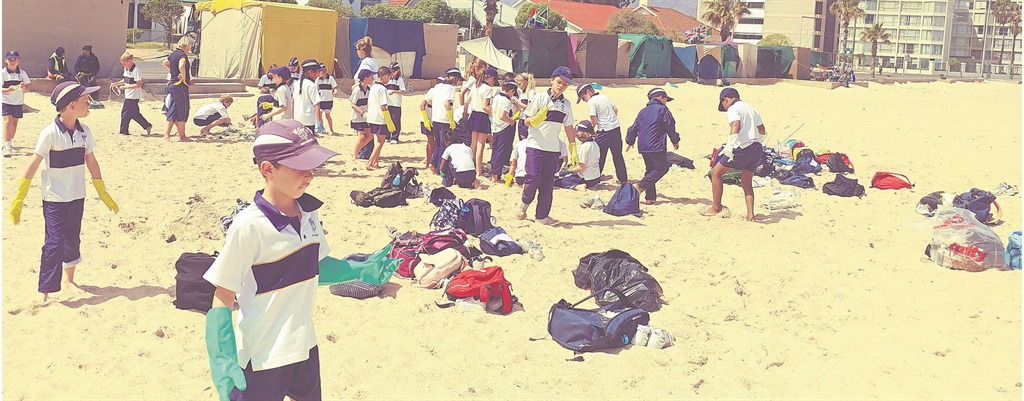
In a matter of hours, Grade 3 pupils of Beaumont Primary School collected 3 020 chip packets and sweet wrappers, 1 732 plastic bags, 1 261 cigarette butts, 947 straws and 646 lollipop sticks on Strand Beach.
This is, however, only a drop in the bucket of the tons of litter polluting the ocean daily.
A recent study showed that a truck- load of litter is dumped in the ocean every minute.
Over the last number of years, Beaumont, an eco-friendly school, has made a large contribution offering its time and resources to collecting litter on the beach.
The ocean clean-up is part of an annual project conducted by the Grade 3s at the end of the third term.
Having joined the Wildlife and Environment Society of South Africa (WESSA) Eco schools programme in 2008, Beaumont was awarded green flag status in 2009, bronze in 2010, silver in 2011, gold in 2012, international flag status in 2013 and their first platinum flag status in 2014. They are currently in their fourth platinum year.
They also received a gold certificate for their efforts in 2012 and the Green Business Award in 2014.
Last year, the school was voted one of South Africa’s big 5 eco-friendly schools.
Joanne Trinchero, head of the school’s Eco Department said they decided to change things up a bit this year to involve the whole school and educating the broader community on the importance of recycling and ridding the ocean of toxic plastics.
Dr Sylvia Kirkman, a biodiversity conservation specialist and Beaumont parent, was also brought in to assist with the project.
The Grade 3s took to the beach on Thursday 28 September, combing the area for litter, starting at the surf club all the way down to the tidal pool.
Then, the hard work started, sorting through all the litter and categorising it.
Kirkman said they were shocked by the result.
During an assembly last week, she provided some feedback on the beach clean-up data. Other items included 525 cold drink lids, bottle tops and beer caps, 237 glass pieces and 237 disposable nappies, sanitary towels and wet wipes.
Sand and water samples were taken back to the school for the Grade 4s to test for micro-plastics.
The Grade 5s were responsible for drawing up graphics based on the data gathered, while Grade 6s and 7s had fun converting the recyclable materials into pieces of art, building sea animals and recreating sea life out of the same toxic plastics that threatens the fragile creatures.
The art is on display in the school’s entrance hall.
Kirkman reminded pupils of the three top plastic polluters: balloons, plastic bags and straws, and encouraged them to educate others on the negative impact plastic has on the environment and the ocean.
Trinchero said they hope the pupils effort will inspire the broader community to become actively involved in recycling and doing their bit to help prevent plastic pollution.


