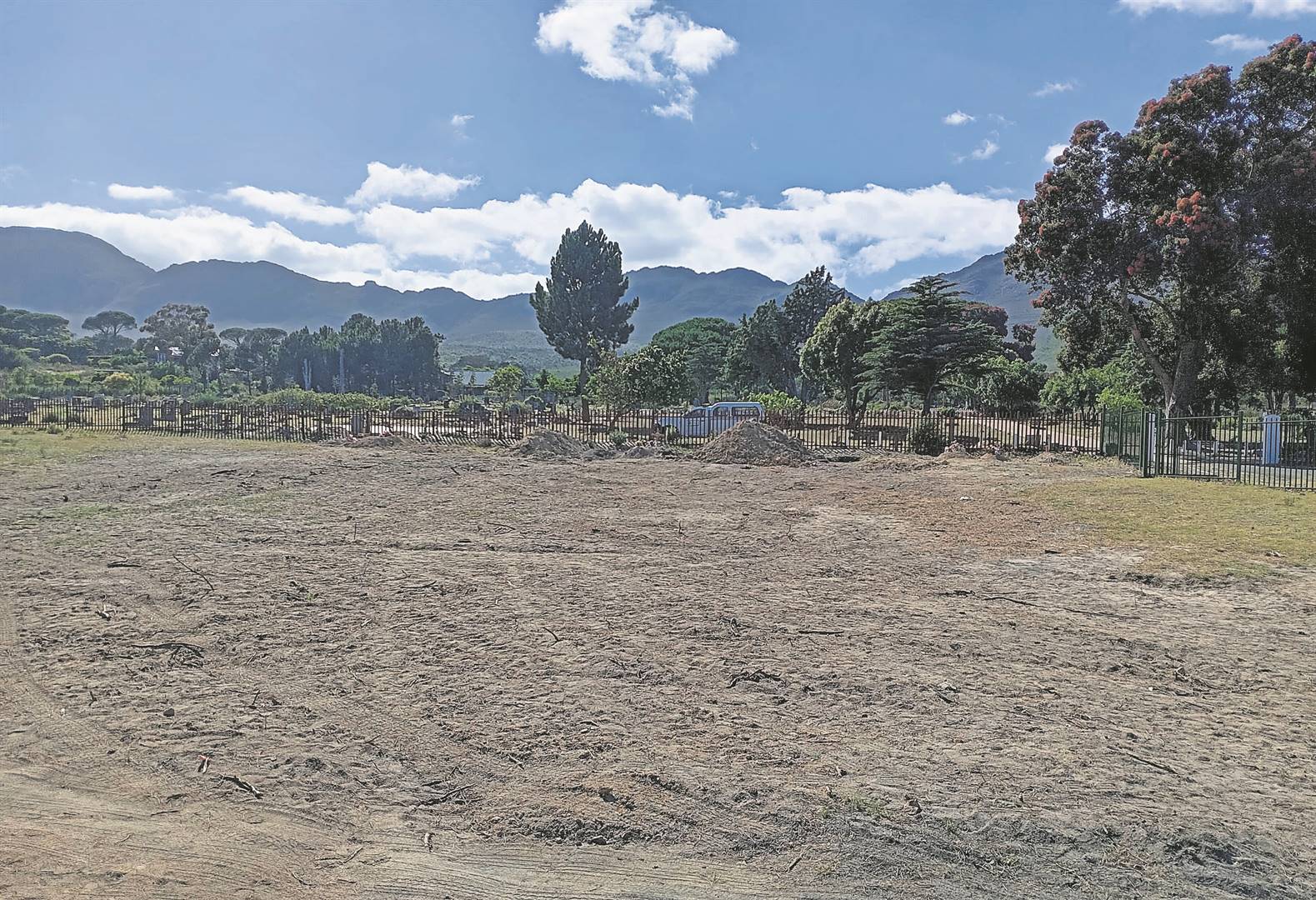

The shortage of cemeteries and burial space in the Helderberg continues to be pressing issues for communities of the basin, as most are forced to bury their loved ones several kilometres from home in areas like Eerste River, where up to 40 burials are held weekly.
To counter this shortage, the City of Cape Town initiated a process to establish a new cemetery in the Helderberg 10 years ago, but the planned facility has not materialised due to apparent discrepancies with the tender and later the environmental impact assessment (“New cemetery for Somerset West”, DistrictMail, 26 April 2012).
However, Patricia van der Ross, Mayoral Committee member for Community Service and Health, said the project is still on the table.
“The Vaalfontein Cemetery is still in the planning and approval process,” she said, adding that the extension of the waste transfer drop-off site in Firgrove had been the cause of delay to the project more recently. This meant that the Cemetery Site Development Plan had to be amended accordingly.
Asked to elaborate on the existing cemeteries’ capacity in the Helderberg, Van der Ross said the Rusthof Cemetery in Strand is earmarked for extension and a preliminary scoping exercise was done for an environmental impact assessment (EIA), with the application for environmental approval currently under way.
“This extension will provide the equivalent size of the existing cemetery, which will double in size,” she said.
“The City plans to address shortages of graves by extending Rusthof Cemetery, encouraging reuse and reopening of private graves for on-top burials, where sufficient depth is conducive; encouraging cremation where religion and culture accept such practices; extending Sir Lowry’s Pass Cemetery; and finding opportunities in old cemeteries for infill graves, where pathways are not essential and can be converted to burial space.”
According to Garrith Hendricks, owner of Hendricks Funerals, which services the Helderberg, the biggest issue the limited options for families to have funerals in this community.
“It’s difficult for many families and most do not have a choice but to go to Welmoed Cemetery in Eerste River or elsewhere, which at times can be very inconvenient. There’s no graveyard in Macassar as well, so there are many communities affected by this issue.”
Cassim Peer, chairperson of the Gordon’s Bay Islamic Society (GBIS), said there is an urgent need for a Muslim cemetery in the area, with the closest one being up to 40 to 50 km away.
“The GBIS has expressed deep concern at the absence of a burial site for the community and accordingly set up a meeting with the City where this requirement was tabled and an urgent solution was sought. We require assistance with the allocation of a permanent cemetery as well as an interim solution to the problem of burial. The City officials undertook to investigate the matter urgently and revert to GBIS within the next few days. The officials have indicated that there are some plans in the works and we are confident that this matter should be resolved as soon as officials are able to finalise the process.”
Van der Ross indicated that no exact statistics are available for current capacity at cemeteries, but those further away from Helderberg have sufficient burial space. “The community will need to become accustomed to burying further away from home in future, as local cemeteries have reached their limits and open land is not necessarily environmentally conducive nor suitable for cemetery development,” she said.
Ward 15 councillor Gregory Peck concurred, adding that he continues to engage with the team that manages the cemeteries in the Eastern region. “There is a shortage of open space for graveyards and the plans for the Vaalfontein site are, after a number of delays, currently being redesigned and the type of graves decided,” he pointed out.
“There is a possibility of some family grave sites that can be used multiple times by a family.”