

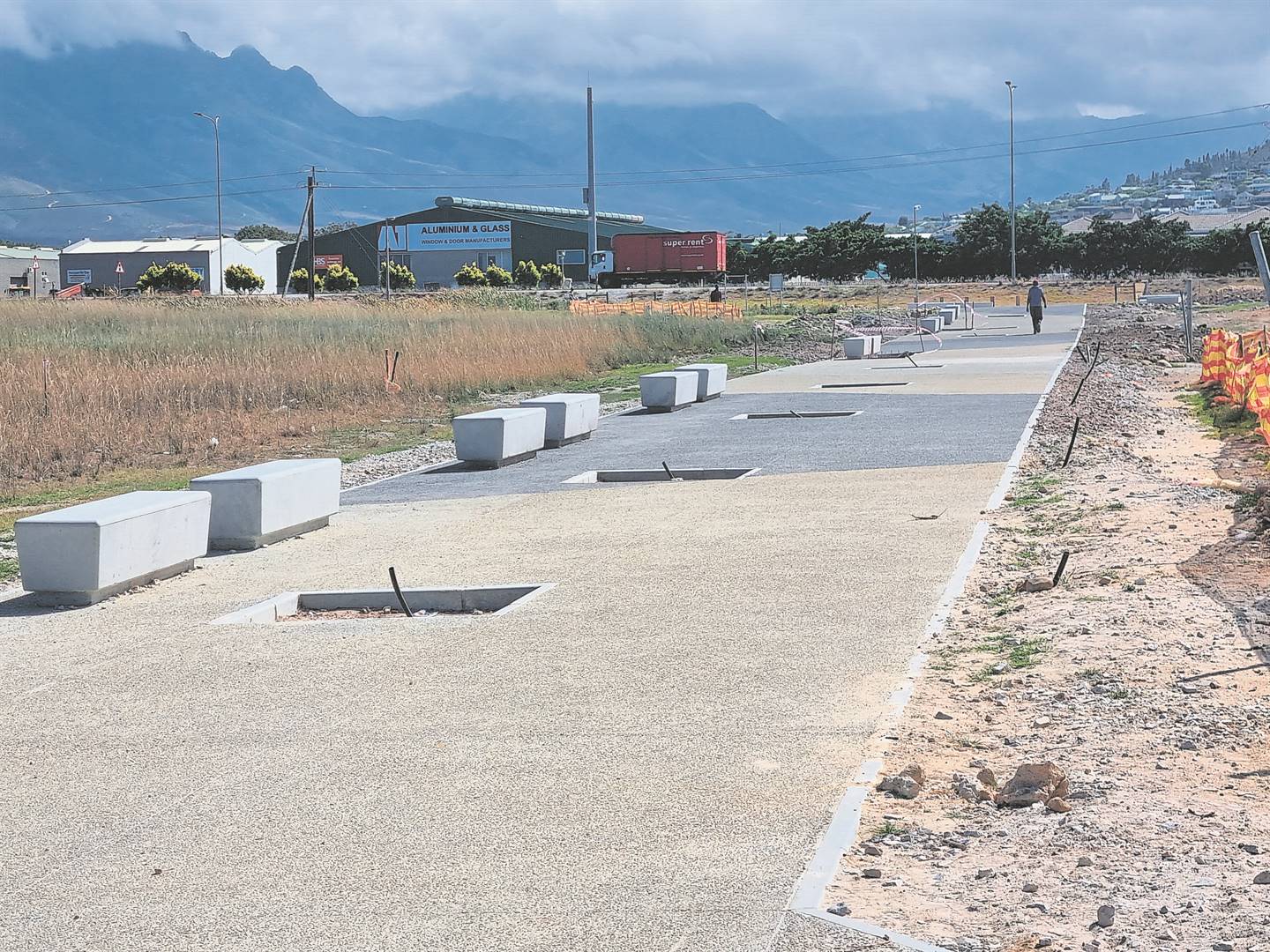
The Asanda Village Wetland is a large public open space that forms part of a pedestrian route between the Van der Stel Train Station, the N2 freeway, three adjacent schools and surrounding residential areas of Asanda Village, Nomzamo and Lwandle.
“Those driving past, or living in the vicinity, would have noticed some activity lately on what used to be a dumping ground, full of litter and filthy dammed water,” says Alderman Eddie Andrews, Deputy Mayor and Mayoral Committee Member for Spatial Planning. “I am happy to say we are hard at work transforming parts of this 5-ha site into a children’s play park with paths for cyclists and pedestrians, while repairing the stormwater drainage system and rehabilitating the wetland to turn this into a healthy ecologically functioning system again.”
The City identified this site for restoration some time ago after realising the site had initially been set aside for conservation purposes prior to the development of Asanda Village. Environmental reports at the time indicated fairly diverse and abundant fauna, frogs and birds supported by the wetland.
“The City’s investment in this project amounts to about R16 million,” Andrews said. “I visited the site recently to witness the progress to date. I look forward to the completion day, and I’m sure the local community does as well.”
Security, access and recreation were identified as top priorities by the community during the design process.
In 2019 a multidisciplinary team was appointed to do the detailed designs for the Asanda Village Wetland Park, the objectives being a rehabilitated and ecologically functioning wetland area and a formal non-motorised route through the public open space – meaning, a walkway that can be used by pedestrians and cyclists. These objectives include a stormwater system, hard and soft landscaping upgrades and multi-use recreational and play areas.
The detailed designs were informed by assessments and investigations undertaken by the professional team to address the lack of maintenance and degradation of the wetland, illegal dumping and littering and the poor stormwater management system.
The detailed designs were shared with the community in October 2020 when further input was provided.
“Construction commenced in June 2022 and is currently underway,” Andrews said. “If all goes as planned the project should be completed by June this year. Once done, we will have a healthy functional wetland and a green space for children and the local community.”
He mentioned surrounding property owners also stand to benefit from the new upgraded stormwater system, which will ensure proper drainage of the area, mitigating flooding and ponding, in particular during the wet winter months.
“We are extremely proud of this project, and I want to thank the community for their interest and support. The protection of our natural areas is vital; it gives our children and residents green spaces in the middle of the city where they can interact with nature.”
Dr Liz Day, specialist freshwater ecologist, who accompanied Andrews on the site visit, said the viability and success of this project rested with the effort the City will have to put into managing the solid waste and enforcement of the management plan for the wetland, among which controlled grazing, removal of solid waste, controlling human movement and encouraging local people to use it as a recreational space.
“Addressing solid waste is, I believe, the greatest challenge in making parks such as this one an amenity for communities. The condition of wetlands and other water courses is a real gauge of the condition of the catchment, and in a city, this translates into a real reflection of successful service delivery,” says Dr Day.
Andrews added that in November last year the City of Cape Town was granted accreditation as an international Wetland City.
“This is a huge honour and recognition of the best-practice work that the City has undertaken with innovative policies and plans to ensure Cape Town’s wetlands are protected, rehabilitated and restored,” he said. “We are continuing this work. The Asanda Village Wetland Park project is another example of our commitment to preserve our natural assets. This is a key priority for the City, not only because it is the right thing to do, but also because our natural environment protects us from natural disasters and ensures our future resilience to climate change.”

