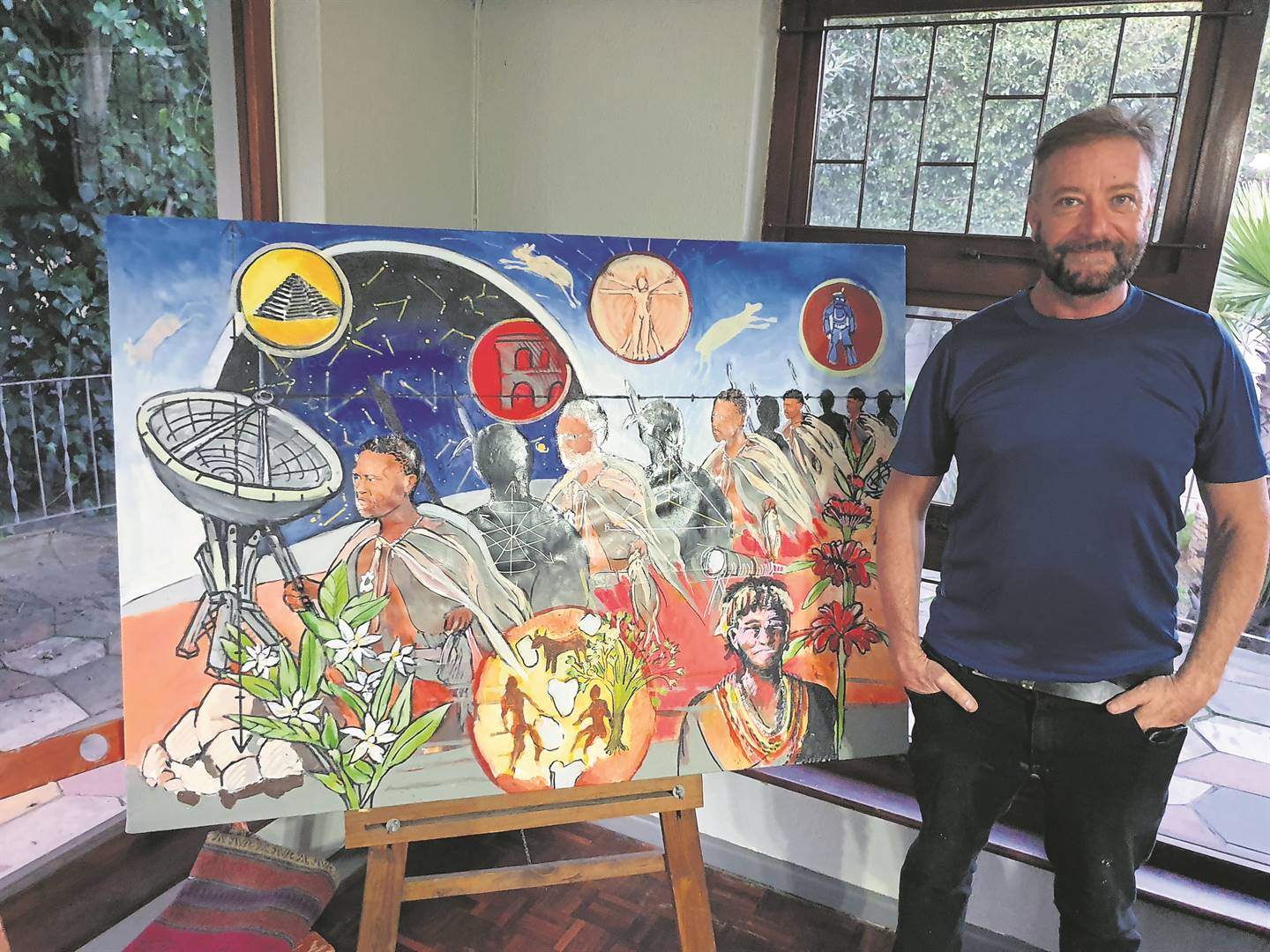

The Gordon’s Bay-based artist, children’s book author and technical-artwork illustrator Will Joubert Alves was the natural choice to create an artwork that would best illustrate the University of the Western Cape’s (UWC) Science Week initiative to remind learners to look back while advancing forward with technology.
The institution is working around-the-clock to get learners interested in science, but also to provide professional development to science teachers. The Science Learning Centre for Africa (SLCA) invited school learners in the Western Cape to a full programme on Saturday 5 August during Science Week.
The theme of Alves’ artwork was Tracing Humanity’s Artistic Dialogue with the Universe, Science and Mathematics Through Time.
Growing up in Zimbabwe and South Africa has given Alves a disposition for bold colour and a love of nature and botany. He worked in the Northern Cape as a craft development specialist for the Northern Cape Arts and Culture Council, where he assisted disadvantaged communities to develop their art and craft skills.
The artist has painted for many years and also branched into textbook publishing, doing artwork for over 600 textbooks, specialising in science, biology, mathematics and technology. His interest is in holistic living and natural medicine, and using art as a therapy to heal.
Alves said about the artwork he created: “As humanity heads towards the next level of existence, let us not forget our origins and the knowledge preserved and passed down through our ancestors. Technology is a tool that can lead us back to the source and, if used wisely, it can protect and not destroy what we inherited, Mother Earth, and the astounding secrets of the universe we yet have to fully discover”.
UWC’s Professor Josef de Beer, the director at the SLCA, who hosted the Science Week event that featured a science-art competition, commented on the symbolism behind the artwork.
“It captures the artistic interpretations of science and the universe through the ages, highlighting the deep connection between art and human intellectual pursuits. The artwork depicts five dominant eras: ancient civilisations such as the Mayans and the San; the Classical World with dominant Greek and Roman influences; the Renaissance which was characterised by scientific exploration; and artistic reawakening.
“In the artwork, Leonardo da Vinci’s Vitruvian Man is shown the Enlightenment, which brought much scientific progress and scientific discoveries such as microscopes and the telescope, and the current stage, the Fourth Industrial Revolution, depicted by the image of a robot, in the era of artificial intelligence.
“Central in the artwork is the Khoisan. Carnarvon in the Northern Cape is both the home of the SKA radio telescope and the Khoisan. It speaks to the motto of UWC, ‘Respice Prospice’, looking back, looking forward. We need to learn from our rich indigenous knowledge.
“The San expressed their knowledge of the universe and nature through their rock art, which is also shown in the painting. The Khoisan people are scientists with a wealth of knowledge of plant use (ethnobotany). In the artwork, Aloe dichotoma (the quiver tree) is shown, which was used as quivers for their arrows. Also shown is the Eland, which played an important role in San belief, ritual and rock art.”