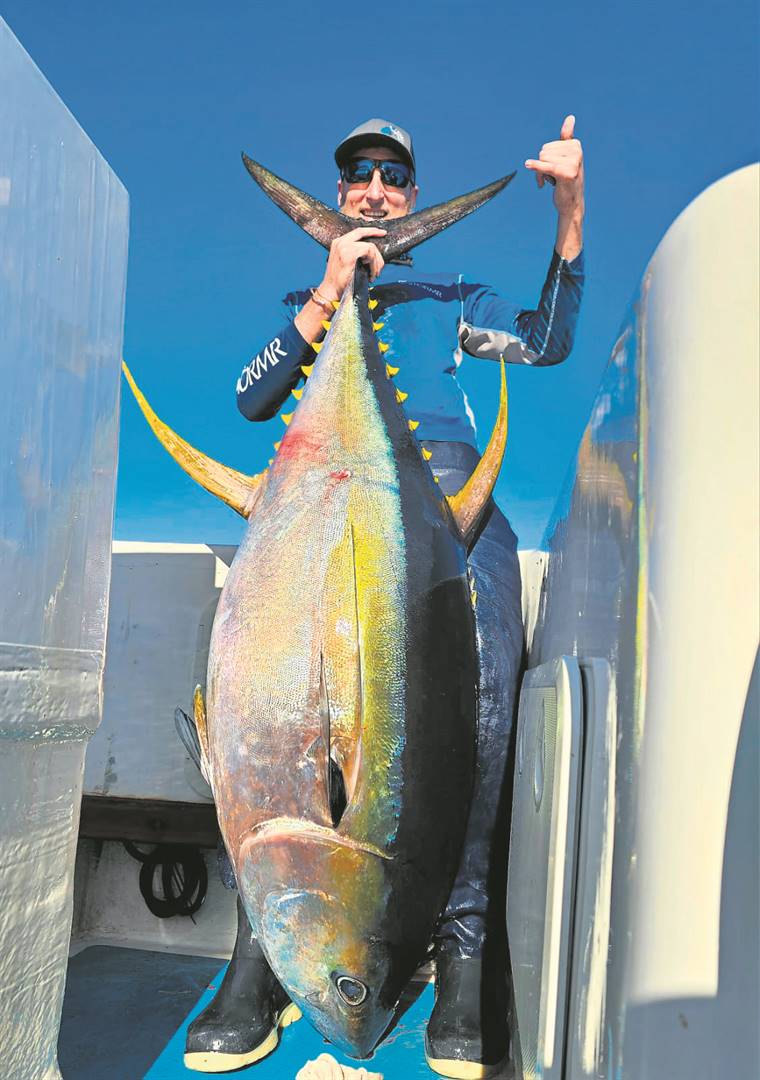

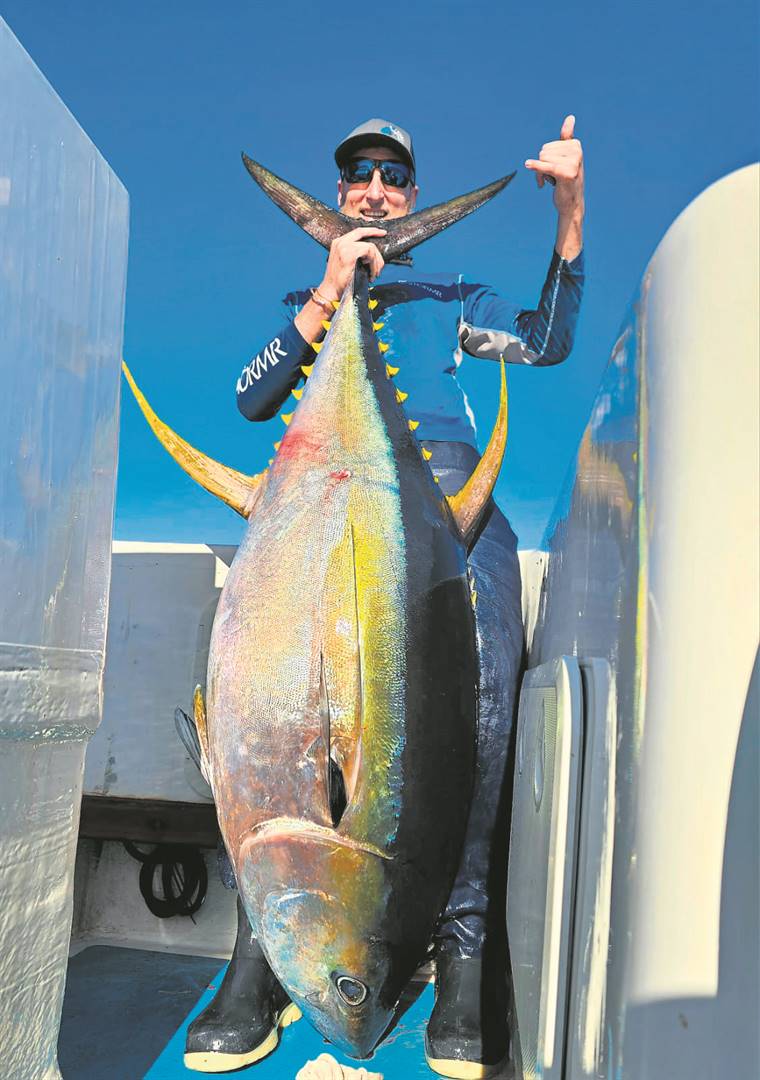
This time of the year is one of the best times of the year to head offshore and target a serious fish, a fish every angler dreams to one day catch and a fish that has broken many hearts with its speed and power . . . let’s focus on the famous yellowfin tuna of the Cape.
With the offshore tuna classic being hosted by Gordon’s Bay Deep Sea Angling Club as we speak, we thought it would be a good idea to talk about this facet of angling this week.
Cape Town is well renowned across the world for having one of the best tuna fisheries in the world. Not only in terms of numbers but in terms of size too. Many fish are caught each year in the 80 kg class and then there are those who are lucky enough to catch a 100 kg plus monster fish. It is a dream for most avid offshore anglers, but a dream that can easily become a reality when fishing off Cape point in the beautiful deep blue water off the canyons.
In the old days there use to be a brilliant bluefin tuna fishery off Cape Town too, but unfortunately most of these fish were wiped out by overfishing. There are, however, a handful of bluefin tuna caught each year often weighing over a 100 kg.
The tuna grounds lie around about 20 miles offshore off Cape Point, the most famous area is called the canyon, but the fish, however, move with the currents and can sometimes be found way in the west, which can be a 110 mile or more run around the point and up the West Coast.
The hardcore tuna fisherman, especially the commercial captains are constantly on the prowl, watching conditions and listening out for any news on tuna sightings on the various networks they have available to them. Once there is even the slightest news about tuna fever, the guys ready their crews and boats, stock up with the necessary tackle and trawling lure and load the boat with loads of 5 kg boxes of sardines for the purpose of chumming for the tuna.
There are two main ways to target yellowfin tuna, so let’s discuss the basics of these two types of fishing.
Tackle: The typical tackle used by tuna fishermen is very simple but very robust and strong, able to handle numerous big fish over many tuna seasons. Most boats fish with Shimano Tiagra 50 w or 50 wlrs or 80 w size reels, for those who don’t know the 50 wlrs is a 50 w with a 80 w drag system. Guys fish with 50 lb or 80 lb mono straight or onto of some sort of braid backing. Rods are standard 50 or 80 straight or bent but big game rods for clipping into a black magic harness.
Guys are using 80 to 150 lb fluorocarbon hook shoots onto 10/0 short shank tuna style hooks like the mustard hoodlum 10/0 or bandit 8/0.
Trolling: Once the boats reach the tuna grounds after a long run they need to try find out where the fish are feeding, to do this they start to search for the fish by trolling lipped lures, squids and small konas attached to a bird along the various contour lines and marks they have built up over the years. One can also spot jumping fish and find the fish sitting deeper with a good sonar. The lipped lures consist of deep and shallow diving rapala magnums, x–raps, halcos and / or speedpro lures.
The guys often troll a white squid behind a Williamson bird on the shotgun rig. This seems to be a standard and very successful setup which is widely used by the fleet to successfully get the bite.
Chumming: Once a fish is caught on the lure the guys will often start working that area with the chum. You usually have one or two guys constantly cutting chum pieces, creating a long chum line which the fish will hopefully move into and work there way up towards the boat. Boats can work through 100 to 200 kg of chum in one day trying to get the fish into there chum line. It is hard work.
It is an amazing experience to throw chum into the water and watch how these massive tuna with big yellow fins appear out of the deep blue water and eat bait right under the boat. There movements are majestic and powerful. They are called gas bottles for a reason as once they are hooked, they are incredibly powerful and fast.
Once you have the fish working the chum properly, you can then bait up a hook and drift it with some chum pieces and watch as one of these monsters engulfs your chum piece in front of your eyes. That is the moment you watch your line pull dead straight and watch your heavy tuna rod start to bend towards the water, followed by the growl of a tiagra 50 w or 80 w ratchet which is unmatched. Only a big tuna can make a tiagra sing like that.
These fish are incredibly strong and put up a battle like no other, it is well documented where anglers battle fish for over five hours and sometimes more. A true adversary.
Although these are the main two ways of targeting these fish, there are a handful of guys who use poppers and stick baits as well as jigs to target these fish. If you are wanting to do this, make sure that you tackle up correctly and double check your knots because you are in for a serious battle.
20k Stella- or Saltiga-type grinders with 80 lb braid and strong jigging and popping rods are required. Make sure you have a solid rod bucket and bring some deep heat for the pain. The fish don’t always eat the popper or lure but when they are on and feeding properly it can be a very successful way of targeting these fish.
Sometime the fish like to sit a little deeper, this is where dropping a 80 to 150 g type jig down and working it through the water column can really do the trick for you if nothing else is working.
If you get the chance to head out to the deep, don’t let it pass, never mind the fishing itself, the ride out there is amazing enough, with whales, dolphins, sunfish and many other species of marine life being regularly spotted on the way to the tuna grounds.
Once you are deep offshore, the water colour changes and the raw beauty of the ocean really comes on display. One would think there is no life in 800 m of waters but this is far from the case.
This is truly a species of fish that every angler should have on his bucket list. I was lucky enough to recently be invited on a tuna trip and it is even more amazing when you look down and see the shine and outline of big yellowfin tuna attached to the end of your line, believe me, it will be a fight you will not forget anytime soon.
If you would like to learn more about this type of fishing or need tackle or bait, feel free to visit us at Fishing Republic situated opposite the municipal swimming pool in Strand. Alternatively, call us on 072 552 4400 and check us out on Instagram or Facebook.