

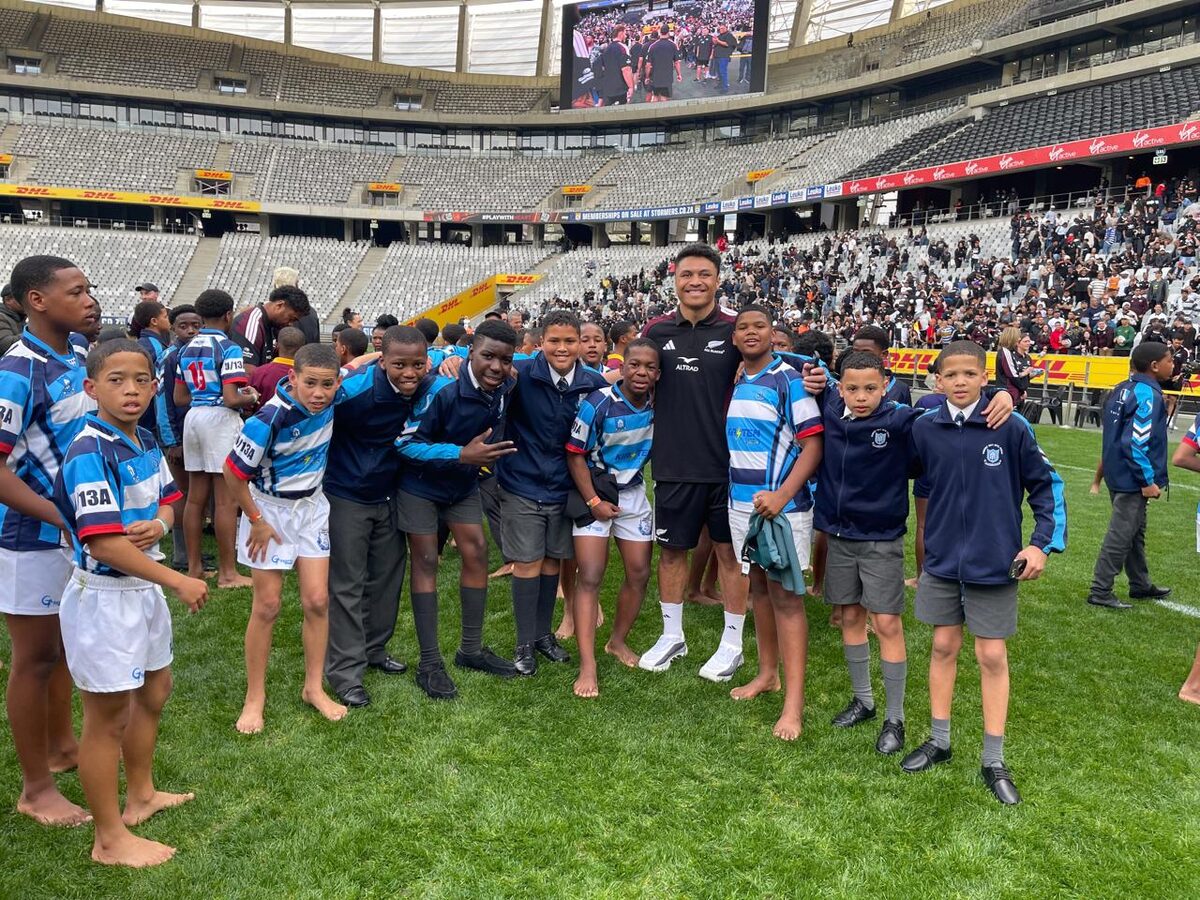
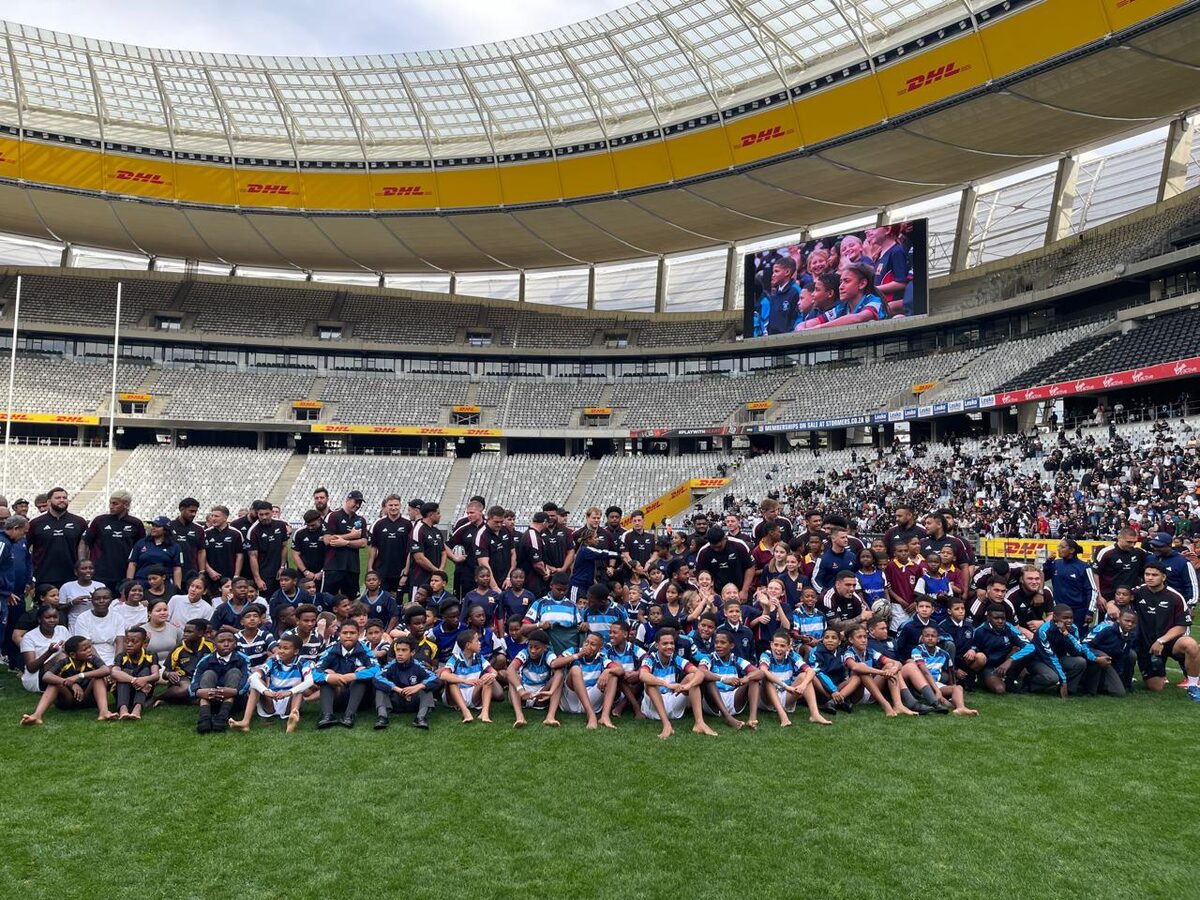
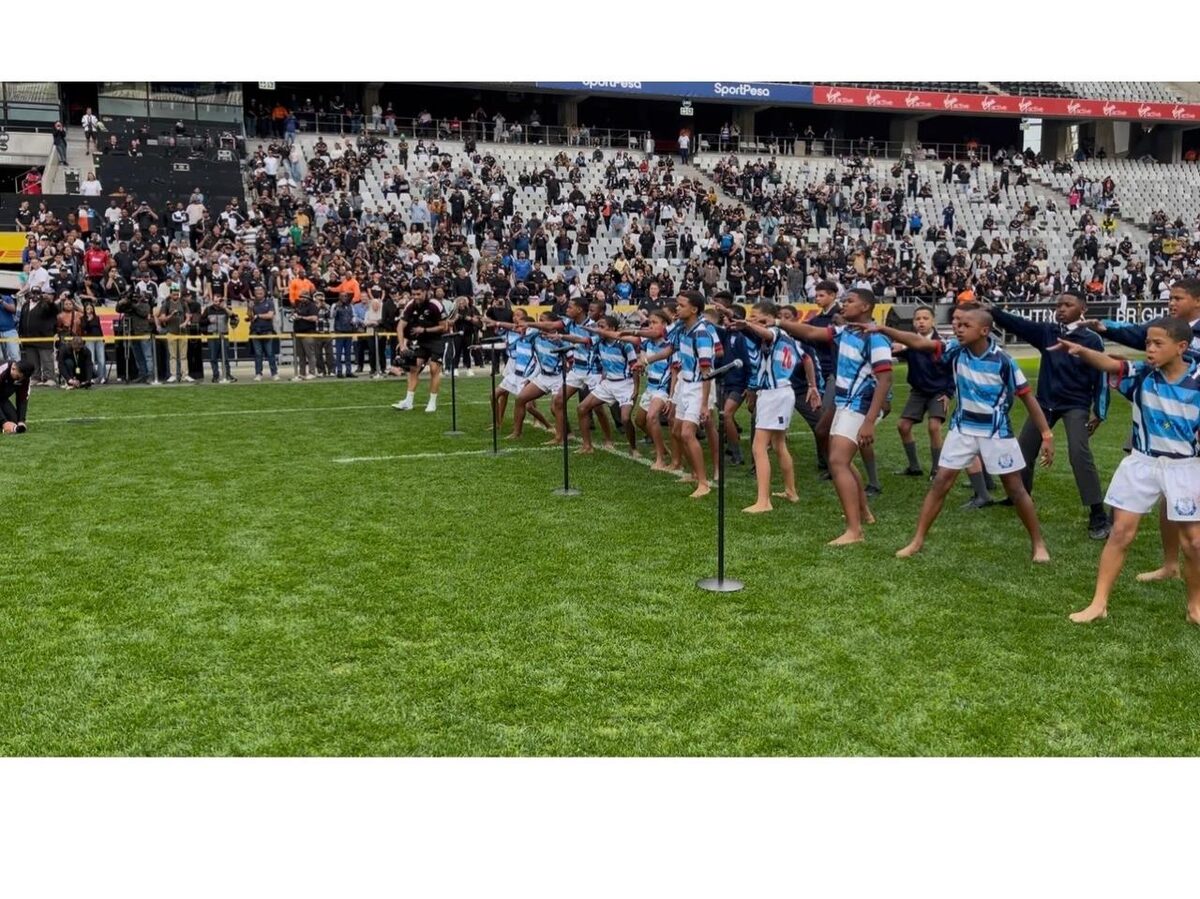
When the young rugby players of Somerset West Methodist Primary School stepped onto the turf at DHL Stadium to perform their war cry in front of the touring New Zealand All Blacks on Friday 31 July, they were doing far more than putting on a performance. They were carrying a 33-year-old legacy and completing a remarkable 30-year full circle.
Affectionately known as the Metho Squirrels, the primary school learners delivered a powerful rendition of the Metho Spirit, their unique isiXhosa war cry, as part of the All Blacks’ “Welcome to Country”” ceremony arranged by sports agency Moonsport.
For the learners, standing face-to-face with international rugby icons was an unforgettable moment. But for the broader school community, it was the continuation of a story that began three decades ago.
History runs deep
While often referred to as a “haka” locally, the school’s leadership emphasises that the Metho Spirit is a deeply personal cultural tradition.
“It is a cry from the heart,” explains Winston Baard, coordinator and head of rugby at Somerset West Methodist Primary. “It represents who we are as the Metho Squirrels and forms an important part of the identity and traditions of our school.”
First created in 1993, the war cry was originally chanted in English before being translated into isiXhosa by the late Terrance Nduna, a former learner. Over the past 33 years, the Metho Spirit has been performed before matches, to welcome guests, as a farewell greeting, and during memorial services for members of the school family.
“We were certainly inspired by the All Blacks, but what we have at Methodist Primary is our own, unique expression,” Baard relates. “The Metho Spirit is now 33 years old, and we maintain that it should never be commercialised because its meaning goes far beyond entertainment.”
Captured in time
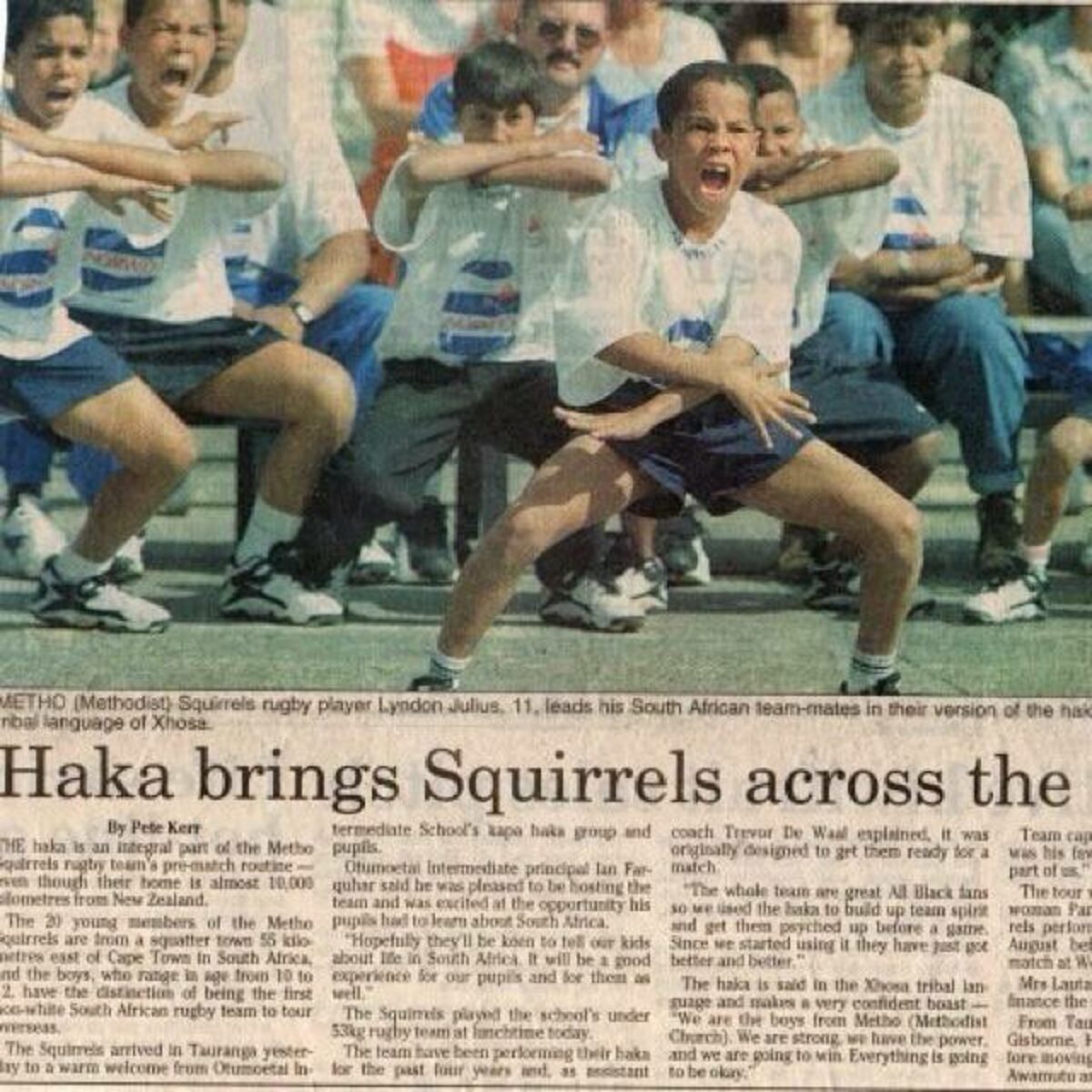
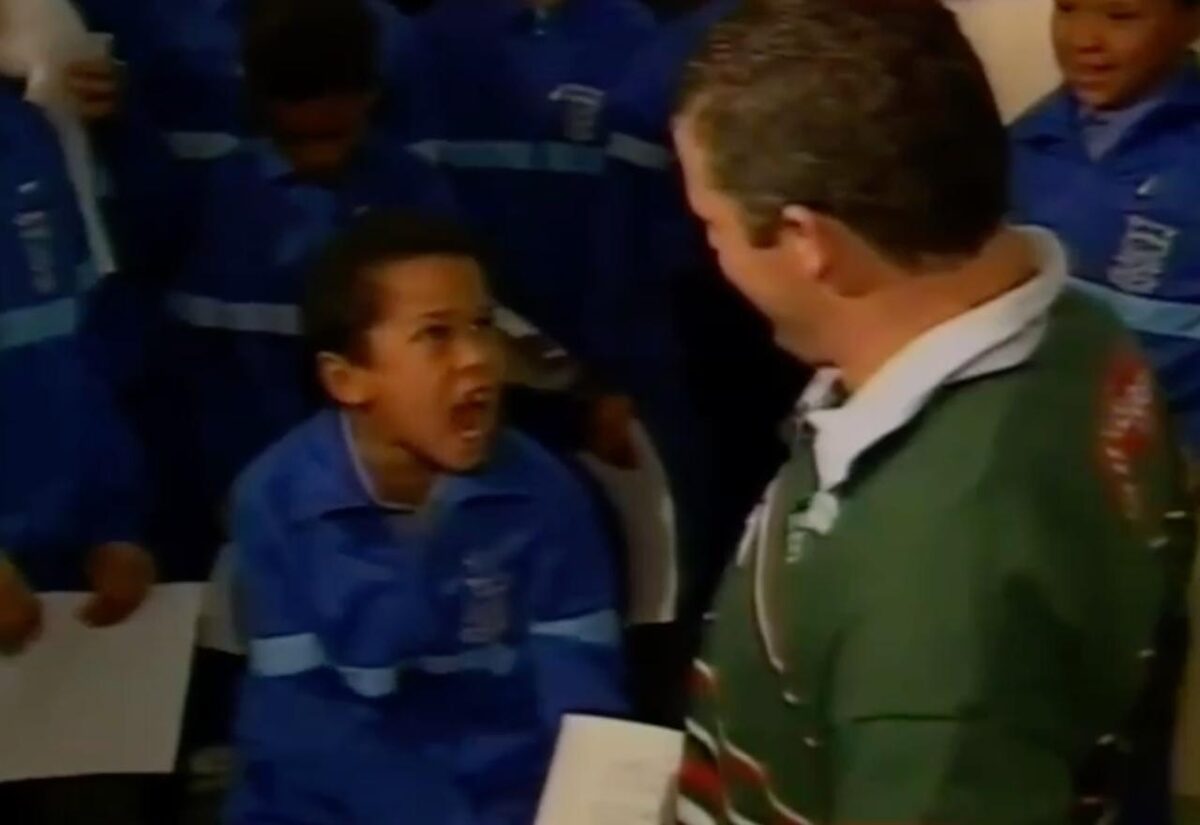
In the mid-1990s, a previous generation of Metho Squirrels famously performed the war cry for the touring All Blacks at the Lord Charles Hotel in Somerset West.
Lyndon Julius, now the media and communications manager at the Sanlam Boland Kavaliers, was the learner who led the war cry that day 30 years ago.
“We waited for hours outside the entrance of the Lord Charles Hotel,” Julius recalls. “The moment we saw the All Blacks’ bus, all the fatigue and hunger from waiting almost instantly left our bodies. I remember everyone and everything went quiet, and the next sound that was heard was my voice, shouting as loud as possible to get the ‘haka’ underway.”
Julius even performed a personal rendition for legendary former All Blacks captain Sean Fitzpatrick, his childhood hero – a moment captured in the local newspaper at the time.
That performance set off a chain of events leading to a historic six-week tour to New Zealand in 1997, making Methodist Primary one of the first non-white South African primary schools to tour abroad.
Unifying effect
The boys who performed in the 1990s have since gone on to become teachers, chartered accountants, engineers, lawyers and sports leaders.
One former learner, Wilton Hindley, took the connection even further, moving to New Zealand where he currently serves as a professional firefighter.
“The ‘haka’ is a sign of strength and unity,” Hindley says from New Zealand. “When I tell people here in New Zealand the story of doing the ‘haka’ for the All Blacks in 1996, their reaction is one of wonder. Due to the culture here, people understand the meaning and are deeply curious about how this cultural art reached a primary school in South Africa.”
Hindley sees strong parallels between the war cry he performed as a young boy and his work in emergency services today.
“In firefighting, we work together to perform a task and get the desired outcome,” Hindley notes. “We are stronger together than as an individual. A team is only as strong as its weakest player, so we pick each other up.”
‘Something special’
Preparing for the DHL Stadium performance required weeks of dedicated practice. At Methodist Primary, the under-13A rugby team leads the war cry during training, with younger teams – affectionately known as the “Baby Squirrels” (under-7 to under-9) – following their lead.
When the moment finally arrived on the DHL Stadium pitch, the current learners delivered a roaring rendition that left the All Blacks squad and coaching staff visibly moved and appreciative.
“Standing on the field and seeing the All Blacks right in front of us was a feeling that is difficult to describe,” says Baard. “There were definitely nerves, but once we started, we focused on representing our school properly. Afterwards, the players were so ecstatic to be part of something special.”
Legacy for generations
For Baard, walking the learners onto the field was an emotional milestone.
“You realise that you are carrying something that started 33 years ago,” says Baard. “Thirty years from now, I hope the learners who performed in 2026 will look back and remember this moment in the same way that we look back at those who performed it in 1996. Legacy is about passing something meaningful from one generation to the next.”
Julius adds some wise words to the current crop of players: “The moment of doing something so special lasts only for a short while, but the memories last longer. Hold firm to the values, principles and ideologies that you are taught as a Metho Squirrel, and never forget that a Squirrel never gives up.”
From New Zealand, Hindley echoes that sentiment: “Kia Kaha – stay strong. Be confident, put your best foot forward and dream big. If you dare to dream, you can carve out the future you want.”

You must be logged in to post a comment.