

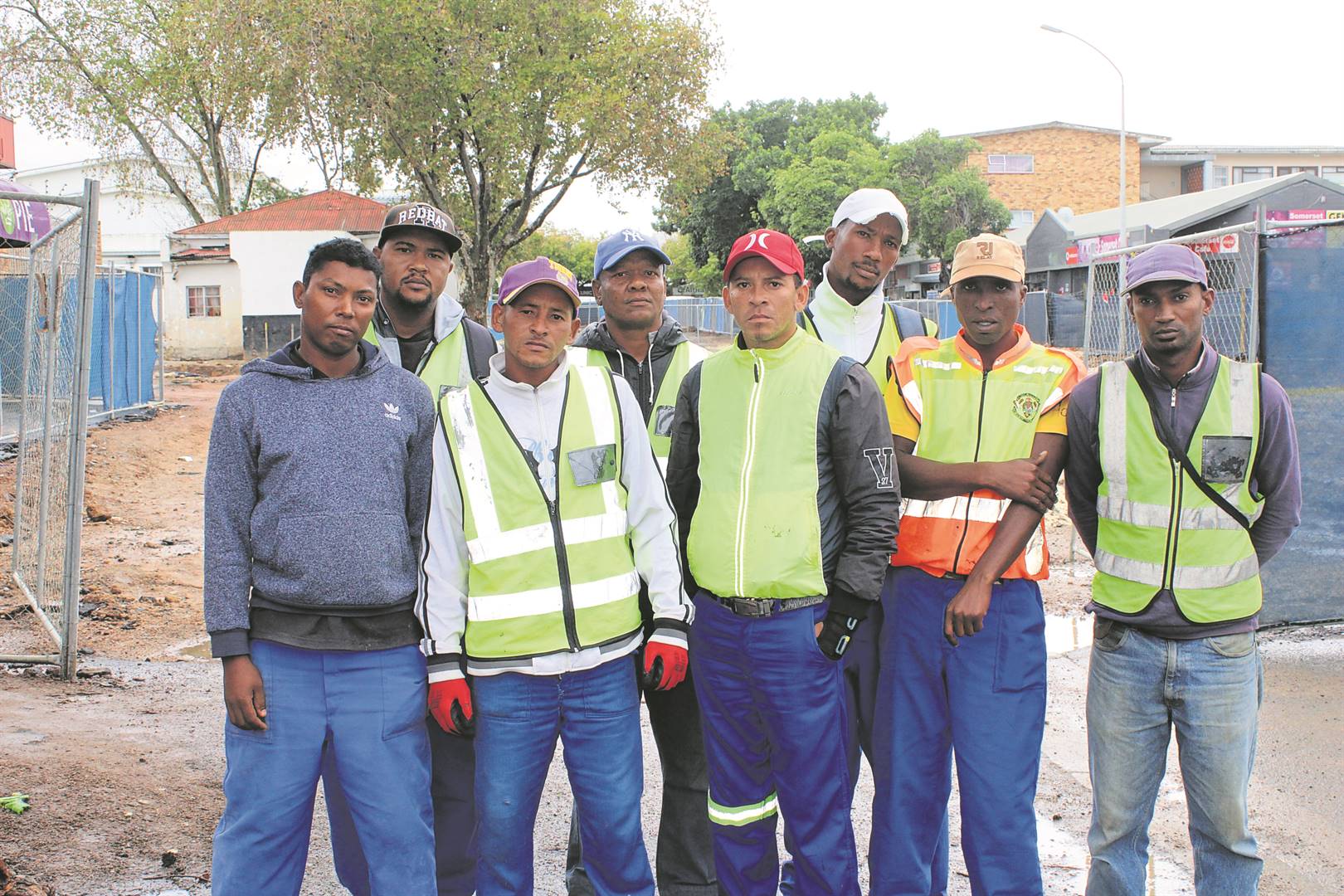
A group of dissatisfied general workers employed in the construction of the new Somerset West Public Transport Interchange have threatened to down tools because they are unhappy with the pay rate per hour, among other grievances.
They number just over a dozen and are tasked with general duties, which at times include the use of power tools such as jackhammers and drills.
The workers are employed by contractors Cornfield Construction, which was awarded a R64 million tender by the City of Cape Town last September.
According to one of the workers, Stanley Jacobs, they started work on-site in November last year and signed contracts. His payslips indicate that at the time he earned just over R30 per hour.
“We were approached in February and asked to sign another contract,” Jacobs said. “No-one explained in detail to us what the new contract entailed, and we just hurriedly signed it. As a result, we are now getting paid R15,50 an hour. Apparently it’s the same rate as City-employed Expanded Public Works Programme (EPWP) workers, but nobody has explained to us why this was the case.”
The result is that the monthly income of the workers has effectively been halved. They are dismayed and have since tried to meet with their employers, and representatives of the City, on multiple occasions.
Another worker, Andrew Anderson, said the group has struggled to obtain copies of the contracts they signed, and every time they make enquiries they are just told that the matter is before the bargaining council.
“We are just not given answers, and it’s really reaching a boiling point,” he said. “We want to work, to keep our jobs. But we’re just not prepared to be pushovers. We want given to us what is our due.”
According to Ivan Baadjies, the contract they received was handwritten and it was “ridiculous” to change the rate after two months.
“We are trying to get help from anywhere we can,” he said. “We just feel that they’re taking advantage of us.”
When contacted, Gerrit Wessels, COO for Cornfield Construction, said all municipal and government contracts are awarded a Targeted Labour component, and this component will contribute to Treasury’s National EPWP programme.
He said: “For us to comply contractually we have to employ said Targeted Labour under EPWP contracts and meet the stipulated target and comply to contractual definitions. If we fail to meet these targets financial penalties will be imposed on the contractor.”
Wessels explained the general labourers were corrected to EPWP contracts as per contractual obligations and communicated to all workers through the appointed Community Liaison Officer.
“We are currently paying our EPWP workers 30% more than the gazetted minimum (Government Gazette 44136),” he pointed out. Wessels added all EPWP workers were given contracts as they have to submit proof of contributions monthly to the employer (City of Cape Town).
He concluded that as a member of the Bargaining Council for the Civil Engineering Industry (BCCEI) and South African Forum of Civil Engineering Contractors (SAFCEC), Cornfeld has to comply to administrative obligations to employ workers on EPWP contracts.
“This process is ongoing, and with all documentation now in place from employer and contractor it will be concluded soon. Currently we are still confident that the contract will be completed in contractual stipulated time,” he said.
Asked to weigh in on the matter, Rob Quintas, the City’s Mayoral Committee member for Urban Mobility, said the City met with the contractor and employees early last week. “This matter is now before the bargaining council for a decision,” he said. “The City will closely monitor the outcome, as it is of the utmost importance that the construction proceed as planned.”
This week the workers said they were still awaiting the outcome. “So far the meetings have had no impact on progressing this matter towards a solution,” said Anderson.