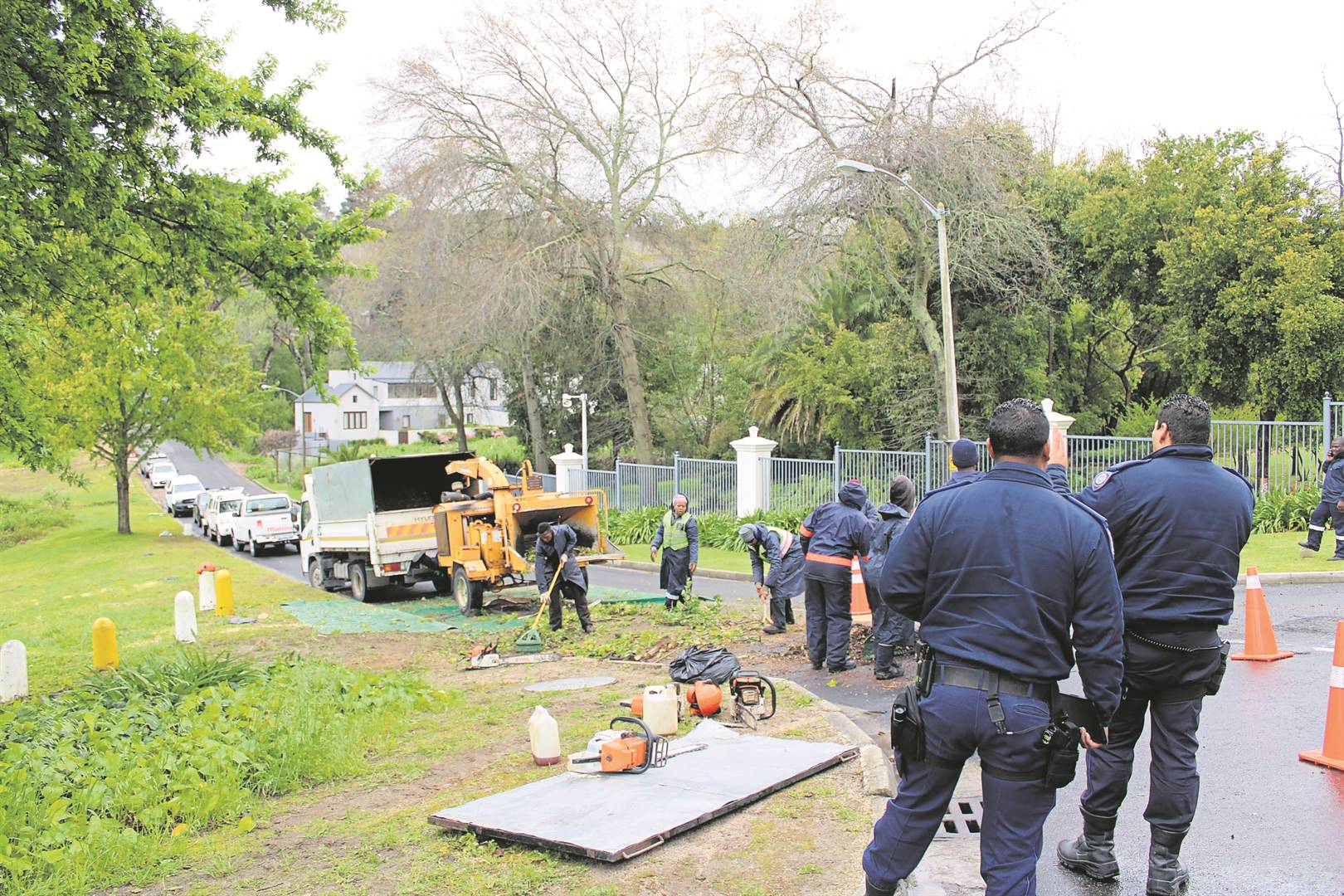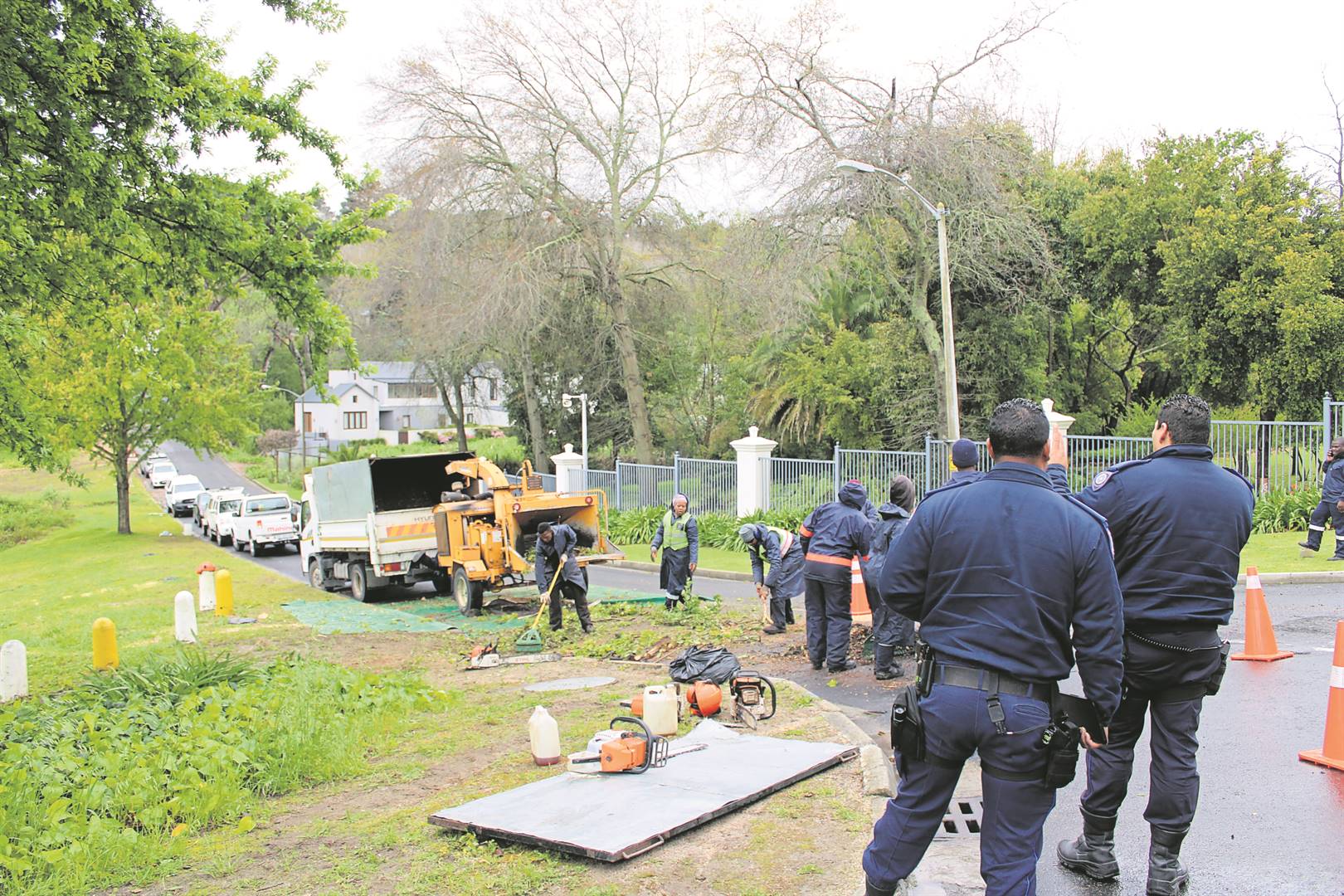

A kerfuffle played out in Helderberg Estate last Thursday (14 September) when residents forcibly stopped City workers from removing trees at Harewood Park, citing lack of communication regarding tree removals and proposing other solutions and more practical approaches to dealing with invasive tree species and the shothole borer beetle.
Law enforcement had to be called to the scene after a resident stood against a tree to prevent the oak trees from being cut down, before City officials agreed to temporarily halt the tree-felling action.
According to Prof Dirk Bellstedt, a biochemist affiliated with Stellenbosch University and also a resident of Helderberg Estate, the removal of poplars are somewhat warranted since the large trees close to Companje Road pose a risk of falling down and obstructing the road due to the Polyphagous Shothole Borer (PSHB) beetle infestation. Bellstedt added that the white poplar (Populus alba) is on South Africa’s National List of Invasive Species.
But when the contractors arrived on site last week, they started felling a lane of Turkish Oak trees (Quercus cerris) bordering the park in Harewood Avenue, which are not on the national list of invasive species.
Resident Shané van der Merwe said Harewood Avenue used to be a registered heritage site and one of the most beautiful roads in Somerset West, with large, historic English Oaks lining the road.
PSHB infestation
These oaks suffered from fungal wood-rot and powdery mildew which caused their leaves to go grey and fall off prematurely in autumn. At first, the older, hollow oaks could still survive, but the arrival of the PSHB infestation dealt these trees the final blow.
“The Turkish Oaks, however, seem to be coping very well with the PSHB infestation with no branch dieback, very little gumming and staining and few visible entry and exit holes,” Van der Merwe said.
“Residents were eager to find out why and by whom the order was given for these trees to be cut down. Officials from the City told us that the Turkish Oak is an invasive species. When residents pointed out that it is not on South Africa’s National List of Invasive Species, they were told that these trees are being cut down due to PSHB infestation.
“Why was there no consultation with residents who will be footing the bill for these private contractors?”
She added several parties had pointed out that there had been no public participation or consultation with any civic organisation when applying the felling policy.
Alderman Eddie Andrews, the City’s Deputy Mayor and Mayco member for spatial planning and environment, countered that the trees being removed were English Oaks (Quercurs robur) infested by the PSHB beetle.
“According to our records, the first English Oak tree in the Harewood Park and surrounding area was first identified in 2020 and the first English Oak tree was removed in 2022 in this area. The decision to remove it was taken after continued monitoring of infested trees.”
He said since 2019 a number of awareness, education, training and community engagement interventions as well as media releases and publications were sent out.
On 17 May 2022, a public meeting was organised by the local councillor between the Harewood/Helderberg Estate Community and the Invasive Species Unit to address issues related to the removal of PSHB infested trees in the Harewood Park and surrounding areas.
Removals based on research
“It is not uncommon for trees to look healthy particularly considering the season/time of the year,” Andrews said.
“The City’s decision to remove infested trees is guided/influenced by research accompanied by the monitoring that the City conducts on regular basis.”
In Somerset West we have already observed PSHB symptoms in a total of 45 tree species (over 150 trees) that are not known to be the host of PSHB mostly in areas where infested highly susceptible host trees are found.
The switch of host trees by PSHB and attack on tree species not known to be a host of PSHB are concerning, and if we don’t react properly by targeting trees that are amplifying the PSHB spread we will end up losing a lot more tree species.”
In response to Bellstedt’s proposal that the trees be chemically treated as well, Andrews stated the City welcomed any recommendation of treatment of infested trees if they are available, provided such chemicals had been scientifically proven to be effective.
“The City also works with renowned scientists and experts in this regard, and we are willing to put the professor in contact with them to discuss treatments,” he said.
Asked what the way forward was in terms of garnering the support of residents for the City’s removal of these trees, Andrews replied that the City will continue to engage with communities using all available platforms.
“We understand removal of trees is a very sensitive issue, but we want our communities to know the removal efforts are done for a good cause, and as we have always said not every single tree will be removed.
“The City is also working on a tree replacement strategy in an effort to compensate for the trees that are lost or are going to be lost due to the PSHB invasion.”
He said, in line with the prioritisation methodology, removal operations will take place in several areas, including Harewood Park, areas neighbouring Helderberg Nature Reserve, areas along the Lourens River as well as the Heldervue area (Poinsettia Park).