


The Cancer Association of South Africa (Cansa) says that while May marks the end of summer for South Africans with winter fast approaching, it’s also Melanoma Awareness Month, reminding us to continue to be sun smart throughout the year, no matter the weather conditions.
“South Africa could become the skin-cancer capital of the world,” says general medical practitioner Dr Donny Fick, who raised awareness for skin cancer when he took part in this year’s Two Oceans half marathon last month.
“I used the event to place the spotlight on skin cancer because SA has high running participant numbers, with an increasing number of people having taken up the sport since Covid-19.”
While he is not saying there is a connection between more runners and a higher occurrence of skin cancer, Fick says runners focus on the proper shoes and nutrition, but not so much on protecting themselves from the sun.
“Not enough runners use sunscreen and very few wear hats. Using the Two Oceans as a platform was an attempt to educate not only the runners, but also the rest of the population about the harmful effects of the sun.”
Figures prove that South Africans are at a higher risk of skin cancer. Melanoma, the most serious type of skin cancer, is one of the top five cancers in the country among men and women, according to the 2022 National Cancer Registry.
Cansa’s melanoma-awareness drive focuses on cancer-risk reduction and early detection, which applies to most types of cancer. It means adjusting lifestyle choices, if necessary, to lower the risk of cancer and keep a watchful eye for warning signs that need to be checked by a medical professional.
Melanomas develop in the cells (melanocytes) that produce melanin, the pigment that gives skin its colour. Melanomas can develop on any skin colour and anywhere on the body, including the head, neck, eyes, under the fingernails, the genitals and the soles of the feet or palms of the hands. They can be similar in colour to a mole, have no colour at all or be slightly red.
While melanomas most often develop in areas that have had exposure to the sun, such as the back, legs, arms and face, they can also occur in areas that don’t receive much sun exposure and can show up inside the body too.
All ethnic and racial groups are susceptible to melanoma, however, in which the typical patient has a fair complexion and a tendency to burn in the sun, even after a brief exposure to sunlight. Although there is no conclusive evidence that exposure to sunlight results in the development of melanoma, lesions are most commonly found on sun-exposed areas of the body.
Other risk factors include the occurrence of a previous melanoma in the patient and in a close family member like a parent or sibling.
“We advocate to check your spots, it’s a highly presentable cancer, which can be easily detected on your skin,” said Lorraine Govender, Cansa’s national manager of health programmes,
The organisation also advises companies whose employees work outside in the sun, such as in the agricultural or building industries, to ensure they have adequate protection against the sun. Look out for sunscreens, clothing, hats, and summer accessories that bear the Cansa seal of recognition.
“Even when you are driving, you need to protect yourself,” she explained. “Certain UV rays penetrate windows and clouds, so you still need to wear sunscreen on overcast days.”
Ficks supports this sentiment, saying that the sooner people start using sunscreen the better. “Protecting yourself from the sun slows down the aging process,” he says.
According to Govender, sunscreen should be a mandatory part of beauty regimes of men and women. “Apply a broad-spectrum sunscreen with a sun protection factor (SPF) of 20 or higher, according to skin type,” she advises.
Fick says part of his awareness campaign is aimed at getting men to use sunscreen. “Men can be really bad at remembering to use sunscreen. Just do it; you will thank me later.”
In South Africa, the risk of melanoma seems to be increasing in people under 40, especially women.
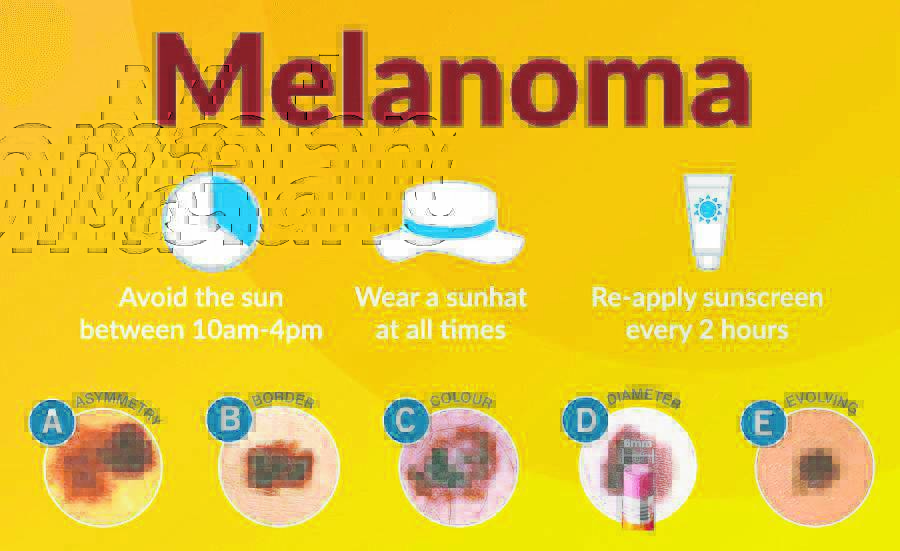
Signs and symptoms of melanoma
To help identify characteristics of unusual moles that may indicate melanomas or other skin cancers, think of the letters A, B, C, D and E:
- Asymmetry: Halves might not match when you draw a line through the mole.
- Border irregularities: Edges may be scalloped or notched.
- Colour variations: Different shades or unconventional colours may appear.
- Diameter: Moles that are wider than a pencil eraser.
- Evolving characteristics: Encompasses any change in size, shape, colour, elevation, or new symptoms like bleeding or itching.
Cancerous (malignant) moles vary in appearance, with some showing all the changes listed above, and others having only one or two unusual characteristics. The first sign of a melanoma is usually a new spot or an existing mole or freckle that changes in appearance.
Some changes can include growing in size or evolving; edges that are irregular rather than smooth and even; a range of colours such as brown, black, blue, red, white or light grey; and moles becoming itchy or bleeding.
- For more information on how to reduce the risk of skin cancer, go to cansa.org.za for fact sheets on melanoma, and ways to be sunsmart.