


“Those who cannot remember the past are condemned to repeat it.”
George Santayana wrote this in 1905. The first time I heard it, I assumed it was reserved for documentaries about World War II.
Then I turned 30 last week, felt the first creak in my knee and watched my four-year-old nephew launch himself off a wall, land perfectly and carry on. My internal monologue: “Eina! That is going to hurt in 25 years.”
The DistrictMail has been publishing for nearly 100 years. Journalists have come and gone but left behind a record.
When I started here nearly two years ago, I was desperate to dig into the archive but lacked a purpose. I think I have finally found one: to look back and see what we are repeating, what we have forgotten, and what has quietly changed while no-one was watching.
And so I opened the bundle from May 1976.
The first headline I spotted was the origin story of a local rivalry. Fifty years ago, Hottentots-Holland High School was preparing for its first-ever interschools rugby match against Hoërskool Strand. Before that, HHH had made the annual trip to Stellenbosch to face Paul Roos Gymnasium, and HS was only 16 years old. Its principal, AH Potgieter, called it “a great honour” to be considered worthy opponents. On 22 May, in front of hundreds of spectators at the Charles Morkel Stadium, HHH won 12-6.


Next I found Robert Swann’s report on the Liquor Price War of May 1976. Ronnie Hirsch of the Helderberg Hotel placed an advert in this very newspaper: a six-pack of beer for R1,56, Richelieu Brandy for R3,29 and Smirnoff Vodka for R3,23.
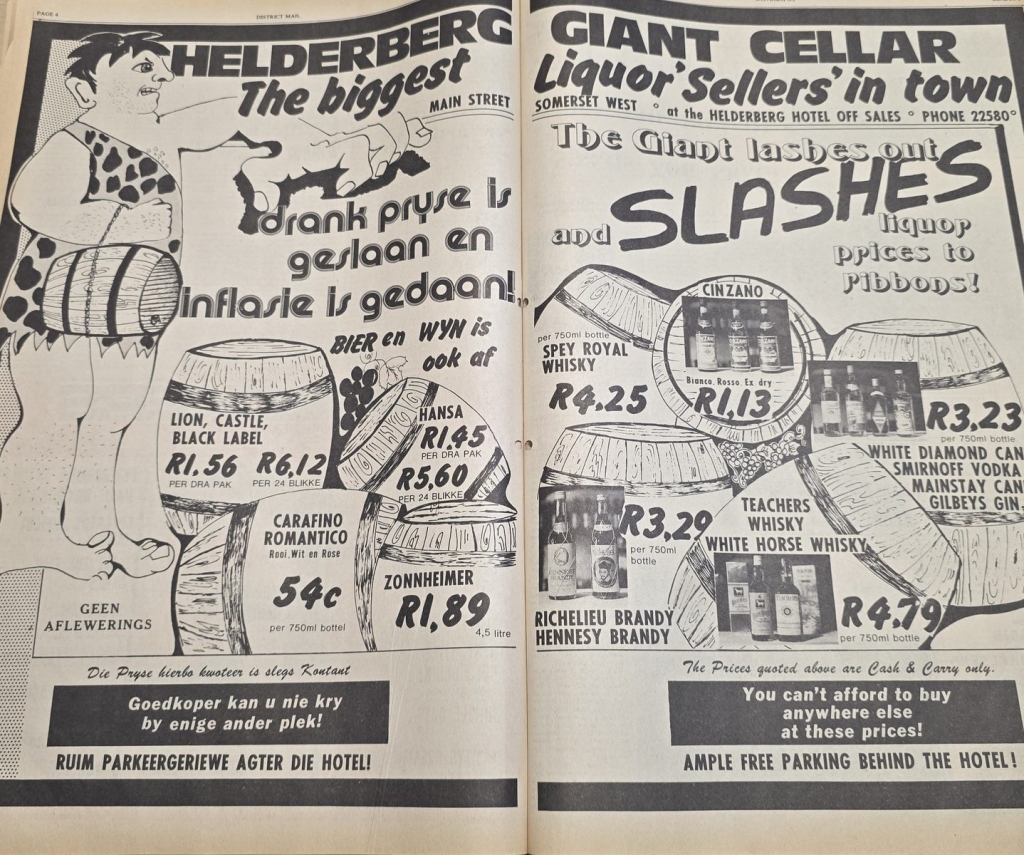
One dealer sold spirits below cost. It lasted a week. Hirsch’s reasoning: Cape Town had become too easy to reach and local stores had to compete.Today that six-pack costs R109,99. The brandy is R234,99 and the vodka R179,99. What has changed is the price. What has not is the argument. Today it is Checkers Sixty60 doing the disrupting, not a hotelier with a point to prove. Some things repeat themselves without even trying.
Then came 1996 – the year I arrived.
In May of that year, Alison Swannack opened the Boland Sign Language School in Somerset West – the first of its kind in the Helderberg. Born deaf, she had lived through the era when sign language was banned in South African schools.
This month, we reported on a level-four South African Sign Language (SASL) course in Strand for youth aged 16 to 26. SA recognised SASL as an official language in 2023. Interpreters, however, remain in short supply.
The school ran for two years before her work expanded into Cape Town. Thirty years on, Swannack is still involved in the deaf community — now from East Sussex in the United Kingdom.
Swannack started fighting that battle the year I was born.
May 1996 also brought the basin’s first fully democratic local elections. FW de Klerk campaigned for the National Party (NP) in the Helderberg. Thabo Mbeki and Cyril Ramaphosa – long before either held the presidency – appeared for the African National Congress (ANC). The result: NP 16 seats, ANC 15, Democratic Party (DP) one. A local government of national unity, nearly three decades before the term became fashionable.


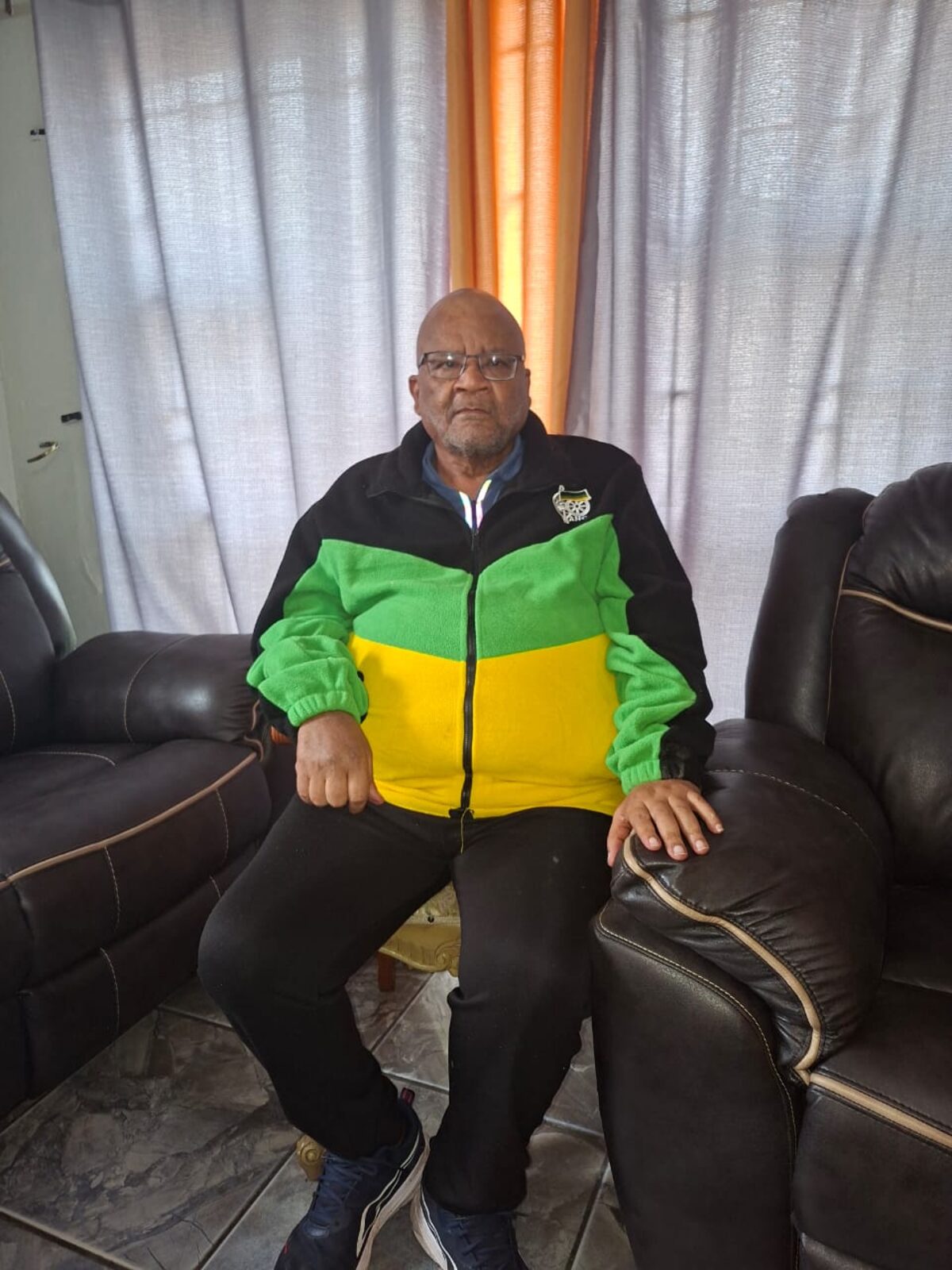
Today, the ward councillor John Brits-Magwebu recalls the first sitting as tense – a marriage of convenience, with the budget as the ultimate referee. Sound familiar? Some things do not need 30 years to repeat themselves.
Fast forward to 2014, when I was dreaming in a matric classroom while others were making history around me.
Current news editor Jamey Gordon reported 51 accidents at the Main Road/R44 intersection that year, including one fatality. I know that stillness. I have stood in it more times than I can count.
Rob Quintas, Mayoral Committee member for Urban Mobility, confirmed 72 crashes over the past 12 months – nine minor injuries, no fatalities. More crashes. Fewer deaths.
The truest measure of change is not in the numbers. It is in the people.
In the 1996 social pages I found a photograph of the Mej Gordon Hoër pageant and tracked down first princess Adéle Gordon (née Volkwyn), now 45. Married with two children and working part-time for the MCSA Hottentots Holland, she says the nerves backstage and night’s energy created memories she still holds dear.


Elton Botha, who fundraised to represent SA at the 1997 Ballroom Dancing Championships in Blackpool, is now a father and works at Ocean Basket in Somerset Mall. He and Lizelle du Plessis made it to England and reached the second round, before an accident later that year kept him off the dance floor for more than a year.


In 2014, Roné Roux (28) from Strand and Ayabonga Mani (23) was among just 76 students worldwide selected for the Stagecoach Theatre Arts Summer Showcase in the UK. Roux raised funds by staging a In 2014, Roné Roux (28) from Strand and Ayabonga Mani (23) from Nomzamo were among just 76 students worldwide selected for the Stagecoach Theatre Arts Summer Showcase in the UK. Roux raised funds by staging a one-woman show, while Mani raised funds the only way an 11-year-old knows how — a solo flash mob in a mall, community support and the unshakeable belief that it would all work out.
Today Roux is staging her own musical in America, where she lives with her husband. Mani is in London, in his second year at LAMDA — the London Academy of Music and Dramatic Arts — having trained in Cape Town, lived in New York and never stopped moving since that mall flash mob in 2014.
| Growing up in the Helderberg |
|---|
| What was it like growing up in the Helderberg? – Adéle Volkwyn: Strong-willed, energetic and never afraid to speak my mind. I threw myself into high school life and by 1998 had earned the title of deputy head girl, a milestone that still ranks among my proudest. – Elton Botha: I was a typical teenager: time with friends, movies, pool and DJ’ng on the side. Life was simple and I loved it. – Roné Roux: Goal-oriented, hardworking and always eager for the next big adventure, whatever that might be. – Mani: A daydreamer, mostly. My mother ruled with an iron fist — no ifs, buts or maybes — and thank God she did. Growing up in Nomzamo, it is easy to fall into traps. My passion kept me out of them. |
| How has the Helderberg changed? – Volkwyn: Busier, faster and barely recognisable in places, but the one thing development has not managed to take is the sense of community. – Botha: Growth has brought opportunity, but at a cost. In 1996, I could freely walk from my Gordon’s Bay home to family in Rusthof. Today that is simply not something you can do. – Roux: I have two homes, one in North Carolina and one in the Helderberg. But the Helderberg will always be home. – Mani: From London, the Helderberg lives in my senses — Radloff Park in June, the river, the rain, the greenery. But more than anything, I miss the people. You can strike up a conversation with just about anyone. That is the South African magic I carry with me |
| If you could say something to your younger self, what would it be? – Volkwyn: Stop shrinking to fit into spaces you were never meant to belong in. The strength that made you stand out then is the foundation of everything you are now. – Botha: Keep dreaming, keep trying and keep working toward your goals. Family is everything; cherish them. – Roux: Do not be afraid to start small and grow from there. – Mani: When it feels like you have come as far as someone from your circumstances is allowed to come, lean forward anyway. |
History is not a dusty archive; it lives and breathes. If we do not take the time to look back, we risk not only repeating it, but forgetting it altogether. Santayana was right; I just had no idea he was talking about the Helderberg.

You must be logged in to post a comment.