

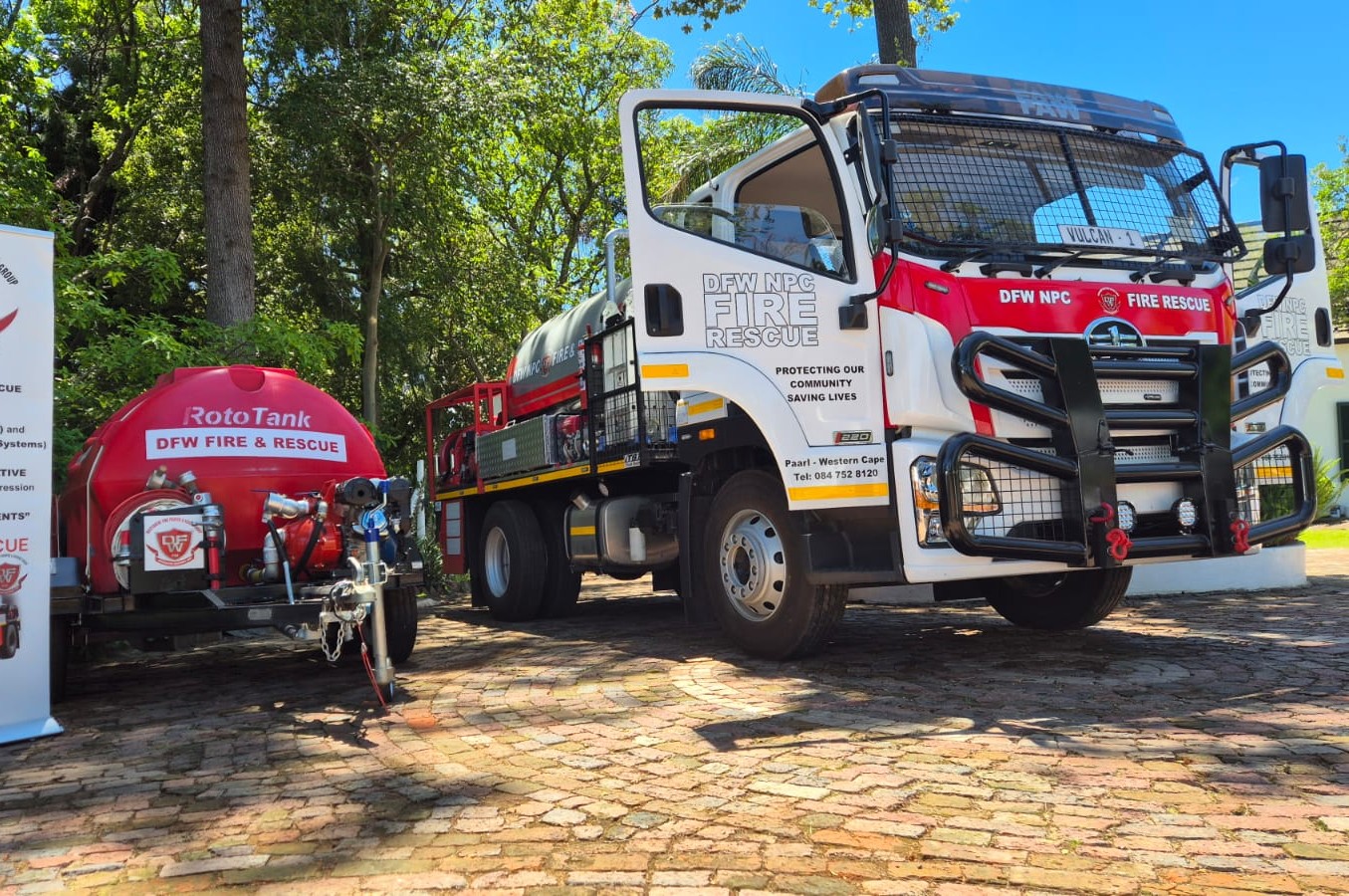
PAARL – A non-profit firefighting organisation in Paarl has invested in advanced foam technology to address the growing challenges of water shortages and extreme fire conditions in the Cape Winelands.
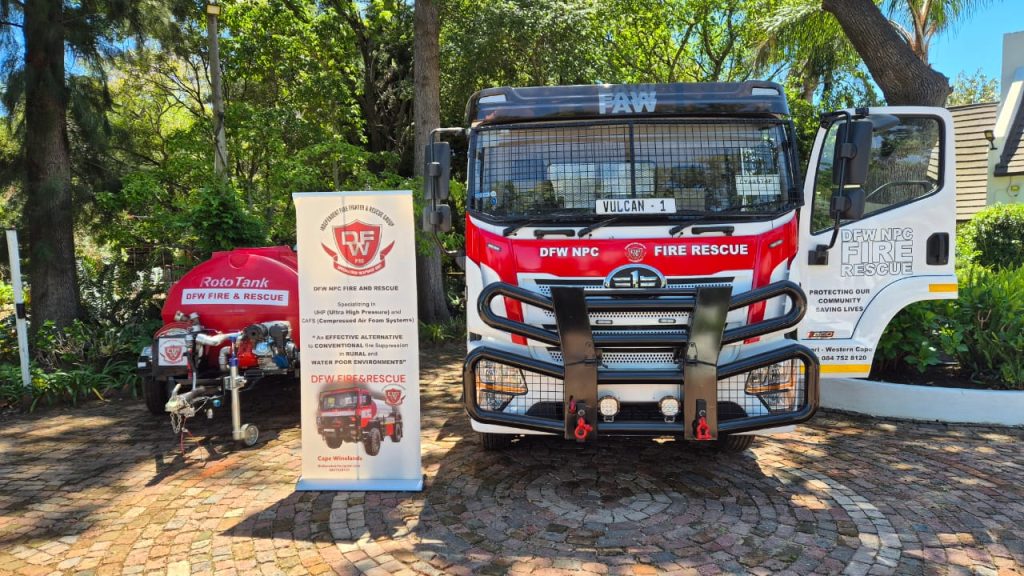
DFW Fire & Rescue NPC officially launched its new FAW fire truck at its Paarl headquarters on Friday, 23 October, marking a shift in how rural firefighting operations prepare for increasingly demanding fire seasons.
The vehicle, equipped with a 5 000-litre water tank and Compressed Air Foam System (CAFS), addresses a critical challenge facing firefighters in rural areas: achieving effective fire suppression in water-scarce environments.
Fighting fires with less water
According to Daan van Leeuwen Boomkamp, DFW chief executive and chairperson, the acquisition reflects changing realities in the Western Cape.
“The objective was never simply to acquire another fire truck. We needed to strengthen our capabilities with equipment that addresses the actual conditions our firefighters encounter,” Van Leeuwen Boomkamp said.
“Fire behaviour is changing, water is becoming an increasingly valuable resource, and government emergency services are under considerable pressure.”
The CAFS technology mixes water, compressed air and foam concentrate to create a firefighting medium that uses significantly less water than conventional methods while maintaining effectiveness.
“In rural firefighting, our greatest challenge is often not simply reaching the incident, but ensuring that we have sufficient water and the right equipment to achieve an effective result,” Van Leeuwen Boomkamp explained.
“The future of effective firefighting is not necessarily about carrying more water. It is about achieving more with the water we have.”
Proven track record protecting historic buildings
DFW’s confidence in foam technology stems from practical experience during major fires at some of the Winelands’ most significant properties.
During the December 2025 fire at Laborie Estate in Paarl, DFW firefighters deployed foam cannon equipment to help protect the historic Manor House and Die Stoep restaurant, both featuring vulnerable thatched roofs.
Similar interventions at Boschendal, Otterkuil and Roggeland reinforced the value of specialised equipment in protecting historic Cape Dutch buildings.
“When a historic Cape Dutch building is lost to fire, the damage extends far beyond its financial or insurance value,” Van Leeuwen Boomkamp stated.
“We lose part of our architectural heritage, our agricultural history and the craftsmanship of generations before us. These buildings cannot simply be replaced with insurance money.”
ALSO READ: Outpouring of support after fire guts popular Cucina Di Giovanni restaurant
Supporting, not replacing, public services
DFW operates as a registered non-profit organisation serving members and supporting emergency operations in the greater Drakenstein region.
Van Leeuwen Boomkamp stressed the organisation’s role complements municipal services rather than replacing them.
“Our intention has never been to replace municipal firefighting services or assume their statutory responsibilities,” he said.
“When serious fires occur, communities benefit most when capable emergency responders work together rather than in isolation. Ultimately, fire does not distinguish between public and private resources.”
The organisation, established as a volunteer initiative in 2014 and formally registered in 2017, provides structural and vegetation firefighting, emergency first aid, fire prevention and humanitarian assistance.
As a non-profit, DFW’s sustainability depends on member support, donors and volunteers.
“This new FAW fire truck is not a symbol of prestige or an exercise in collecting vehicles,” Van Leeuwen Boomkamp concluded.
“It is an investment in preparedness, operational resilience and the ability to intervene when lives, livelihoods, property and irreplaceable heritage are threatened.”
ALSO READ: WATCH | Fires devastate wine farms in Franschhoek, Wemmershoek areas



You must be logged in to post a comment.